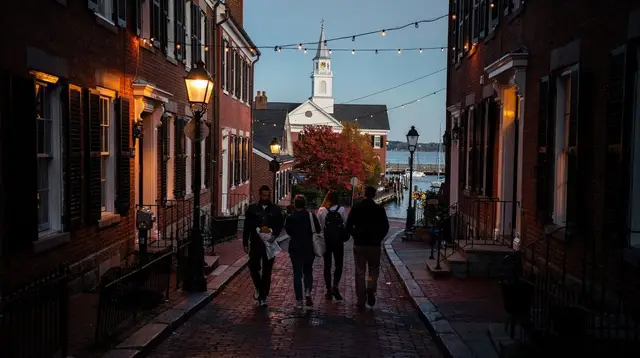
Newport and the Gilded Age, seen from today
I walked the Cliff Walk in Newport on an ordinary Tuesday in early fall, the kind of day when the crowds have thinned but the light is still generous. On one side, the Atlantic, doing what it always does. On the other, through hedges and iron fences, a sequence of houses so large that “house” starts to feel like the wrong word. Someone nearby, also walking, called them “cottages,” which is the word Newport itself has used for well over a century, and which I found harder to say out loud than I expected.
Bellevue Avenue runs roughly parallel to the coast here, a few blocks inland from the water, and the Cliff Walk cuts along the shoreline behind the properties that face it. This is not a hidden route. It is a public path, established through legal easements that predate the mansions themselves, and it remains the main way most people encounter this stretch of Newport without paying to go inside anything. You look at these houses the way you might look at a court case from the outside: through a fence, at a distance, aware that something significant happened here and that you were not invited to it directly.
What happened here, in the last decades of the 19th century, was a concentration of wealth that a handful of American families translated into architecture. The houses belong to what is commonly called the Gilded Age, a period name that already carries a verdict — gilded, not golden, a surface applied over something else. Families whose fortunes came from railroads, shipping, and industrial capital built summer residences in Newport on a scale that had little precedent in American domestic building. The word “cottage” was, from the start, a kind of joke that only the people saying it could fully enjoy.
The scale is the first thing that argues with you. These are not large houses in the way a comfortable house is large. They were built, in several documented cases, for a use of only a handful of weeks each year — the length of the Newport summer season, when a small social circle moved from house to house, party to party, before returning elsewhere for the rest of the year. A building with dozens of rooms, marble imported across an ocean, ceilings painted by artists brought over for the purpose, standing largely empty for ten or eleven months — that fact alone tells you something about what these houses were built to do. They were not shelter. They were argument. Each one made a case, to the others on the avenue, about where its builder stood in a hierarchy that otherwise had no fixed rules.
It is difficult, walking the Cliff Walk in 2026, not to bring the last decade of conversation about inequality with you. The vocabulary is different now — wealth gap, one percent, concentration of capital — but the underlying question is not new: what does a society owe itself when a very small number of people can command resources on this scale, and what do the rest of the people living alongside that wealth actually see of it. Newport’s marble houses were, among other things, an answer to that question in their own era, and not a subtle one. They were visible on purpose. The whole point of building on Bellevue Avenue, facing the ocean, facing each other, was to be seen.
And yet I don’t think the honest response is to walk past these houses simply cataloguing what they cost or who could not afford to build one. They are also, without qualification, considerable achievements of craft. The stonework, the ironwork, the landscaping that ties a house to its cliff, the interior decoration commissioned from some of the most skilled artisans working in America and Europe at the time — none of that becomes less real because the money behind it was concentrated unfairly.
Architectural historians study these buildings seriously, not as curiosities but as a genuine chapter in how the United States absorbed European building traditions and reworked them into something of its own. To reduce the houses only to a symbol of injustice is to stop looking at them as buildings at all, and that loss is real too. A stone carved well is carved well regardless of whose money paid the carver, even if the money itself deserves scrutiny.
I don’t think these two readings resolve into each other. I don’t think they’re supposed to. Standing on the Cliff Walk, I found I could hold appreciation for a roofline or a garden terrace in one hand and something closer to unease in the other, and neither one canceled the other out. That discomfort, held rather than solved, might be closer to what looking at Gilded Age wealth actually requires of a visitor now — not a verdict, but attention to both facts at once.
It helps, a little, to remember that the Newport these houses sit in was not always this one. Long before Bellevue Avenue existed as a fashionable address, Newport was a working harbor town, built by sailors, fishermen, and merchants whose relationship to the Atlantic was practical rather than decorative. The ocean the Cliff Walk now frames as scenery was, for most of the town’s history, a place people worked, not a view they owned. The mansions arrived relatively late in Newport’s story and imposed themselves on a place with a much older, much more modest identity — one that is still visible a few streets back from the water, in the smaller colonial houses and the downtown that has nothing to do with the Gilded Age at all. Visiting only Bellevue Avenue gives you a version of Newport that leaves out most of what the town actually was for most of its existence.
I don’t have a tidy way to close this. I left the Cliff Walk without having decided whether these houses are best understood as monuments or as warnings, and I suspect that’s the honest position to leave a reader in as well. They are both, at the same time, depending on which direction you’re facing when you look at them — out toward the ocean the houses were built to overlook, or back toward the town whose labor they were never built to share.
Frequently asked questions about Newport’s Gilded Age mansions
What is the Gilded Age significance of Newport, Rhode Island?
In the late 19th century, a small number of America’s wealthiest families built enormous seasonal residences along Bellevue Avenue in Newport, used for only a few weeks of the summer social season. The Cliff Walk, a public path along the Atlantic, runs behind several of these properties and remains the way most visitors see them today.
Is Newport in Massachusetts?
No. Newport is in Rhode Island, a separate state from Massachusetts, though it is commonly visited as a day trip from Boston. For the practical details of getting there, see our Newport day trip guide.
Who built the Newport mansions?
Families such as the Vanderbilts commissioned these houses as summer residences during the late 19th century, at the height of what is commonly called the Gilded Age in the United States.
What is the Cliff Walk?
The Cliff Walk is a public path along the Atlantic coastline in Newport that runs behind the gardens of several of the Gilded Age estates, allowing anyone to see the properties from outside without paying an admission fee.
Were these houses lived in year-round?
No. Most were used only during a few weeks of the summer social season, despite their scale, which is part of what makes them unusual as domestic architecture.
Is it worth visiting Newport if you’re uneasy about celebrating extreme wealth?
Many visitors hold both reactions at once: discomfort with what the houses represent and appreciation for their craftsmanship. The site does not resolve that tension for you, and neither does this piece.
Can you visit the mansions without going inside?
Yes. The Cliff Walk lets you see several of the estates’ exteriors and grounds from a public path at no cost, which is the approach this essay takes. For interior visits, ticketing, and opening hours, see the Newport mansions day trip guide, since those practical details change from year to year.
How does Newport compare to Boston’s own history of wealth and inequality?
Boston has its own version of this story, visible in neighborhoods like Beacon Hill and Back Bay, where 19th-century fortunes built entire streetscapes. Newport simply makes the contrast more visible, because the houses stand largely alone rather than folded into a working city.
If you’re weighing a Newport trip against other options within reach of Boston, our comparison of day trips and the Providence guide cover nearby alternatives, and the Cape Cod and Plymouth pages cover destinations with a very different relationship to American history. For a broader sense of how the region’s wealth and architecture show up elsewhere, see our pieces on Harvard Square and on riding the T, both of which look at Boston’s own layered history of money and infrastructure.
The Newport mansions themselves, and the wider day trips hub, are the practical starting points if this piece has made you want to go see Bellevue Avenue for yourself — perhaps as part of a broader fall foliage day trip through western Massachusetts and Vermont, or a quieter sunset cruise on Boston Harbor to think it over on the water. Some people prefer to process a day like this with a drink in hand, which is part of why the sunset cocktail cruise on the Charles River stays popular with visitors doing a Newport trip and a Boston stay back to back. Others just want the harbor itself, which the Boston Harbor Islands ferry covers on its own terms, closer to home and further from Bellevue Avenue’s particular version of the water.
tours.History & Memory
Verified deep-linked GetYourGuide tours. Book through these links and we earn a small commission at no cost to you.
GetYourGuide does not provide a product photo for this activity — the image shows the meeting point, photographed by us.