A grid where the rest of Boston has none
Almost everywhere else in central Boston, streets follow old cow paths and colonial-era property lines, which is why the Freedom Trail zigzags the way it does. Back Bay is the exception. It was built, not inherited: from the 1850s through the 1880s, the city filled in a tidal flat of the Charles River and laid the new land out on a strict grid, alphabetical streets running one way (Arlington, Berkeley, Clarendon, Dartmouth, Exeter, Fairfield, Gloucester), broad avenues running the other. The result is the most orderly walking neighborhood in Boston, and the one most visitors mean when they picture “brownstone Boston.”
That regularity is worth understanding before you arrive, because it changes how you should plan a visit. You are not threading a maze here, as you would in the North End or on Beacon Hill. You are walking a grid, which means Back Bay rewards a loose, unhurried route more than a fixed checklist: start at one end of Commonwealth Avenue, finish near Copley Square or the river, and let the architecture do the work.
Commonwealth Avenue Mall and the brownstones
The spine of the neighborhood is the Commonwealth Avenue Mall, a tree-lined pedestrian strip running down the middle of the avenue for about a mile, from the Public Garden to Kenmore Square. It was laid out at the same time as the rest of Back Bay, modeled loosely on Parisian boulevards, and it is still the easiest way to see the neighborhood’s architecture without dodging traffic. Statues of 19th-century Bostonians line the Mall at intervals; most visitors walk past them without reading the plaques, which is a minor loss, since a few (abolitionists, a mountaineer, a Revolutionary War general) are more interesting than they look.
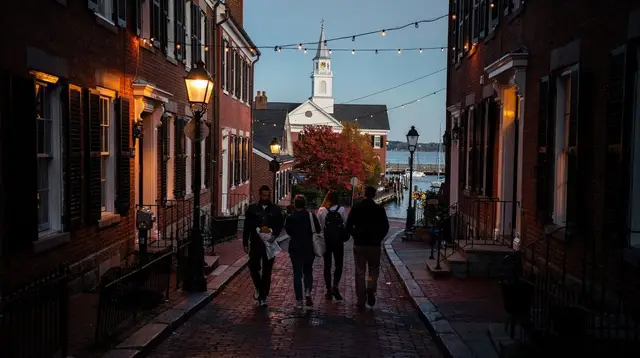
On either side, the brownstone rowhouses are the main attraction, and they reward slow walking rather than a single photo stop. Bay windows, mansard roofs, wrought-iron railings and stoops repeat down each block with small variations, and the differences between them (a Second Empire roofline here, a Queen Anne detail there) are part of what a guided walk can point out that a quick pass cannot. A dedicated walking tour through the brownstone blocks is the most direct way to get that context, and it pairs naturally with a stop in the South End guide if you want to keep walking past the Back Bay grid into its residential neighbor.
Newbury Street, one block south of Commonwealth Avenue, is the shopping and café street: eight blocks of storefronts in converted rowhouses, running from the Public Garden to Massachusetts Avenue. It gets more commercial and less architecturally distinguished the further you go from the Public Garden. It is a pleasant place to break up a walk with coffee or a meal, not a must-see landmark, and this guide will not pretend otherwise or invent a shop name to send you to — browse as you go.
Copley Square: Trinity Church and the Boston Public Library
Copley Square, at the western end of Newbury Street, is where Back Bay’s architecture peaks. Trinity Church, completed in 1877 and designed by H. H. Richardson, is the building most architecture historians point to when they talk about Back Bay: a heavy, Romanesque stone church that set the tone for a wave of similar buildings across the country. Across the square, the Boston Public Library’s original 1895 building, with its arched windows and courtyard modeled on an Italian palazzo, is a public building worth stepping into even if you are not there to read: the courtyard and the reading rooms are open to visitors, free of charge, during library hours.
Copley Square itself is a public plaza with a reflecting pool and seasonal events (a farmers’ market runs there on certain days from spring through fall), bordered by the Fairmont Copley Plaza hotel and the John Hancock Tower’s glass facade. It is the natural midpoint of a Back Bay walk: Commonwealth Avenue and Newbury Street both feed into it, and the T station named for it (Copley, on the Green Line) sits right underneath.
The Prudential Center and the Skywalk Observatory
At the western edge of Back Bay, the Prudential Center rises well above the brownstone roofline: a shopping mall and office tower complex built in the 1960s, with the Skywalk Observatory on its 50th floor offering an enclosed, indoor view over the city. It is the practical alternative for anyone who wants an elevated view of Boston without the outdoor exposure of a rooftop deck, and on a clear day it takes in the harbor, the Charles River, and the Boston skyline in one sweep. Entry is ticketed; check current pricing and hours directly with the Skywalk Observatory rather than relying on a number printed elsewhere, since observation-deck pricing changes.
The Prudential Center is also a useful reference point rather than a destination in its own right: the mall connects by enclosed walkway to the Hynes Convention Center and, further on, to parts of the Fenway neighborhood, which makes it a dry-weather shortcut in winter. The Green Line’s Prudential stop sits directly beneath the tower, which matters more than it sounds: on a cold or rainy day, it is possible to move from Copley Square to the Prudential Center and on toward Fenway almost entirely under cover.
The South End, next door
South of Back Bay, across the rail corridor that runs behind Copley Square, sits the South End: a separate, larger residential neighborhood of Victorian bowfront rowhouses, generally understood to be the largest such collection in the country. It grew up alongside Back Bay in the same building boom but developed a different character over the 20th century, becoming one of the centers of Boston’s LGBTQ+ community from the 1970s onward and, more recently, a dense concentration of restaurants, small galleries and independent shops, especially along Tremont Street and Washington Street.
Visitors sometimes treat Back Bay and the South End as one neighborhood because they border each other and share an architectural period. They are not the same place, and they read differently on foot: Back Bay is grander and more formal, laid out for a 19th-century upper middle class; the South End is quieter, more residential, and more oriented toward food and art than shopping. A South End neighborhood guide covers it in its own right, and it pairs well as a second half-day after a Back Bay morning, since the two are a short walk apart.
The Charles River Esplanade
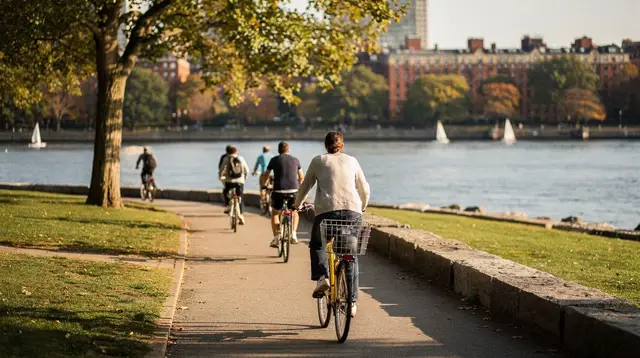
Back Bay’s northern edge runs along the Charles River, and the Esplanade, a parkland strip along the river’s Boston bank, is one of the best walking and cycling routes in the city. It stretches for several miles, connecting toward Beacon Hill at its eastern end and continuing west past Back Bay and beyond, with the Hatch Shell (an outdoor concert venue, home to the Boston Pops’ Fourth of July concert) as its best-known landmark. Rented bikes from the city’s Bluebikes system, or a rowboat or kayak from a seasonal boathouse, are the two easiest ways to get onto or along the river without a lot of planning.
The Esplanade is at its best from late spring through early fall, when the trees are full and the boathouses are running; winter does not close it, but wind off the river makes a long walk considerably less pleasant, and this is the one real seasonal constraint on an otherwise year-round neighborhood. For a view of the river itself rather than a walk beside it, a sunset cruise on Boston Harbor is a different way to see the same waterfront from the water, though it departs from the harbor side of the city rather than directly from the Esplanade.
Getting there and getting around
Back Bay is served by three separate T stations, and which one you want depends on where you are headed. Copley (Green Line) sits at Copley Square, the most central point for Commonwealth Avenue, Newbury Street and Trinity Church. Back Bay station (Orange Line, and also a Commuter Rail stop on a separate network with its own ticket, not the T lines) is a few blocks south, near the South End border, and is the better choice if you are arriving from outside the city or heading toward the South End. Prudential (Green Line, E branch) sits directly under the Prudential Center and the Skywalk Observatory.
Once you are in the neighborhood, walking is the only way to actually see it: the whole grid, from the Public Garden to the Prudential Center, covers roughly a mile end to end, flat and easy underfoot. A T guide explains fares and CharlieCard basics if this is your first time on the system, and the broader guide to getting around Boston without a car covers how Back Bay fits into a car-free visit. There is no need to drive here, and parking in Back Bay is expensive and limited, which is one more reason to arrive by T.
Back Bay’s other side: women’s history
Back Bay’s grid and its brownstones tend to dominate the conversation, but the neighborhood also carries a less-visited layer of history: several of the row houses along Commonwealth Avenue and the surrounding blocks were home to prominent figures in the American women’s suffrage movement, and a handful of buildings and markers around the neighborhood trace that history directly. It is not signposted the way the Freedom Trail is, and most visitors walk past it without knowing it is there. A guided history walk focused on the suffrage movement in Back Bay is the most direct way into that story, and it is a genuinely different angle on a neighborhood most people see only as architecture.
What else is nearby
Back Bay sits between two of the site’s other core neighborhoods, and both are close enough to fold into the same day. Fenway, home to Fenway Park and the Museum of Fine Arts, is two or three Green Line stops beyond the Prudential Center; the Fenway Park tour guide and the Museum of Fine Arts guide cover it in detail. Beacon Hill sits just across the Public Garden from Back Bay’s eastern end, connected by the same Esplanade that runs along the river.
For a broader sense of how Back Bay fits into a first visit to the city, the two-day Boston highlights itinerary slots it in alongside downtown, and the Boston destination hub is the place to start if you have not yet mapped out the rest of the city. If music or theater is part of your plan, the Boston Symphony Orchestra guide covers Symphony Hall, a short walk from the Prudential Center, and the theater district guide covers the cluster of stages a few blocks further east.
If Cambridge is also on your list, note that it is a separate city across the Charles River, not part of Back Bay: a guided walk through Harvard’s campus in Cambridge is a reasonable add-on for the same trip, reached by T rather than on foot from Back Bay.
Back Bay and the South End: frequently asked questions
Is Back Bay walkable, or do I need public transit?
It’s walkable end to end: the grid from the Public Garden to the Prudential Center is roughly a mile, flat, with sidewalks on every block. Use the T (Copley, Back Bay or Prudential stations) to arrive or to connect onward to Fenway or downtown, not to move around within the neighborhood itself.
How is the South End different from Back Bay?
Back Bay and the South End were built in the same 19th-century boom and share a brownstone architectural style, but they are distinct neighborhoods. Back Bay is more formal and commercial, centered on Commonwealth Avenue, Newbury Street and Copley Square; the South End is quieter and more residential, with a concentration of restaurants and galleries and a historic LGBTQ+ community, and sits just south across the rail corridor.
Is the Boston Public Library worth visiting if I’m not borrowing books?
Yes. The original 1895 building on Copley Square is free to enter, with an Italian-palazzo-style courtyard and murals in the reading rooms; it’s one of the few free architectural sights in Back Bay and a natural stop between Trinity Church and Newbury Street.
How much does the Skywalk Observatory cost?
Pricing changes, so check current tickets and hours directly with the Skywalk Observatory before you go rather than relying on a fixed figure here. It’s an indoor, enclosed viewing deck on the Prudential Center’s 50th floor, reachable by the Prudential T stop.
Is Back Bay part of downtown Boston?
No. Back Bay is its own neighborhood west of the Public Garden, built on filled land in the second half of the 19th century. Downtown Boston and the Freedom Trail sit further east, on the older, irregular street pattern that predates the Back Bay landfill.
When is the best time to walk the Commonwealth Avenue Mall or the Charles River Esplanade?
Late spring through early fall, when the trees along the Mall and the Esplanade are full and the riverside boathouses are open. Winter doesn’t close either one, but wind off the Charles River makes a long walk considerably less comfortable, and this is the main seasonal factor for Back Bay.
Can I combine Back Bay with Fenway or Beacon Hill in one day?
Yes, both are close by. Fenway is two or three Green Line stops past the Prudential Center; Beacon Hill borders Back Bay’s eastern edge across the Public Garden and the start of the Charles River Esplanade. A full day covers Back Bay plus one of the two comfortably on foot and by T.
Do I need to book anything in advance for Back Bay?
Most of the neighborhood — the Mall, Newbury Street, Copley Square, Trinity Church’s exterior, the library courtyard — needs no booking at all. Reserve ahead only for ticketed stops like the Skywalk Observatory or a guided walking tour, especially on weekends in peak season.