Harvard Square after the bookstores closed
What the square used to sound like
I come up out of the Red Line at the Harvard Square stop, past the old brick kiosk that has sat at the center of the square since before most of the people walking past it were born, and for a second the layout tricks me into thinking nothing has changed. The kiosk is still there. The newsstand rhythm of the corner is still there. Students still cut across the plaza in clusters, backpacks over one shoulder, arguing about something I can’t quite hear. Then I actually look at the storefronts ringing the square, and the trick falls apart.
I used to know this place by its bookstores. Not one flagship, but a whole ecosystem of them, stacked within a few blocks of each other, each with its own temperament — one that specialized in used academic titles nobody outside a seminar room would ever ask for, another that stayed open absurdly late and filled up with people who clearly weren’t there to buy anything, just to sit on the floor in the poetry section and read for free. There were record stores too, the kind where the person behind the counter had opinions about your purchase and wasn’t shy about sharing them.
That density of small, opinionated, commercially irrational businesses is what gave Harvard Square its reputation as a place where intellectual life spilled out of the university and into the street. You could feel it walking by, even if you had nothing to do with Harvard or MIT. Some of that same curatorial instinct survives today inside the institutions rather than on the sidewalk — the Harvard museums and, a short walk further down the river, the MIT Museum still do what the old bookstores used to do, just behind admission desks instead of shop windows.
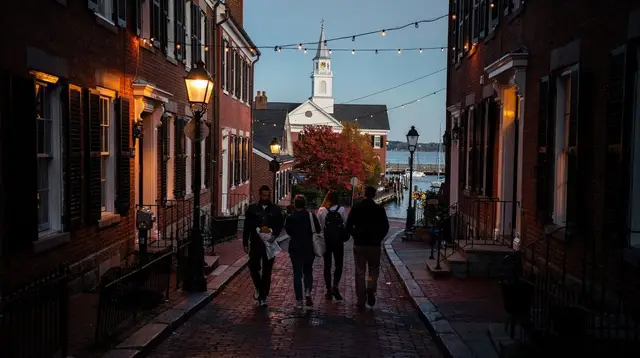
Most of that is gone now. Not all of it, but enough that the absence is the thing you notice first. Walk the same blocks today and the storefronts read differently: a bank branch where a bookstore used to be, a national outerwear chain, a phone carrier’s shop with the same fluorescent lighting you’d find in a mall outside Hartford. It’s not that the square looks bad. It looks clean, prosperous, orderly. That’s exactly the problem, if you’re the kind of person who came here for disorder. For a sense of how deliberate that orderliness is, it helps to have walked the older streets across the river first — Beacon Hill, with its gas lamps and single-family townhouses, has managed to keep a version of its nineteenth-century texture that Harvard Square’s commercial blocks largely haven’t.
The economics underneath the nostalgia
It’s tempting to blame this entirely on Harvard itself, and the university is not innocent — it’s one of the largest landowners in Cambridge, and its wealth has done real, measurable work in pushing up commercial rents in the square over the past few decades. But it would be lazy to stop there. What happened to Harvard Square happened to independent booksellers and record stores across the country, for reasons that have as much to do with online retail and shifting reading habits as with any single landlord’s decisions.
A used bookstore that survived on serendipity — a customer wandering in, stumbling onto something they didn’t know they wanted — was always going to struggle once that same customer could search for the exact book they wanted and have it delivered in two days. Harvard Square didn’t lose its bookstores because Harvard is rich. It lost them because the entire model those stores depended on stopped working, and Harvard’s real estate market simply made sure that whatever replaced them would be able to afford the rent.
That distinction matters, because it changes what kind of loss this is. It’s not a simple story of a beloved neighborhood crushed by one greedy institution. It’s a story about what happens to a certain kind of commercial ecosystem — bohemian, intellectual, deliberately unprofitable — when it sits on some of the most valuable retail real estate in New England. The same forces that make Newbury Street in Back Bay increasingly indistinguishable from any upscale shopping district elsewhere have been at work here too, just with a university library instead of a fashion district as the anchor. The North End has faced its own version of the same question — whether a neighborhood can stay authentic once its reputation becomes the thing being sold — and it’s worth reading that comparison in the piece on the North End and the question of authenticity if this kind of tension interests you.
What’s still real, if you look for it
I don’t want to write the version of this piece that just mourns and stops there, because it wouldn’t be honest. Walk through the actual gates into Cambridge and stand at the edge of Harvard Yard, looking through the iron fencing at the lawns and the brick dormitories beyond, and you’re looking at something the chain stores haven’t touched at all. Tens of thousands of students still move through this square every single day. The seminars still happen. The arguments in the cafés — the ones that have survived — are, as far as I can tell, still real arguments, not performances of intellectual life staged for tourists.
A friend who teaches nearby put it to me plainly: the ideas didn’t leave, they just stopped being visible from the sidewalk. You have to go into a lecture hall, or a department reading group, or one of the university museums a few blocks off the main square, to find them now, instead of tripping over them on your way to buy a coffee. Anyone who wants that indoor version of the square’s intellectual life mapped out in advance, rather than stumbled onto, will find it laid out in the one-day itinerary for the Harvard and MIT campuses.
That’s the honest version of the contrast. The square’s bohemian storefront culture — the version you could access just by walking past a window — has thinned out considerably. The intellectual substance underneath it, the actual reason Harvard Square earned its reputation in the first place, is still operating, just retreated indoors, behind university doors rather than shop windows. Whether that counts as the neighborhood’s soul surviving or merely relocating is a genuinely open question, and I don’t think nostalgia is qualified to answer it on its own.
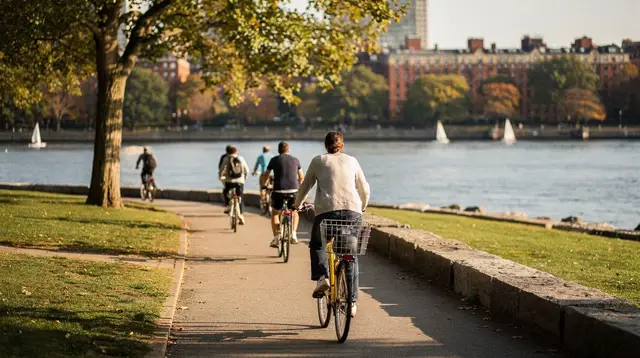
A handful of the old commercial world does hang on, tucked between the newer chains — a print shop here, a stationer there, businesses that have simply been around long enough to have negotiated leases nobody wants to touch. They’re outliers now rather than the rule, small proof that the square hasn’t been entirely rationalized into a shopping mall, even if it sometimes feels close. If you’d rather cover the square by bike than on foot, a Cambridge electric bike tour is one way to cover more of these surviving pockets in less time.
The gentrification question I keep coming back to
What unsettles me most isn’t the specific stores that disappeared — businesses close everywhere, all the time, for all kinds of reasons. It’s what their disappearance says about what a neighborhood built around one of the wealthiest universities on earth can afford to keep. A place that lived, for generations, on its margins — its used bookshops, its all-night arguments, its economically irrational little businesses — has been slowly priced into looking like everywhere else, even as the institution at its center has never been richer.
That’s not a uniquely Cambridge story. It’s the same math playing out in university towns and gentrifying neighborhoods across the country. But it lands differently here, because Harvard Square spent so long being cited as the proof that a great university could generate a genuinely bohemian street life around it, not just a well-funded one behind closed doors. It’s the kind of gap between reputation and reality that most guidebooks gloss over, which is part of what I try to unpack in a separate piece on what guidebooks still get wrong about Boston.
If you want to see the two versions of the square side by side, the walk itself does the work: the polished storefronts on the surface streets, then the Yard’s older brick and iron fencing just a few steps off the main square, where the university’s actual weight still sits. Some visitors take that walk on their own; others prefer it narrated, which is really the only place a booking belongs in a piece like this — a guided walk through Beacon Hill and out to Harvard covers some of that same ground with someone who can point out what’s actually old and what’s a recent replacement, in French if that’s your language.
If you’d rather see the university district from the water, a sunset cocktail cruise on the Charles River puts Cambridge’s skyline, including the campuses on the far bank, at a distance that flatters it. And if it’s the older, stranger version of New England you’re chasing — the one Harvard Square used to gesture at before the banks moved in — a private after-dark ghost tour elsewhere in the city scratches a similar itch for the odd and the overlooked.
I still go back to Harvard Square regularly, and I don’t think I’ll stop. The kiosk is still there. The gates to the Yard are still there. But I no longer walk those blocks expecting to stumble onto anything I didn’t already know I wanted, and that, more than any single closed storefront, is what I think the neighborhood actually lost. For the practical layer — what’s open, what a self-guided walk through the square looks like today, which museums are worth the detour — that belongs in the Harvard Square neighborhood guide, not here.
Questions about Harvard Square’s changing character
Did Harvard University cause Harvard Square’s independent bookstores to close?
Not entirely on its own. Harvard is one of the largest property owners in Cambridge and its wealth has pushed up commercial rents in the square over decades, but the decline of independent bookstores and record shops also reflects a national shift — online retail and changing reading habits — that hit small booksellers everywhere, not just in university towns.
Are there any independent bookstores left in Harvard Square?
A few older, independent businesses have survived, generally ones with long-standing leases, but they are now the exception rather than the rule. The dense cluster of used bookstores and record shops that once defined the square has thinned out considerably since its peak in the late twentieth century.
Is Harvard Square still worth visiting if the bohemian scene has faded?
Yes, for different reasons than it used to be worth visiting. The storefront-level bohemian culture has diminished, but the university itself still brings tens of thousands of students through the square daily, and the academic and cultural life around Harvard Yard, the university museums, and MIT nearby is still substantial — it’s just less visible from the sidewalk than it once was.
Is Harvard Square part of Boston?
No. Harvard Square is in Cambridge, a separate city from Boston on the other side of the Charles River. It’s reached from Boston via the T’s Red Line to the Harvard station, not by walking from downtown Boston.
What’s the difference between Harvard Yard and Harvard Square?
Harvard Yard is the historic, gated core of Harvard University’s campus — lawns and brick dormitories enclosed by iron fencing. Harvard Square is the surrounding commercial district just outside the Yard’s gates, with its own shops, cafés, and the T station.
Has gentrification changed other historic Boston-area neighborhoods the same way?
Similar pressures have reshaped parts of Boston too, notably around Newbury Street in Back Bay, where rising commercial rents have pushed out smaller independent businesses in favor of national retailers. It’s not unique to Cambridge, though the contrast feels sharper in Harvard Square given its earlier reputation for bohemian, non-commercial street life.
Can you still see the older version of Harvard Square anywhere?
Mostly in fragments — a handful of long-standing independent shops between the newer chains, and in the university spaces themselves, like Harvard Yard and the campus museums, which operate largely independent of the commercial changes on the surrounding streets.
How do you get from Boston to Harvard Square?
The Red Line, part of the T system run by the MBTA, runs directly from downtown Boston to the Harvard station in the square — see the guide to the T for how the line works and what a ride costs. For the practical side of visiting the neighborhood itself, including what’s open and worth the detour today, see the Harvard Square neighborhood guide.
Is Cambridge worth a full day on its own, or just a quick stop from Boston?
It depends on how much of Harvard and MIT you want to see. A quick stop covers the Yard and the square’s main streets in an hour or two; a fuller visit that includes the university museums and both campuses is closer to a full day, which is roughly what the Cambridge campuses itinerary is built around.
tours.Local Culture
Verified deep-linked GetYourGuide tours. Book through these links and we earn a small commission at no cost to you.
GetYourGuide does not provide a product photo for this activity — the image shows the meeting point, photographed by us.