Fall foliage and the business it became
What actually happens to a leaf
Every autumn, somewhere around late September, the hills west and north of Boston start to change color, and by the time I notice it from a highway on-ramp, someone has already been tracking it for weeks. State tourism offices in New Hampshire, Vermont and Maine publish weekly foliage forecast maps, color-coded from green to “past peak,” updated through the season and watched by people who plan entire trips around a single week of the year. There is nothing manufactured about the underlying process.
As daylight shortens, trees stop producing chlorophyll, the green fades, and the yellows and oranges that were there all along — carotenoids, mostly — become visible, joined in sugar maples by the reds of anthocyanins, produced fresh in response to bright days and cool nights. A warm, wet September pushes the color later and duller. A dry summer followed by cold, clear autumn nights produces the vivid year everyone remembers and tries to replicate. Nobody controls it, which is part of why the industry around it works so hard to predict it.
The industry that grew around a season
Boston sits at the southern, urban edge of a foliage region that runs north through New Hampshire’s Monadnock and Lakes regions and into Maine, with the color generally arriving in the higher elevations first and reaching the coast and the city itself later and less dramatically. From Boston, the hills of southern New Hampshire are close enough to reach on a day trip, which is exactly the premise a chartered bus tour sells. I have watched a coach unload forty people at a scenic pull-off, cameras out for eight minutes, before it reloads and continues to the next stop on a pre-set loop.
It is efficient, it is popular, and it is not pretending to be anything else. The infrastructure runs deeper than buses: the foliage forecast maps themselves are marketing tools as much as meteorology, timed press releases go out to travel writers every September, and small-town chambers of commerce plan festivals, craft fairs and pumpkin-adjacent events for the specific weeks when visitor traffic peaks. None of this is hidden. It is printed on the state tourism websites in plain language, because the volume of visitors is the point.
Villages that become sets
What strikes me more than the buses is what happens to the towns themselves. A white clapboard church against orange hillside, a covered bridge, a general store with a porch — these are real buildings that real people live and work near, and for a few weeks each fall they also function as a backdrop, photographed by a volume of visitors that the same street would never see in June. I have stood at a scenic overlook in southern New Hampshire and counted out-of-state plates two to one against local ones. The town does not stop being a town. People still buy groceries at the same store the tour bus parks in front of.
But the relationship between resident and visitor inverts for a stretch of weeks, and the businesses that depend on it know exactly how short that stretch is. A farm stand selling apples, cider and pumpkins from the same field it has worked for generations is not performing agriculture for tourists — it is farming, and the fact that a bus of leaf-peepers stops to photograph the same rows a local family is filling a bag from does not make the harvest less real. The coexistence is closer than “authentic versus staged” suggests: the same view serves both purposes at once, and the income from one often subsidizes the ordinary, unphotographed months of the other.
Why the dismissal is too easy
It would be simple to write this off as kitsch — a natural event packaged, mapped and sold back to people who drove up from Boston for the weekend. I do not think that holds up. The color is not diminished by being predicted, and a forecast map does not manufacture the reds in a sugar maple; it just tells you where to look. More to the point, a real share of small-town New England’s economy, particularly in parts of New Hampshire and Maine that do not have much else going for them commercially, depends directly on these few weeks.
Inns that would sit empty in a shoulder season fill up. Farm stands sell out a season’s harvest in a compressed window. A festival that draws visitors for one Saturday can matter more to a town’s finances than the other fifty-one weeks combined. Treating that commercial reality as a betrayal of the “real” New England misses that the real New England includes people who need the leaves to sell rooms and cider, not just people who want to look at them for free.
What it changes to watch a season become a product
What I keep coming back to is less a verdict than a discomfort worth sitting with. A season that used to simply arrive now gets tracked, forecast, timed and, in places, choreographed — and I am not sure that is a loss so much as a different relationship to the same event. The maple does not know it is being forecast. The hillside does not care whether the bus that stops below it is full or empty. But the towns in between do care, visibly, and watching that dependence up close — a chamber of commerce betting its year on three good weekends, a farm stand’s whole season compressed into a month — is a different way of seeing autumn than driving up once and calling it beautiful and moving on. It is both of those things, at the same time, and New England does not seem interested in resolving the tension for you.
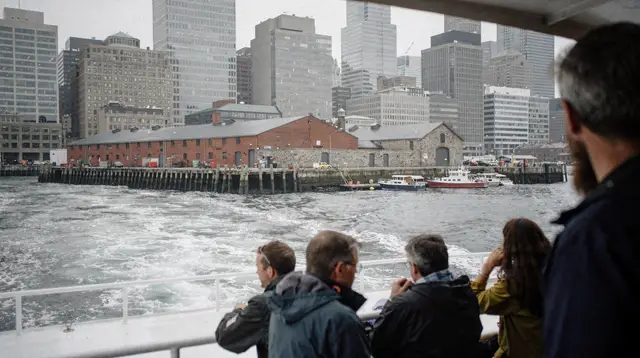
If you want to see the hills without joining a coach tour, one option is a smaller trip that stays flexible rather than following a fixed itinerary: a day trip from Boston into the color further west, timed to the season rather than a fixed calendar date. Closer to the city, the color also shows up on the water — a fall lunch cruise around Boston Harbor and a sunset cruise along the Charles River both put the season’s lower light over water rather than hillside, which is its own kind of autumn view without a scenic overlook full of parked buses.
None of this is a substitute for going and looking. It only changes what you are looking at: not just a hillside, but a hillside that a lot of people, for a lot of reasons, have decided is worth building a season around. For the practical version of this trip — where to go, how far, what to expect on the ground — the fall foliage guide and the New England fall foliage itinerary cover the routes and timing I have deliberately left out here. The Salem in October piece is the closest companion to this one — a different New England town, a different month, the same question about what a season becomes once it is sold. Boston itself barely factors into peak foliage, since the color arrives later and more muted in the city than in the hills; the best time to visit Boston guide and the Boston in winter piece cover the seasons on either side of it.
If you are staying closer to the city, Boston Harbor Islands in a day and the Charles River kayaking guide are lower-key ways to catch the season without leaving Massachusetts. For the towns north of Boston that also lean on a short, intense visitor season — Salem chief among them — the North Shore day trip guide and the Lexington and Concord day trip guide sit in the same territory of history and small-town economics running on a compressed calendar. The Head of the Charles and the wider question of how the region manages its own crowds shows up again in the Freedom Trail piece, which asks a version of the same question about a different New England institution: does the packaging change what’s underneath it.
Fall foliage in New England: questions worth asking before you go
Is fall foliage predictable enough to plan a trip around?
Not precisely. State tourism offices in New Hampshire, Vermont and Maine publish weekly foliage forecast maps through September and October, but color intensity and timing shift year to year with rainfall and temperature, and a forecast a month out is a rough guide, not a guarantee.
Why does the color vary so much from year to year?
Color depends on weather in the weeks leading up to the change: a warm, wet late summer tends to mute and delay the display, while a dry summer followed by cool, clear autumn nights tends to produce a brighter, more vivid year. The same hillside can look markedly different two years running.
Does Boston itself get good foliage?
Some, in its parks and along the Charles River, but the display is generally later and less dramatic in the city than in the hills of southern New Hampshire and Maine, where elevation brings the color change earlier and more intensely.
Are the chartered bus tours worth it, or better to skip them?
They serve a real purpose for visitors without a car who want a fixed, no-planning route to see the hills, and they are not misrepresenting what they offer. Anyone who wants to linger at a single overlook or take a longer, unscripted drive will likely prefer going independently.
Do the small towns mind the crowds that show up for foliage season?
It is mixed, and worth being honest about rather than assuming either resentment or gratitude. Some businesses depend directly on the few weeks of visitor traffic and plan their year around it; other residents deal with traffic and crowding on streets that are quiet the rest of the year. Both things are true in the same town at the same time.
Is farm-stand shopping during foliage season “authentic,” or is it staged for tourists?
Neither framing is quite right. The farms are working farms harvesting a real seasonal crop; the fact that visitors also come to photograph the same fields doesn’t change what the farmers are doing, and the tourist income often supports the farm through the rest of the year.
Does the commercialization — forecast maps, tour buses, festivals — make the foliage less genuine?
The color itself is unaffected by how it’s marketed; the biochemistry runs the same whether or not anyone is watching. What’s fair to say is that the season around the color — the maps, the buses, the festivals — is a real industry layered on top of a real natural event, not a replacement for it.
Seasonal tours and activities on GetYourGuide
Verified deep-linked GetYourGuide tours. Book through these links and we earn a small commission at no cost to you.
GetYourGuide does not provide a product photo for this activity — the image shows the meeting point, photographed by us.