Boston in winter: the season nobody recommends
What the cold actually does to this city
I will start with the part the guidebooks get right, because it is true. The cold that comes off the Atlantic in Boston is not decorative. It is not a backdrop for a nice photo of snow on brick. It closes things. The harbor cruises that fill the summer schedule thin out or stop. The Boston Harbor Islands ferry season ends, and the islands go back to being a green smudge on the horizon instead of a place you can reach. Whale watching out toward Stellwagen Bank goes quiet.
Walking the Freedom Trail stops being a pleasant afternoon and becomes a task you do with your hands in your pockets and your head down between the marked stops. If you came to Boston expecting the version of the city that fills every travel photo — people spilling out of Quincy Market with ice cream, sailboats on the Charles, the Common green and crowded — winter will not give you that. It cannot. So the deconseil, the standard advice to skip Boston in the cold months, is not wrong. It is just incomplete.
The light does something the crowds never let you see
What it does not tell you is what happens to the light. Boston in winter gets a low, raking sun for a few hours in the middle of the day, and it lands sideways across Beacon Hill in a way summer light never manages. The brick rowhouses go the color of the inside of a clay pot. The black iron railings and the old gas lamps throw long shadows down Acorn Street and Chestnut Street, and because there is almost nobody else on the sidewalk to walk through your sightline, you actually see it happen instead of catching it between someone’s shoulder and someone else’s dog. I have stood at the top of Mount Vernon Street in January with nobody else in view for a full minute, watching that light move across the windows, and I have also stood in the same spot in July surrounded by four different walking tours converging at once. Both are Beacon Hill. Only one of them lets you notice it.
The waterfront empties out, and that is the point
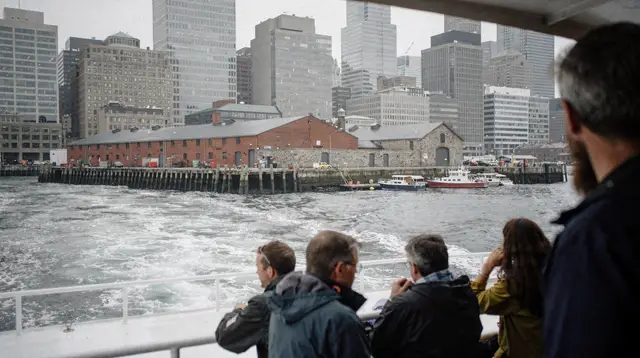
Down at the water, the change is even more obvious. The wharves near the Charlestown Navy Yard and the piers along the inner harbor that are packed with cruise operators, food trucks, and tour groups from June through September go nearly still. The USS Constitution, which is free to board year-round, sits at its berth with almost no line at all, and the sailors who work aboard her have time to actually talk instead of moving you along. A Charles River cruise in warmer months means a boat full of people angling for the same photo of the Boston skyline; the same stretch of river in winter, on the days boats still run it, is a colder, emptier, and honestly more interesting way to see the same skyline, without anyone’s elbow in your frame.
a late-day sunset cruise across the harborRefuges instead of stops
This is where the season changes what a visit even is. In summer, a café or a library reading room is a place you duck into between things — a stop on a list, a box to check. In winter, they become something closer to shelter, and you use them the way locals use them, which is to say: not as a photo opportunity but as a place to actually sit down. I have spent more good hours reading in the Boston Public Library’s Bates Hall on a gray February afternoon, radiators clanking, than I ever have rushing through it as a five-minute stop on a checklist. The small coffee shops around the North End and Beacon Hill stop being backdrops for a to-go cup and become the kind of place where the same four regulars are there every morning, and where a stranger sitting for an hour with a book does not stand out. That is not a small difference. It changes what kind of traveler you are while you are there.
The Common, twice
Nowhere is the contrast sharper than Boston Common. In summer it is a lawn full of picnic blankets, food carts, street performers, and a constant low roar of conversation — genuinely good, if you want that. In winter, snow-covered and mostly empty on a weekday morning, it is close to silent. You hear your own boots on packed snow. A dog runs across the open ground with nobody to dodge. The gold dome of the State House across Beacon Street sits above it all the same as it does in July, but there is nothing between you and it. I do not think one version of the Common is objectively better than the other. I think they are different parks that happen to share a name and a plot of land, and most visitors only ever meet one of them.
What you give up, and what it buys you
None of this erases what I admitted at the start. The cold is real, and it does close parts of the city down — the islands, a good share of the harbor traffic, the outdoor version of Boston that summer visitors take for granted. If your idea of a trip is one where every listed attraction runs on its full summer schedule, winter will disappoint you, and I would rather say that plainly than oversell it.
But if what you actually want is some sense of Boston at the pace its own residents live it at — the Cambridge sidewalks with students hurrying between buildings instead of tourists posing at the gate, the South End restaurants with a regular crowd instead of a summer rush, a city that has stopped performing for visitors because there are not enough of them around to perform for — winter is the only season that hands you that, and it does so honestly, without asking you to pretend the cold is not part of the deal.
a Charles River cocktail cruise timed to the early winter sunsetI will not pretend every visitor should come in January. If this is your one trip to Boston and you want the harbor, the islands, and the full run of outdoor tours, the best time to visit is genuinely elsewhere on the calendar, and a guide that tells you otherwise is not being straight with you. But if you have already seen the crowded version, or you simply prefer a quieter one, the case for Boston in winter is not a consolation prize. It is a different, smaller, and in some ways more honest city, and I would rather walk it cold than not walk it at all.
a guided walk through the Crane Estate on the North ShoreBoston in winter: the questions I get asked most
Is Boston worth visiting in winter?
Yes, if you accept the cold as part of the experience rather than an obstacle. Fewer visitors, calmer streets, and a slower version of the city are the trade for weather that keeps some attractions and harbor activity on a reduced or seasonal schedule.
Does everything close in Boston during winter?
No, but the rhythm changes. Harbor cruises and whale watching thin out or pause for the season, outdoor markets disappear, and some island ferries stop running, while museums, restaurants, and the T continue on their normal schedule.
Is winter cheaper than summer in Boston?
Generally yes for hotels and some tours, since demand drops outside the warm months, though exact rates change year to year and by property, so this piece is about the experience rather than a price guide.
What do I lose by only visiting Boston in summer?
Mainly the sense of the city as a place people actually live in day to day. Summer crowds fill the Common, the Freedom Trail, and the harbor with visitors, which is its own kind of energy, but it is a different city than the one residents walk through the rest of the year.
Is Beacon Hill nicer in winter or summer?
Both have a case. Summer brings green window boxes and busy sidewalks; winter strips that away and leaves the brick, the ironwork, and the gas lamps more exposed, which some visitors find more atmospheric and others find simply colder.
Are the Boston Harbor Islands accessible in winter?
Ferry service to the islands is seasonal and generally does not run through the coldest months, so winter visitors see the harbor from the shore rather than from the islands themselves.
Should first-time visitors come to Boston in winter?
It depends on what they want. Someone visiting once and wanting the full roster of harbor cruises, island ferries, and outdoor events is better served by late spring through early fall; someone who wants to see the city as its residents experience it has a real argument for winter.
Seasonal tours and activities on GetYourGuide
Verified deep-linked GetYourGuide tours. Book through these links and we earn a small commission at no cost to you.
GetYourGuide does not provide a product photo for this activity — the image shows the meeting point, photographed by us.