The Black Heritage Trail: Beacon Hill's Black history, on foot
What is the Black Heritage Trail in Beacon Hill?
It's a roughly 1.6-mile self-guided or ranger-led walking route through the north slope of Beacon Hill, tracing 15 sites tied to Boston's free Black community and the abolitionist movement before the Civil War. It's a separate route from the Freedom Trail, though both touch Beacon Hill.
A different trail through the same hill
Boston has two well-known walking trails that both touch Beacon Hill, and conflating them does a disservice to each. The Freedom Trail is the red-brick-and-paint line that most first-time visitors follow, tracing sites from the Revolutionary War era. The Black Heritage Trail is a separate route, maintained separately, telling a separate story: the history of Boston’s free Black community in the decades before the Civil War, concentrated on the north slope of Beacon Hill.
The two trails share a neighborhood and, in a few spots, nearly share a sidewalk. They don’t share a theme, and they aren’t the same walk. If you only have time for one Beacon Hill history walk and want the Black Heritage Trail specifically, don’t assume the Freedom Trail’s red line will get you there — it won’t, beyond a few blocks of overlap near the Massachusetts State House.
The route: steep streets, brick sidewalks, 15 sites
The Black Heritage Trail runs roughly 1.6 miles (2.5 km) through the north slope of Beacon Hill, connecting about 15 sites tied to Boston’s 19th-century free Black community. It’s an outdoor walking route, not a single building or museum: markers and interpretive signage stand at each stop, and the route itself costs nothing to follow.
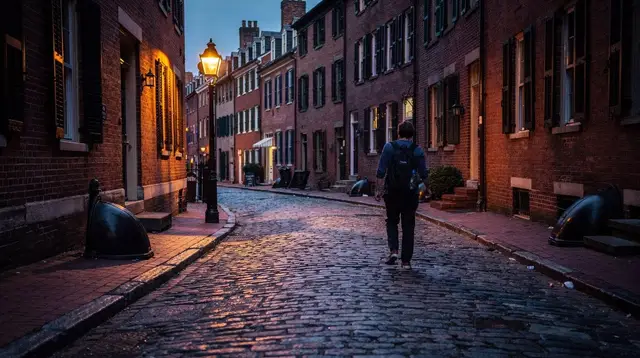
The streets here are some of the steepest and narrowest in Boston — cobblestones, brick sidewalks buckled by tree roots, and grades that turn a short block into real effort in winter ice or summer heat. Flat, cushioned shoes matter more here than almost anywhere else on a Boston walking itinerary. This is also part of what makes the north slope feel different from the manicured south slope around Louisburg Square: tighter lanes, less symmetry, a rougher edge that hints at what a working-class 19th-century neighborhood actually looked like, even though most of today’s brick rowhouses read as uniformly affluent.
Stops along the trail include private homes once owned or occupied by Black Bostonians active in abolitionist and community life, sites tied to the Underground Railroad, and former schools and meeting places. Most of these buildings are privately owned today and not open for interior visits — the trail is a walk past and around them, reading the history from the street, not a series of museum entries.
The African Meeting House
The centerpiece of the trail is the African Meeting House on Smith Court, built in 1806. It’s widely cited as one of the oldest surviving Black church buildings still standing in the United States, and for much of the 19th century it functioned as far more than a place of Sunday worship: a school for Black children met here before Boston’s public schools were integrated, and the hall hosted abolitionist meetings and speeches, including appearances by Frederick Douglass and William Lloyd Garrison.
The building today is part of a small museum complex on Smith Court that includes an adjoining schoolhouse. Museum admission is separate from simply walking the outdoor trail — following the route and reading the outdoor markers costs nothing, but going inside the meeting house or schoolhouse exhibits, when open, is a different, ticketed experience. Hours and admission details change, so check current information before planning a visit around specific opening times.
Guided or self-guided
Two ways to do this trail, and neither requires much planning:
Self-guided: Follow a printed or downloadable map between the numbered stops, reading the outdoor interpretive panels at each site. This works well if you want to move at your own pace, linger at the African Meeting House, or combine the walk with general Beacon Hill wandering.
Ranger-led or organization-led: Guided walks have historically been offered through the Boston African American National Historic Site, the National Park Service unit that oversees much of the trail, and local historical organizations also lead occasional walks. A guide adds context that the panels alone don’t — specific stories about specific residents, connections between sites that aren’t obvious from the street. Availability, schedule, and group size vary by season and aren’t fixed, so confirm current offerings rather than assuming a walk departs at a set time every day.
For a guided experience with a fixed itinerary and a private or small-group format, a booked tour is the more predictable option:
a guided walk through Beacon Hill’s Underground Railroad and abolitionist historyWhy the north slope mattered
In the first half of the 19th century, before the Civil War, Boston had one of the largest free Black communities in the North. Many residents lived on the north slope of Beacon Hill — the side of the hill closer to what was then the working waterfront, more affordable and denser than the fashionable south slope. It became a center of Black civic, religious, and political life: churches, schools, mutual aid societies, and a dense network of abolitionist activity, much of it organized in private homes along streets like Smith Court and Phillips Street.
This is also part of what the trail asks visitors to hold onto without flattening it into a single feel-good anecdote: the history here includes real risk. Some of the homes and sites along the route are tied to the Underground Railroad, and residents who sheltered people escaping slavery did so knowing Massachusetts law, and later federal law, could be turned against them. The Fugitive Slave Act of 1850 made that risk concrete, and Boston’s Black community and its allies organized public resistance to it. None of this reduces neatly to a single dramatic story — it’s a pattern of sustained, collective, often dangerous work, and the trail’s markers are the better source for the specifics of any one site than any summary here.
Combining it with the rest of Beacon Hill
Because the Black Heritage Trail sits entirely within Beacon Hill, it pairs naturally with a broader walk through the neighborhood rather than standing as an isolated errand. After or before the trail, most visitors extend the walk to:
- Acorn Street, one of the most photographed cobblestone streets in the city, on the south slope
- Louisburg Square, the private, gated green space ringed by some of Beacon Hill’s grandest townhouses
- Charles Street, the neighborhood’s main commercial strip, for antique shops and cafés
- Boston Common and the Massachusetts State House, both within a few minutes’ walk of the trail’s southern end
A single loop that starts at the Common, threads north through the Black Heritage Trail sites, then loops back south through Acorn Street and Louisburg Square, gives a fuller sense of Beacon Hill than either half alone — its architecture on one side, a harder and more specific history on the other. For a broader look at the neighborhood’s layout and best photo spots, see the Beacon Hill neighborhood guide.
If a guided format across both threads — history and architecture — appeals more than doing them separately, a general Beacon Hill walking tour covers the ground too:
a small-group or private walking tour that covers Beacon Hill’s streets and architectureWhat this trail is not
Worth stating plainly, because guidebooks sometimes blur it: this is not an extension of the Freedom Trail, not a rebranded second half of the same walk, and not primarily a Revolutionary War history. It’s its own trail, with its own focus — a free Black community’s civic, religious, and political life in the decades before the Civil War, and the abolitionist organizing that grew out of it. Treating it as a Freedom Trail bonus stop undersells both a specific history and the neighborhood that held it.
It’s also not a trail best rushed. The interpretive panels carry real historical detail — names, dates, specific events — that reward slow reading over a quick photo stop. If your schedule only allows fifteen rushed minutes, it’s worth reconsidering whether that’s the day for this walk, or whether a future visit with more time would serve the material better.
Other angles on the same streets
Beacon Hill’s dense, atmospheric layout has made it a draw for more than one kind of walking tour. If ghost stories and true-crime history interest you alongside — or instead of — this history, the neighborhood has a separate track for that too, covering different stories on overlapping streets:
a true-crime walking tour through Beacon Hill’s darker historical incidentsFor an evening version built around ghost stories rather than documented history, see the Beacon Hill haunted walk — a distinctly different, more folkloric angle on the same physical streets.
Getting there
Beacon Hill sits directly north of Boston Common, an easy walk from the Park Street or Charles/MGH stations on the Red Line and Green Line of the T. There’s no dedicated parking for the trail, and Beacon Hill’s narrow one-way streets make driving here more trouble than it’s worth — walking or the T is the practical choice. For a wider view of how to fold this walk into a longer stay, see the first-time Boston guide or the Freedom Trail guide for how the two Beacon Hill-adjacent walks fit into a broader itinerary.
Related neighborhoods and walks worth pairing with this one: the North End’s Italian food scene across town, Harvard Yard in Cambridge for a different kind of historic-campus walk, and the Charlestown Navy Yard if you’re building a fuller day around Revolutionary and 19th-century history across the city. For a broader sense of the categories this trail sits within, browse Freedom Trail and history activities or walking tours more generally.
Frequently asked questions about the Black Heritage Trail
Is the Black Heritage Trail the same as the Freedom Trail?
No. They’re distinct trails with different themes and mostly different sites. The Freedom Trail follows a painted red line through downtown Boston tracing the Revolutionary War. The Black Heritage Trail runs through the north slope of Beacon Hill and tells the story of Boston’s free Black community and the abolitionist movement in the decades before the Civil War. The two routes overlap geographically near Boston Common but aren’t the same walk.
What is the African Meeting House?
Built in 1806, it’s widely cited as one of the oldest surviving Black church buildings in the United States. It served as a house of worship, a school, and a meeting hall for abolitionist organizing, including speeches by Frederick Douglass and William Lloyd Garrison. It sits at the heart of the trail on Smith Court.
Is the Black Heritage Trail free?
Following the route on your own, using the outdoor markers and map, costs nothing. Ranger-led walks, when offered, are typically free as well, though group size and availability vary by season, so check current details before planning a visit around a specific walk time.
How long does the walk take?
Budget around an hour to 90 minutes for the outdoor route at a relaxed pace, more if you stop to read each marker closely. The route covers about 1.6 miles (2.5 km) on Beacon Hill’s steep, cobblestone side streets, so allow extra time and wear shoes with real grip.
Can I combine this with the Freedom Trail?
Yes, but treat them as two separate walks rather than one extended loop. Many visitors do the Black Heritage Trail as its own outing, then walk Beacon Hill more broadly afterward, or tackle the Freedom Trail on a different day. Trying to merge both into a single rushed circuit tends to shortchange both stories.
Is Beacon Hill’s north slope different from the rest of Beacon Hill?
Historically, yes. The north slope, closer to the base of the hill and once nearer the water, was a more modest, dense area of rented rooms and small houses where Boston’s free Black population concentrated in the 19th century. The south slope, around Louisburg Square, was wealthier. Today the brick rowhouses on both sides look similarly affluent, which can obscure that historical divide.
Are there guided tours of the trail?
Ranger-led walks have historically been offered through the Boston African American National Historic Site, part of the National Park Service, and local historical organizations also lead walks at times. Offerings and schedules change, so confirm current options and meeting points before you go rather than assuming a fixed timetable.
Freedom Trail and Revolutionary history tours on GetYourGuide
Verified deep-linked GetYourGuide tours. Book through these links and we earn a small commission at no cost to you.
GetYourGuide does not provide a product photo for this activity — the image shows the meeting point, photographed by us.