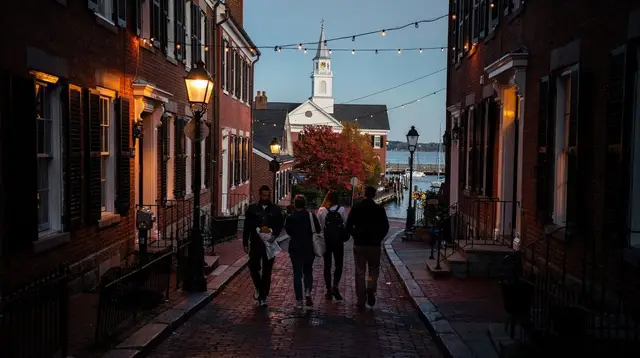
Walking Beacon Hill: Acorn Street, Louisburg Square and Chestnut Street
What is Acorn Street and how do I get there?
Acorn Street is a short cobblestone lane on Beacon Hill, one block off Chestnut Street, lined with early-19th-century brick row houses. It is a five- to ten-minute walk from the MBTA Charles/MGH or Park Street stations on the Red Line, and there is no admission fee.
A hill of brick, gas lamps and cobblestones
Beacon Hill is the residential slope that rises from the north side of Boston Common toward the Charles River, and it has stayed almost entirely brick, brownstone and cobblestone since the early 19th century. There is no single museum or paid attraction that sums it up: the point of visiting is to walk the streets themselves, which is why this guide treats it as a walking destination rather than a checklist of stops. For a broader introduction to the neighborhood, including its history and layout, see the Beacon Hill neighborhood guide; this page focuses specifically on the walk, on Acorn Street, and on how to do it well.
The core of a Beacon Hill walk usually includes three streets. Acorn Street, a narrow cobblestone lane just off Chestnut Street, is the one most people come looking for, and it is often described as one of the most photographed streets in the United States, though that claim comes from repetition rather than a documented count. Louisburg Square, a private, gated green space ringed by some of the most expensive row houses in Boston, sits a few minutes’ walk away. Chestnut Street itself is longer, lined with well-preserved Federal and Greek Revival facades, and connects the two.
None of this costs anything to see. There is no ticket booth, no entrance, no scheduled opening hours, because these are ordinary public streets running past private homes. That is also the central fact to keep in mind while walking here.
Getting there: Park Street or Charles/MGH
Beacon Hill is compact enough that a single MBTA stop puts you within walking distance of everything on this page. The T, operated by the MBTA, serves the neighborhood from two Red Line stations:
- Park Street, on the Boston Common side of the hill, a roughly five- to eight-minute walk up to Chestnut Street and Acorn Street.
- Charles/MGH, on the river side, a similarly short walk that approaches the neighborhood from the opposite direction.
Either station works; the choice mostly depends on where you are coming from and whether you want to start your walk from the Common side or the river side. A standard T fare applies at both, paid with a CharlieCard, a CharlieTicket or contactless payment, with transfers included in a two-hour window — check current fares on mbta.com before you travel, since they change periodically. If you are combining this walk with the Freedom Trail, Park Street is also a stop on that route, which makes it easy to link the two on foot without doubling back through transit.
Beacon Hill is not large. Once you are off the train, everything described here is within a 10- to 15-minute walk, and there is no reason to use a car, a rideshare or a bus to get between Acorn Street, Louisburg Square and Chestnut Street.
Acorn Street: what it is, and what it is not
Acorn Street is short: a single block of cobblestones running between Willow Street and West Cedar Street, lined on both sides by brick row houses that were originally built for coachmen working for the wealthier households on Chestnut Street and Mount Vernon Street. Its narrowness, its uneven original paving stones, and its gas-style lamps are what draw photographers and visitors, and they are also the reasons it can feel crowded at points in the day.
It is worth being direct about the scale of the place: this is a residential lane, not a landmark with staffing, signage or a visitor center. There is nothing to buy and nothing to enter. The entire experience is standing on the public street and looking at the facades, which is exactly why the neighborhood’s residential character matters so much to how you should behave while visiting.
Louisburg Square and Chestnut Street
Louisburg Square is a small, private, fenced garden square surrounded by some of the most sought-after real estate in Boston. The square itself and the garden inside the railings are private property, owned collectively by the residents whose homes face it; you can walk the sidewalk around it and look in, but you cannot enter the garden. It sits a short walk from Acorn Street, roughly along Pinckney Street or Mount Vernon Street depending on your route.
Chestnut Street is longer and more varied, a good spine for a walk because it connects the Charles Street shopping strip near the river to the upper part of the hill near the Common. Its Federal and Greek Revival townhouses, many dating to the 1800s to 1820s, are considered some of the best-preserved examples of the style in the city. Walking Chestnut Street end to end, with a detour down Acorn Street and around Louisburg Square, is the shape most self-guided and small-group walks on Beacon Hill take, even though operators vary the exact route.
It’s a residential neighborhood: walk with discretion
Every building mentioned on this page is privately owned and, in nearly all cases, lived in. That has practical consequences for how a visit should go:
- Stay on the public sidewalk and street. There is no legitimate reason to step onto a stoop, a private walkway or into a resident’s entryway for a photograph.
- Keep noise down, particularly early in the morning or in the evening, and be aware that groups clustering on a narrow street like Acorn Street can block the sidewalk for people who live there.
- Do not assume a doorway, gate or garden is open to the public because it looks decorative. Louisburg Square’s garden and the private stoops along Chestnut Street are not part of the walk, only the street itself is.
- If a resident is entering or leaving a building, give way. This is their commute, not a photo opportunity.
None of this is a formal rule enforced by a ticket or a guard; it is closer to basic courtesy, and it is the main thing that separates a considerate visit from the kind of crowding that has made some residents wary of tour groups on Acorn Street in particular.
Light and timing for photographs
Acorn Street’s narrow, east-west orientation and tall facades mean the light on it changes a great deal through the day. Morning and late-afternoon light are generally considered the most flattering for photographing the brick and cobblestones, largely because the sun sits at a lower angle and avoids the flat, harsh look of midday. This guide will not give you a specific hour, because the right time shifts with the season, the weather and how far the sun has moved that week — if you want a precise window, treat sunrise and sunset tables for Boston as your reference, not a fixed clock time.
The same logic that makes early or late light better for photos also tends to mean fewer people on the street at those hours, which matters on a lane as narrow as Acorn Street. If your goal is a clear photograph rather than a crowded one, timing your visit outside the middle of the day is usually more effective than any particular route or vantage point.
For a dedicated look at framing, angles and other photogenic corners of the neighborhood beyond Acorn Street itself, see the Acorn Street and Beacon Hill photoshoot guide, and the broader Boston photoshoot locations guide for how the hill compares to other spots around the city.
Walking it yourself versus joining a guided tour
Acorn Street, Louisburg Square and Chestnut Street are open, free, public streets at any hour, and plenty of visitors simply walk them unguided using a map. What a guide adds is context: who built these houses, why the coachmen’s quarters ended up on Acorn Street, how the neighborhood’s Black history connects to the nearby Black Heritage Trail, or how Beacon Hill’s development compares to the brownstones of Back Bay across the Public Garden.
Guided Beacon Hill walks are commonly offered as part of a small-group or private tour, sometimes combined with Back Bay or with the Freedom Trail. Exact duration and route vary by operator, so confirm the length and stops directly with whoever you book before assuming a specific itinerary. A small-group or private walk through Beacon Hill is one way to get that context without committing to a full-day tour, and it can be booked at a pace and duration suited to your schedule.
If you would rather cover Beacon Hill alongside other central neighborhoods in a single outing, an old Boston walk that links Beacon Hill with Back Bay pairs the brick row houses of the hill with the wider boulevards and brownstones across the Public Garden. For a different angle on the same streets, a guided walk covering Beacon Hill’s Underground Railroad history focuses on the neighborhood’s role in Boston’s abolitionist and free Black communities, a layer of the hill’s history that is easy to miss on a purely architectural walk.
For a general overview of how Beacon Hill’s walking options compare to walking tours elsewhere in Boston, see the general guide to walking tours in Boston, which covers the Freedom Trail, Back Bay and other neighborhoods alongside Beacon Hill.
Combining Beacon Hill with the rest of central Boston
Because it sits directly between Boston Common and the Charles River, Beacon Hill fits naturally into a wider day rather than standing entirely on its own. From Park Street, you are a short walk from the start of the Freedom Trail; from the river side near Charles/MGH, you are close to the Public Garden and the edge of Back Bay. If you are building a first visit around a short itinerary, the two-day Boston highlights itinerary is a reasonable place to see how a Beacon Hill walk slots in alongside the city’s other central sights.
The neighborhood also has a documented, less picturesque history that some walks address directly rather than skipping past. Beacon Hill’s north slope was historically one of Boston’s most important free Black communities before the Civil War, and several stops on the Black Heritage Trail run through the same blocks covered here. Visitors who only follow the Acorn Street photo route can miss this entirely, so it is worth deciding in advance whether you want a walk that covers both.
What Beacon Hill walks don’t include
To be direct about what is not on offer here: there is no interior access to any Beacon Hill home, no museum admission bundled into a walk of Acorn Street or Chestnut Street, and no fixed schedule of departure times the way a bus tour might run. A walking tour of this neighborhood is an exterior, street-level experience, priced and timed by the operator you book with, not by this guide. If a listing promises access to a private residence or garden on Beacon Hill, treat that as inaccurate rather than a bonus.
Some operators also frame Beacon Hill through a specific lens rather than straight architectural history — a true crime-themed walk through Beacon Hill covers the neighborhood’s less genteel past, which is a different experience from a standard architecture-focused walk and worth knowing about before you book if you want one over the other.
FAQ: walking Beacon Hill and Acorn Street
Where exactly is Acorn Street?
Acorn Street runs between Willow Street and West Cedar Street on the flat of Beacon Hill, a short block south of Chestnut Street. It is small enough to miss if you are not looking for it, and most visitors reach it on foot as part of a longer loop through the neighborhood.
How do I get to Beacon Hill by public transit?
The MBTA Red Line stops at Charles/MGH, on the river side of the hill, and at Park Street, on the Boston Common side. Both put you within a 10-minute walk of Acorn Street, Louisburg Square and Chestnut Street. See the guide to the T for fares and how transfers work.
Is Acorn Street really one of the most photographed streets in the United States?
It is widely described that way in guidebooks and on social media, largely because of its narrow cobblestones and gas lamps, but there is no official ranking behind the claim. Treat it as a reputation, not a measured fact.
Can I go inside the houses on Acorn Street or Louisburg Square?
No. Every building on Acorn Street, Louisburg Square and most of Chestnut Street is a private residence. Walking tours here are exterior and street-level only; there is no public interior to visit and no ticket that changes that.
What is the best time of day to photograph Acorn Street?
Morning and late-afternoon light are generally considered more flattering on the brick facades and cobblestones than the flat light of midday, and crowds tend to be thinner outside midday hours. Exact timing shifts with the season, so treat this as a general pattern rather than a fixed schedule.
Is Beacon Hill safe and appropriate to walk through as a tourist?
Yes, it is a residential neighborhood in central Boston with regular foot traffic. The main consideration is courtesy rather than safety: keep noise down, do not block doorways or trespass onto private stoops, and remember that people live behind these doors.
How long does a Beacon Hill walking tour usually take?
Guided walks of Beacon Hill are commonly built around one to two hours, but the exact duration depends on the operator and whether the walk is combined with other areas such as the Freedom Trail or Back Bay. Confirm the length with the tour provider before booking.
Do I need to book a guided walk, or can I do this on my own?
Both are common. Acorn Street, Louisburg Square and Chestnut Street are public streets you can walk unguided at any time, free of charge. A guide adds historical context and local detail, which is the main reason people choose small-group or private options over a self-guided walk. If you would rather see the wider city on foot, the best-of-Boston walking tour covers Beacon Hill alongside other central sights in one outing.
Walking tours of downtown Boston and Beacon Hill on GetYourGuide
Verified deep-linked GetYourGuide tours. Book through these links and we earn a small commission at no cost to you.
GetYourGuide does not provide a product photo for this activity — the image shows the meeting point, photographed by us.