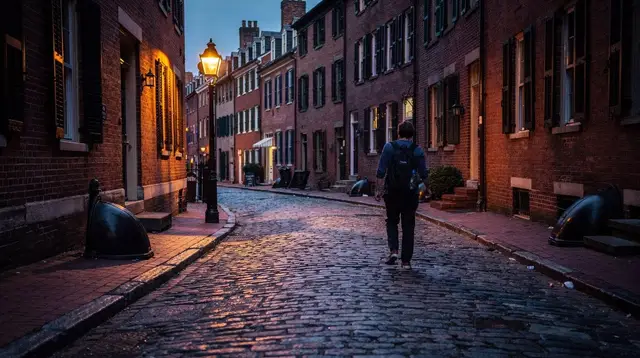
Beacon Hill at dusk: a self-guided haunted walk
Can you walk Beacon Hill's haunted streets on your own after dark?
Yes. Acorn Street, Louisburg Square and the surrounding blocks are public streets you can walk any evening, gaslit and generally well-trafficked. A guided ghost tour adds narrated legends and history; walking it yourself means going at your own pace and respecting a residential neighborhood.
Why Beacon Hill after dark is a different neighborhood
By day, Beacon Hill is a postcard: red-brick rowhouses, black shutters, window boxes, and tourists photographing Acorn Street. By early evening, once the gas lamps flicker on and the day-trip crowds thin out, the same streets read very differently. The narrow lanes, the steep pitch of the hill itself, and lighting that was designed in the 19th century rather than for modern visibility all combine into something genuinely atmospheric. That shift, not any single haunted address, is the actual subject of this guide.
Beacon Hill was built up mostly in the early 1800s on land that had been pasture and, before that, part of Boston’s original three-hill skyline (the “tri-mountain” that gave the city its name). The gas lighting that survives today, largely on private initiative from residents who fought to keep it rather than switch to electric, is one of the largest surviving gaslit districts in the country. Combined with narrow lanes never widened for cars, it is one of the few parts of central Boston where the built environment has changed the least since the 19th century. That is the honest reason ghost-story tours gravitate here: the setting does most of the work.
This page is not a narrated tour. It is a practical guide to walking Beacon Hill yourself in the evening: where the atmosphere concentrates, what the local legends actually are (and are not), how to do it without becoming a nuisance to people who live there, and where to go instead if you would rather have a guide narrate it for you.
The streets that carry the atmosphere
A short list of blocks does most of the work on Beacon Hill, and you can walk all of them in under an hour without rushing.
Acorn Street is the single most photographed street in the neighborhood: a cobblestone lane barely wide enough for two people, lined with small brick rowhouses that were originally built for coachmen and tradespeople serving the grander houses nearby. At dusk, with the gas lamps lit and the cobblestones catching the light unevenly, it looks considerably older than a daytime visit suggests.
Louisburg Square is a private, gated green space ringed by some of the most expensive townhouses in Boston. You cannot enter the square itself, but walking its perimeter at dusk, past ivy-covered facades and brass door fittings, is part of the standard route.
Chestnut Street and Mount Vernon Street are wider than Acorn Street but longer, giving a better sense of the hill’s actual grade — parts of Beacon Hill are steep enough that the sidewalks include informal steps. Bow-front townhouses, purple-tinted antique window glass (a 19th-century manufacturing flaw some residents deliberately preserve), and ironwork boot scrapers by the doorsteps are worth slowing down for.
Beacon Street, along the top edge facing Boston Common, is the most open and best-lit stretch, useful as a starting or ending point since it connects directly to the Common and to the start of the Freedom Trail. The Freedom Trail itself is a roughly 2.5-mile (4-kilometer) route marked by a painted or brick red line in the sidewalk, linking 16 historic sites from Boston Common to Bunker Hill; following the line costs nothing, though a handful of the sites along it sell their own separate admission. Anyone doing the trail on foot can find our self-guided Freedom Trail walk useful for timing a Beacon Hill evening around it.
None of these streets requires a ticket or a set entry point. They are public rights-of-way through a private residential neighborhood, which is the detail that matters most for how you should behave while walking them.
What the local legends actually are
Beacon Hill has accumulated its share of ghost stories over roughly two centuries of continuous habitation, the way most old, dense neighborhoods do. Guides and longtime residents describe things like a widow said to still watch from an upper window on a side street, footsteps on stairs in townhouses with no one home, and cold spots tied to 19th-century deaths in specific buildings. These are told as neighborhood folklore, the kind that gets repeated at dinner parties and on organized tours, not as anything documented or verified. Treat them exactly that way: local color, not history. Specific addresses are deliberately left out of this guide, both because the claims themselves are unverifiable and because the buildings in question are private homes.
Distinguish this from the legends around the Massachusetts State House at the top of the hill, and from stories tied to the Charles Street Jail (now a hotel) at the base — both real buildings with documented histories that guided tours sometimes fold into a Beacon Hill route, alongside the purely residential-street folklore.
Beacon Hill’s version of this is also a different register from what visitors find an hour north in Salem. Salem markets its haunted reputation openly, built around the documented witch trials of 1692 and a calendar of organized ghost tours that peak every October. Beacon Hill has no equivalent civic identity as a haunted destination; the ghost stories here are quieter, undocumented, and attached to a neighborhood that is first and foremost residential rather than a themed visitor attraction. If you are building a trip around New England’s darker history rather than a single evening walk, Salem is the more thorough stop; Beacon Hill offers atmosphere in smaller, gentler doses.
Beacon Hill also has a real, documented history — and it is not this one
It is worth being direct about a distinction the neighborhood itself makes clearly: Beacon Hill’s north slope was, in the 19th century, one of the most significant Black communities in the United States before the Civil War, home to abolitionists, the African Meeting House, and a network of people involved in the Underground Railroad. That history is preserved today as the Black Heritage Trail, a National Park Service-linked, factual walking route through many of the same blocks covered here.
The overlap in geography is real. The approach is not. The Black Heritage Trail documents specific, verified history with markers and interpretive signage; this guide covers unverified local ghost folklore and evening atmosphere. If your interest is the neighborhood’s actual 19th-century history rather than its legends, that guide is the better starting point, and it works equally well as a daytime walk.
Self-guided versus a booked ghost tour
Several organized ghost tours based in downtown Boston include Beacon Hill as one stop on a longer route that typically also covers the Common, Beacon Hill’s edges, and sometimes Boston’s North End, the city’s Italian quarter rather than a business district, or the Financial District — covered in full in our guide to Boston ghost tours. A guide narrates specific stories, sets a pace, and usually covers more ground with less backtracking than you would manage alone. It also costs more than the walk itself, which is free.
Doing it yourself has the opposite trade-offs: no narration, no fixed schedule, and you decide how long to linger on Acorn Street or whether to skip a block that does not interest you. It also means you can combine the walk with dinner in the neighborhood or fold it into a broader evening on the Freedom Trail without waiting on a group.
Table below sets out the main differences.
| Self-guided walk | Booked ghost tour | |
|---|---|---|
| Cost | Free | Paid, booked in advance |
| Narration | None | Guide tells specific stories |
| Route | Choose your own streets and pace | Fixed route, fixed schedule |
| Coverage | Beacon Hill only, as long as you like | Often multiple neighborhoods in one outing |
| Group | Solo, pair, or small group of your choosing | Joins a scheduled group (or private option) |
If you would rather have Beacon Hill specifically as the focus of a guided outing, rather than one stop among several, a small-group or private walking tour built around the neighborhood covers similar ground with a guide.
a small-group or private walking tour focused specifically on Beacon HillA separate option leans into the neighborhood’s darker true-crime history alongside its residential charm, for visitors more interested in documented cases than folklore.
a guided tour covering Beacon Hill’s true-crime historyPlanning an evening route
There is no fixed script here, only a sensible order. Start at the Boston Common edge of Beacon Street as light fades, walk up onto Mount Vernon Street, cut over to Louisburg Square, follow Chestnut Street toward Charles Street, and finish on Acorn Street before the lane gets crowded with other evening visitors doing the same thing. Reverse it if you are coming from the Charles Street end. The whole loop covers well under a mile and can be walked slowly in 45 minutes to an hour, longer if you stop often for photos.
This guide deliberately does not give exact start times or lamp-lighting schedules, since both shift with the season and with daylight saving changes. Boston observes the switch between EST and EDT like most of the country, moving clocks forward on the second Sunday of March and back on the first Sunday of November, so “dusk” arrives noticeably earlier in December than in September. Check sunset time for your visit date and plan to arrive as it is getting dark rather than after full night, when the streets empty out and photography gets harder.
Getting to the starting point is straightforward without a car. Beacon Hill sits directly beside Boston Common, reachable on the MBTA Red Line at Park Street or Charles/MGH, or the Green Line at Park Street, both a short walk from Beacon Street. A CharlieCard covers the ride with transfers included, and since the whole loop described above is under a mile, there is no need to move between stations once you arrive — one T ride in, one T ride out, and the rest is on foot. Driving is not recommended: Beacon Hill’s streets are narrow, mostly residential permit parking, and part of what makes the neighborhood atmospheric on foot makes it frustrating by car.
Pair the walk naturally with our broader Beacon Hill neighborhood guide for daytime context, or with the Boston walking tour guide if you want to fold it into a longer route through downtown. For visitors staying nearby, the things to do in Beacon Hill hub lists other options in the immediate area, and the ghost and haunted tours category covers the citywide options if Beacon Hill alone does not fill an evening.
Doing this respectfully
Beacon Hill is not a themed attraction. Every street on this route is someone’s home address, and the neighborhood association has a long, documented history of pushing back on excessive tourist traffic, particularly around Acorn Street. A few practical rules keep the walk sustainable for the people who live there:
Keep voices down, especially after early evening. Sound carries between brick buildings on narrow streets in a way it does not on a wide avenue. Do not linger directly in front of a lit window or a doorway for photos; step back to the opposite side of the street. Do not touch ironwork, boot scrapers, or window boxes, even for a photo. If a resident is coming or going, give way rather than blocking a narrow sidewalk. And treat the ghost stories as exactly that in conversation nearby — speculating loudly about which specific house is haunted, within earshot of the people who live in it, is the single most common complaint from Beacon Hill residents about evening visitors.
None of this rules out enjoying the walk. It simply means treating a residential neighborhood the way you would want a few thousand annual visitors to treat your own street.
When to walk it
Beacon Hill’s gaslit streets work in any season, but the experience shifts with the calendar. Fall is the most popular stretch: New England’s foliage season, roughly late September through late October, brings shorter days and an earlier dusk, so the gas lamps come on sooner and the walk fits more easily into an early evening without cutting a full day of sightseeing short. Anyone building a longer autumn trip around the region’s fall foliage can easily fold a Beacon Hill evening into a Boston stop on the way to or from northern New England.
Winter changes the character rather than the appeal. Dusk falls as early as mid-afternoon by December, the gas lamps read differently against cold air and, some years, snow on the cobblestones, and the neighborhood is quieter overall since the heaviest tourist season has passed. Dress for the cold and uneven, occasionally icy sidewalks more than for the walk’s short distance; see our Boston in winter guide for what else changes about visiting the city that time of year.
Spring and summer bring the longest daylight and the latest dusk, meaning a later start if you want the gas-lamp effect at its most visible, but also the busiest sidewalks on Acorn Street specifically. If your visit lands on Patriots’ Day, the third Monday in April and the date of the Boston Marathon, expect a citywide event atmosphere and altered traffic patterns downtown; the marathon route itself does not run through Beacon Hill’s residential core, but transit and street closures elsewhere in the city can affect how you get to the neighborhood that day.
Combining it with more organized options
If the self-guided version leaves you wanting more structure, two other formats worth knowing about both touch Beacon Hill without being general city ghost tours. One is built specifically around Beacon Hill’s haunted streets rather than treating the neighborhood as one stop among several.
a walking tour focused on Beacon Hill’s haunted streets and local legendsThe other pairs the storytelling with stops for drinks along the way, a format some visitors prefer for an evening that is part history, part social outing.
a guided evening tour that pairs ghost stories with stops for drinksFor a broader survey of guided options across the city, including tours that cover the North End and downtown alongside Beacon Hill, see Boston ghost tours. If your interest runs more toward atmosphere and photography than legends, Acorn Street and other Beacon Hill photo spots is a closer match, and our Boston photoshoot locations guide covers the rest of the city. First-time visitors building a broader plan can check first-time Boston guide and getting around Boston without a car, since Beacon Hill is compact enough to see entirely on foot once you arrive.
Beacon Hill’s evening walk in a paragraph
Walk it because the streets themselves, gaslit and largely unchanged since the 19th century, are genuinely atmospheric after dark, not because any specific legend is verified. Stick to well-lit, well-used streets like Acorn Street, Chestnut Street, Mount Vernon Street, and the edge of Louisburg Square, keep the visit brief and quiet, and remember this is someone’s neighborhood rather than an attraction. If you want narration and a fixed route, a booked ghost tour or a Beacon Hill-specific walking tour covers similar ground with a guide. If you want the neighborhood’s real, documented history instead of folklore, the Black Heritage Trail is the better guide to read next.
Ghost and haunted history tours of Boston on GetYourGuide
Verified deep-linked GetYourGuide tours. Book through these links and we earn a small commission at no cost to you.
GetYourGuide does not provide a product photo for this activity — the image shows the meeting point, photographed by us.