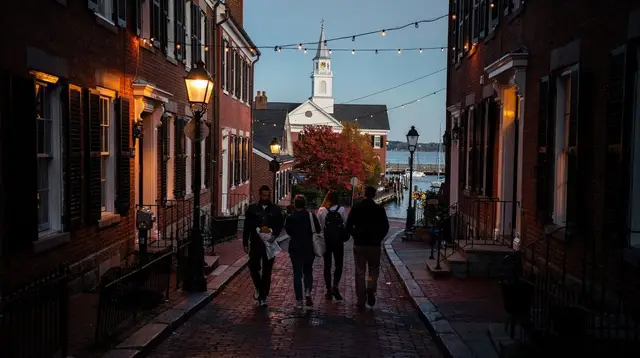
A port town built on two histories
Salem sits on the Massachusetts coast about 16 miles (26 km) north of Boston, and it carries two separate identities that visitors often blur together. The first is the 1692 witch trials, when 20 people were executed and hundreds accused in a wave of hysteria that still defines the town’s public image. The second, older and less marketed, is Salem’s history as a merchant port: ships out of Salem traded with China, India, and the East Indies in the late 1700s and early 1800s, and that wealth built the brick mansions and the customs house still standing near the waterfront. Both histories have dedicated sites, and a single day here can cover a reasonable slice of each without feeling rushed.
Salem is not a neighborhood of Boston. It’s an independent city in Essex County, and the fastest way to reach it doesn’t involve a car at all.
Getting there: the Commuter Rail, not the T
Salem sits outside the MBTA subway network — the T’s Blue, Orange, Green, Red, and Silver lines don’t reach it. The connection is the Commuter Rail, a separate system with its own ticketing, run on the Newburyport/Rockport Line from North Station in Boston. The ride to Salem takes roughly 30 to 35 minutes, direct, with no transfer required. Buy a ticket on the mTicket app or at the station before boarding; fares are zone-based and distinct from a CharlieCard fare.
In summer, a seasonal ferry also runs between Boston and Salem, a scenic alternative on a clear day, though it operates far fewer hours than the train and is worth checking on the operator’s site before planning around it.
Visitors landing at Logan and heading straight north without a Boston stopover first should still plan through downtown: the airport transfer guide covers getting from Logan into the city, and from there North Station and the Commuter Rail platforms are a short ride away. For anyone building a longer stay around several out-of-town stops, the guide to Commuter Rail day trips lays out how Salem compares with Plymouth and Concord as a same-network option, and the broader guide to getting around Boston without a car is useful background if a rental car isn’t part of the plan at all.
Driving is possible — Salem is about 30 to 40 minutes from downtown Boston depending on traffic — but parking in the historic core is limited and expensive most of the year, and effectively a liability in October (more on that below). For most visitors, the train is simply the easier call: no parking search, no highway traffic, and the station drops you a short walk from the historic district.
| Getting to Salem | Time from North Station | Notes |
|---|---|---|
| Commuter Rail (Newburyport/Rockport Line) | ~30-35 minutes | Direct, no transfer, runs year-round |
| Seasonal ferry | ~1 hour | Summer only, scenic but limited schedule |
| Car | ~30-40 minutes | Traffic-dependent; parking scarce in October |
The witch trials sites
Salem’s museums and historic sites approach 1692 from different angles, and it’s worth knowing the difference before choosing where to spend a limited amount of time. Some are theatrical reenactments aimed at a general audience; others are closer to academic history, using court records and period documents. None of the physical buildings where the 1692 trials and executions took place are marketed as single must-see sites in the way the witch trials story itself is — much of what’s on offer is interpretation built around the history rather than surviving original structures. It’s worth checking each site’s own description before buying a ticket, since “witch”-branded attractions in Salem range widely in depth and tone.
The Peabody Essex Museum anchors the more serious end of that range. Founded from the collections of Salem’s China Trade-era merchants, it holds one of the country’s older collections of Asian export art alongside American art and changing exhibitions, and it’s a paid museum with hours that vary by season — check pem.org before visiting.
For a guided introduction to the history rather than a self-directed museum visit, a walking tour with a guide covers the town’s key sites and separates documented fact from later embellishment more reliably than a self-guided wander.
a guided walking tour through Salem’s witch trials history is a straightforward way to get oriented on a first visit, with a guide who can point out which sites are original structures and which are later reconstructions.
For a smaller group and more time for questions, a private tour of the witch trials sites from Boston includes transportation from the city, useful if you’d rather not manage the train schedule yourself.
A version aimed more squarely at the historical record, following the accusations as they moved from household to household, is a walking tour tracing the witch hunt through what was then Salem Village — useful context, since the 1692 accusations began not in the port town itself but in a farming community a few miles inland, now the separate town of Danvers.
For readers who want the fuller written history before or instead of a tour, this site’s own guide to the Salem witch trials walks through the sequence of accusations, trials, and executions in more depth, and the guide to the Salem Witch Museum and the Peabody Essex Museum compares the two most-asked-about museums directly, since visitors regularly conflate them despite covering very different material. Evenings add a different register: Salem’s ghost tours lean into the town’s haunted-history branding rather than the documented record, worth knowing going in if a strictly factual tour is the goal instead.
The harbor and maritime history
Away from the witch trials sites, the Salem Maritime National Historic Site, run by the National Park Service, preserves the wharves, the Custom House, and the Derby House from Salem’s shipping era — free to visit, staffed by rangers, and a useful counterweight if the witch trials sites start to feel repetitive. The working harbor itself is still active with commercial and recreational boats, a reminder that Salem’s fishing and shipping economy didn’t end with the 1800s.
Cape Ann — the fishing towns of Gloucester and Rockport, a short distance further up the coast — extends this maritime thread and is generally covered alongside Salem on this site, since neither has enough visitor volume on its own for a dedicated write-up. If seals and open water are more appealing than another museum, a lobster boat tour out of Rockport with seal watching is a way to see the working-harbor side of the North Shore from the water rather than from a dock.
October: what to actually expect
Salem’s Halloween season, branded Haunted Happenings, runs through the entire month of October, and it changes the town completely. Streets in the historic core get genuinely crowded — sidewalks fill, restaurant waits stretch long, and parking becomes close to impossible near downtown, with overflow lots and shuttle buses pressed into service on busy weekends. This isn’t a quiet month to see witch trials history in a contemplative way; it’s closer to a citywide festival, and treating it as the former is a common visitor mistake.
If a visit lands in October, the practical adjustment is simple: take the Commuter Rail rather than drive. Trains run on a fixed schedule regardless of how full the streets get, while a car adds a parking search on top of the crowds. Outside October, Salem reverts to a considerably calmer town — a good half-day or full-day trip without the crush. This site’s longer read on what October in Salem is actually like goes into more detail on the tension between the town’s Halloween-season economics and its history as a courtroom, for anyone deciding whether the month suits their idea of the trip.
The rest of the year has its own rhythm. Spring and early summer are mild and comfortable for walking. Summer brings warmer weather and the seasonal ferry option. Late September through October also overlaps with New England’s fall foliage window, which peaks slightly later inland than on the coast — worth knowing if foliage, not Halloween, is the draw. The site’s guide to fall foliage in New England and the broader New England fall foliage guide both cover timing in more detail, including how the coastal North Shore compares with inland routes further out toward the White Mountains.
Money and timing
A day in Salem runs roughly USD 60 to 120 per person once museum admission, a guided tour, and lunch are added up — toward the lower end if sticking to the free National Park Service site and a self-guided walk, higher with the Peabody Essex Museum and a paid tour. None of Salem’s paid attractions are cheap by small-town standards, largely because the town leans hard on its single defining story; it’s worth deciding in advance which one or two sites matter most rather than trying to see everything.
A single day is enough to cover the historic core on foot: the witch trials sites, an hour or two at the Peabody Essex Museum, a walk along the harbor, and lunch somewhere downtown. Salem rewards unhurried walking more than a checklist of paid stops.
Where Salem fits with the rest of the North Shore
Salem pairs naturally with other stops covered on this site under the north-shore region, though not all of them share the same transport option. Lexington and Concord, where the first shots of the American Revolution were fired in April 1775, sit west of Boston rather than north, and reaching them from Salem means going back through the city rather than continuing up the coast — they’re not a same-day pairing with Salem without a car. Cape Ann, by contrast, continues north from Salem on the same Commuter Rail line, making it a more natural half-day extension if time allows.
For readers still deciding how to structure the day itself, the site’s Salem day trip guide walks through a full itinerary from North Station and back, and the Salem private day trip guide covers the option of a guided, door-to-door trip instead of the train for travelers who’d rather not plan the logistics themselves. Food is part of the case for combining destinations too: the Salem and Providence food tour guide pairs Salem with a very different New England city further south, for anyone building a multi-stop food-focused trip rather than a single history-focused day.
For a structured, day-by-day version of this trip, the Salem and North Shore day trip itinerary lays out timing for pairing Salem with Cape Ann in a single outing, and the one-week Boston day trips itinerary places Salem alongside the rest of the region’s day-trip options — Plymouth, Lexington and Concord, Cape Cod — for visitors staying in Boston long enough to see several of them.
For a broader view of Boston itself before or after the trip north, the Boston hub covers the city’s own neighborhoods and transport network in more depth.
Salem, Massachusetts: frequently asked questions
Do I need a car to visit Salem?
No. The Commuter Rail’s Newburyport/Rockport Line runs direct from Boston’s North Station to Salem in about 30 to 35 minutes, and the historic core is walkable from the station. A car adds parking costs and, in October, a genuine parking problem.
How long does a Salem day trip take from Boston?
Door to door, including the round-trip train ride, budget a full day. The train itself takes 30 to 35 minutes each way; the historic sites, a museum visit, and lunch fill the rest of a comfortable day.
Is October a good time to visit Salem?
It’s the busiest month of the year by a wide margin, driven by the town’s Halloween season. Streets are crowded and parking is difficult; if visiting in October, take the train rather than drive. Outside October, Salem is noticeably calmer.
What’s the difference between the Peabody Essex Museum and Salem’s witch trial attractions?
The Peabody Essex Museum is a paid fine-art and cultural museum built from Salem’s China Trade-era merchant collections, only partly related to 1692. The witch trials sites and tours focus specifically on the 1692 accusations and trials, with varying degrees of historical depth — check each one’s own description before booking.
Can I visit Salem and Lexington/Concord in the same day?
Not easily without backtracking through Boston. Salem is reached by Commuter Rail north from North Station; Lexington and Concord sit west of the city and use a different approach. They’re both North Shore-area day trips on this site, but not a same-day pairing.
Is the Salem Maritime National Historic Site free?
Yes. It’s run by the National Park Service and covers the wharves, Custom House, and Derby House from Salem’s shipping era at no charge, staffed by rangers.
Is there a ferry between Boston and Salem?
A seasonal ferry runs in summer, taking about an hour, longer than the train but scenic on a clear day. It operates far fewer hours than the Commuter Rail, so check the current schedule before relying on it.
How much does a day in Salem cost?
Roughly USD 60 to 120 per person, including museum admission or a guided tour plus lunch. Sticking to the free National Park Service site and a self-guided walk brings that toward the lower end.