One week in Boston: three city days plus four day trips by car
How this week is split
Boston rewards walking and the T for exactly as long as you stay inside the city and its immediate transit reach — after that, the region’s day trips scatter in directions no single rail line covers well. This itinerary treats the two halves honestly: three days entirely on foot and by the T, no car involved, then four days with a rental car for excursions the Commuter Rail either doesn’t reach on a useful schedule or doesn’t reach at all.
Pick up the car on the evening of day 3 or the morning of day 4 — there’s no reason to pay for one, or hunt for parking downtown, during the city days.
Day 1: The Freedom Trail, North End, Beacon Hill
Start at Boston Common, the oldest public park in the country and free every day, then follow the Freedom Trail’s painted red line north. It’s a 2.5-mile (4 km) walking route linking 16 sites, not a single attraction — some of those sites, including the Old South Meeting House, the Old State House, and the Paul Revere House, charge their own admission; others are free or donation-based. Check thefreedomtrail.org for which is which before you go.
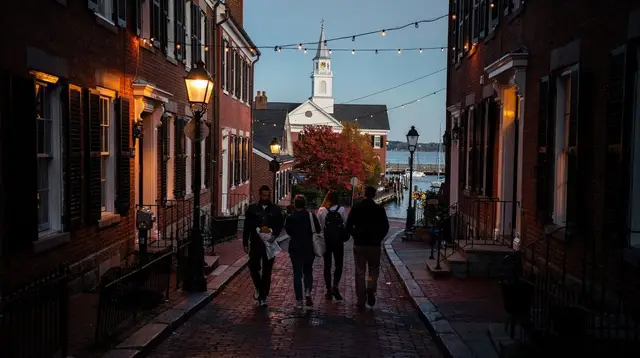
The trail runs through Beacon Hill, with its brick rowhouses and gas lamps, then into the North End, Boston’s Italian neighborhood — worth a stop for a food tour or just cannoli from Mike’s Pastry or Modern Pastry. The trail ends across the water at the Charlestown Navy Yard, home to the USS Constitution: boarding the ship itself is free (bring ID), while the adjacent USS Constitution Museum runs on a suggested donation, not a fixed ticket.
If you’d rather have the history narrated than self-guided, a walking option like a guided Revolutionary War walking tour covers similar ground with more context, though that specific one centers on Lexington (see day 4).
Day 2: Back Bay, the harbor, and a look at the water
Spend the morning in Back Bay, Boston’s brownstone-lined grid along Newbury Street and Commonwealth Avenue, then decide whether the Museum of Fine Arts or the Isabella Stewart Gardner Museum fits your afternoon — both are paid admission for essentially everyone (the Gardner’s one real exception: anyone named Isabella gets in free for life, with ID).
In the afternoon, head to the harbor. A sunset cruise is a straightforward way to see the skyline from the water — this Boston sunset cruise runs a couple of hours and needs no driving. If you’d rather stay on land, Boston Harbor Islands are ferry-accessible and make for a quieter afternoon than the museums.
Day 3: Cambridge, Harvard, and MIT
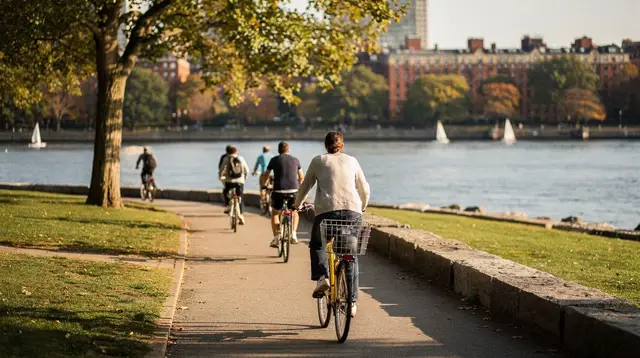
Cambridge is a separate city from Boston, on the other side of the Charles River — not a Boston neighborhood, whatever some guidebooks imply. Take the Red Line to Harvard Square and spend the morning around Harvard Yard and the university’s bookstores; a student-led option like a walking tour of Harvard led by a current student gives a more candid read on campus life than a self-guided lap.
Cross to MIT in the afternoon — the MIT Museum is a short walk or one Red Line stop from Harvard Square (Kendall/MIT). If you have energy left, the Harvard Museum of Natural History is worth the detour. This is your last car-free day; return the bike or T pass mentally, because tomorrow starts with a rental car.
Day 4: Lexington and Concord
Pick up the rental car and drive northwest on Route 2 — allow roughly 30 to 40 minutes each way, more in heavy traffic. Lexington and Concord mark where the Revolutionary War’s first shots were fired on April 19, 1775, and the Minute Man National Historical Park ties the sites together: Lexington Green, where colonial militia first faced British troops, and the Old North Bridge in Concord, a short walk from parking.
Walk some or all of the Battle Road Trail, a roughly 5-mile (8 km) path that follows part of the original road between the two towns. For a guided angle on Lexington itself, a guided walk of Battle Green in Lexington covers the town’s role in more depth than a solo stop allows; travelers who want something less conventional can try a mixed-reality VR tour of Lexington’s battle sites instead. Parking in central Concord is limited, so arrive earlier rather than later, especially on weekends.
Day 5: Salem, with time for Marblehead
Drive north on Route 1A, about 35 to 45 minutes to Salem. The town runs on its 1692 witch trial history — Salem Maritime National Historic Site and the Peabody Essex Museum cover the wider port history if you want more than the trials themselves. One honest warning: skip October if you can. Salem is saturated with visitors for the entire month during Haunted Happenings, with the worst crowds in the final days and on Halloween itself — it’s the busiest month of the year here, not a quiet one.
A guided option like a Salem witch trials walking tour is a reasonable way to get oriented quickly if you’re short on time. If you have an hour or two left, drive on to Marblehead, a working harbor town a short distance from Salem, grouped with it here since neither has enough on its own to fill a full day. Parking in downtown Salem tightens considerably as the day goes on, so arrive before midday.
Day 6: Plymouth
Drive south, about 45 minutes, to Plymouth, the traditional landing site of the Pilgrims in 1620. Plymouth Rock itself is a modest stop — most visitors spend more time at the Plimoth Patuxet Museums, a living-history recreation of the original colony. If seeing Mayflower II matters to your plans, check ahead: the ship periodically goes into dry dock for restoration and isn’t always on view.
On the water, a Plymouth Harbor cruise aboard the Pilgrim Belle is a low-effort way to see the harbor from a different angle before heading back. Downtown parking near the waterfront fills up on summer weekends, so a morning start helps.
Day 7: Newport or Cape Cod — pick one
Your last day is a choice, not a checklist. Newport, Rhode Island is about 1 hour 15 minutes by car and centers on the Gilded Age mansions along Bellevue Avenue — The Breakers and its neighbors — plus the Cliff Walk along the shoreline. Cape Cod is roughly 1 hour to 1 hour 15 minutes depending on traffic at the Sagamore Bridge, and trades mansions for beaches and the Cape Cod National Seashore’s dunes.
If you’d rather not choose in advance, a combined route like a guided tour covering the Freedom Trail, Salem, Rockport, and Cape Cod packages several of the week’s themes into one outing, though it won’t substitute for a full day on the Cape or in Newport if either is your priority. Whichever you pick, drop the rental car back in Boston that evening — neither destination needs a car once you’ve arrived if you’re staying centrally.
A note on driving this route
All four excursion days run through small historic centers with genuinely limited parking — Concord, Salem, and Plymouth in particular fill their downtown lots by midday in summer. Friday and Sunday evening traffic is heavy on every route out of Boston during the warmer months, so build in extra time for the return leg, especially on day 7. None of these day trips require a car once you’ve arrived at the destination itself — it’s only the trip out and back that needs one.
Planning a week in Boston with day trips
Do I need to rent a car for the whole week?
No. Days 1 through 3 are entirely walkable or reachable by the T; a car only becomes useful from day 4 onward, when the itinerary shifts to Lexington-Concord, Salem, Plymouth, and Newport or Cape Cod.
Can the Commuter Rail replace a car for these day trips?
Partly. The Commuter Rail reaches Salem and Concord on its own schedule and ticketing, separate from the T, but it doesn’t serve Lexington, Plymouth’s outer sites conveniently, or Newport at all — a car is the more flexible option for this particular sequence of four trips.
Is October a good time to add Salem to this itinerary?
Not if you want a quiet visit. Salem is at its most crowded throughout October for Haunted Happenings, with the heaviest crowds in the final days of the month and on Halloween. The town is still worth visiting, but expect long lines and full parking lots.
Should I do Newport or Cape Cod on day 7?
It depends on what you want: Newport suits travelers drawn to Gilded Age mansions and a coastal walking path in a compact town; Cape Cod suits travelers who want beaches, dunes, and more driving distance covered. Both are roughly similar in drive time from Boston.
Is Mayflower II always open in Plymouth?
Not always — the ship periodically goes into dry dock for restoration work. Check Plimoth Patuxet’s own site before day 6 if seeing the ship itself matters to you.
Do I need reservations for the Freedom Trail or the walking route itself?
No, following the trail’s red line is free and needs no reservation. Individual sites along it, including the Old South Meeting House and the Paul Revere House, may require or benefit from advance tickets in peak season.
Where should I stay for this itinerary?
A downtown or Back Bay location keeps days 1 through 3 walkable and puts you close to a rental counter for day 4 onward without needing to relocate mid-week.
tours.7 days
Verified deep-linked GetYourGuide tours. Book through these links and we earn a small commission at no cost to you.
GetYourGuide does not provide a product photo for this activity — the image shows the meeting point, photographed by us.