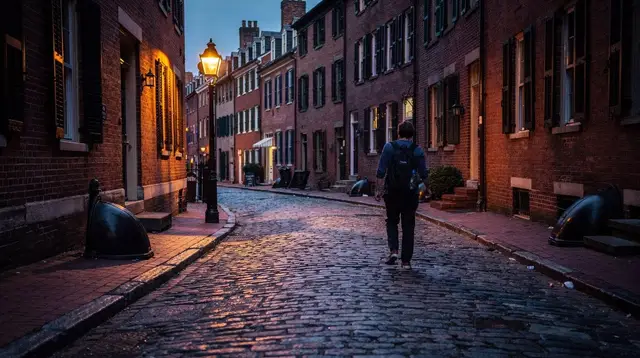
Salem ghost tours: what the evening walks actually cover
What do Salem ghost tours actually involve?
A guided evening walk, usually 60 to 90 minutes, through Salem's historic downtown, old burying grounds, and streets tied to the 1692 witch trials and the city's maritime past. Guides, often in period or dark costume, mix documented history with local legend, clearly framed as tradition rather than proven fact.
Salem sells ghost tours the way Boston sells duck boats: it is the local specialty, and there is a lot of it. Between the 1692 witch trials, a couple of centuries as a working port with its share of shipwrecks and disease, and a downtown full of colonial-era burying grounds, the raw material for ghost stories is genuinely there. What Salem’s tourism industry has done with that material is build one of the densest concentrations of evening ghost walks in New England. This guide covers how those tours generally work, what they cover, and when it makes sense to go, without pretending any of the haunting claims are proven fact.
If you want the documented history behind the legends, start with the Salem witch trials guide. This page is specifically about the after-dark tourism layer built on top of that history.
What a Salem ghost tour actually looks like
The format is fairly consistent across operators, even though this page does not name or compare any of them. A small group, usually capped somewhere between 15 and 30 people, meets at a set point in downtown Salem around dusk or after dark. A guide, often dressed in period clothing or all black, leads the group on foot for 60 to 90 minutes, stopping at six to ten locations to tell stories.
Typical stops include one or more of Salem’s old burying grounds, streets in the historic downtown core, buildings associated with 17th- and 18th-century Salem, and sometimes a private home or business with a local reputation for being haunted, viewed from the street rather than entered. Guides weave together three strands of material: documented history (trial records, ship logs, epidemic records), local folklore built up over generations, and, on some tours, a bit of theater aimed at making the walk feel more atmospheric after dark.
That mix is worth keeping straight in your head as you listen. A guide might tell you, accurately, that a particular street was where accused witches were held, and then tell you, as legend, that a specific ghost still walks it. Neither claim is presented on this page as fact; the first is documented history, the second is tradition, and a good guide will make that distinction clear rather than blur it for effect.
History versus legend: keeping the two apart
Salem’s ghost tourism draws on two very different sources, and it helps to know which is which before you book.
The documented history is real and heavily researched: the 1692 witch trials, in which 20 people were executed and many more accused, are covered in depth at the Salem Witch Museum and the Peabody Essex Museum, and in the National Park Service’s Salem Maritime National Historic Site. Salem’s decades as an international shipping port also left a real record of loss at sea, fires, and disease, all material that predates any ghost-tour marketing.
The haunting claims layered on top of that history are local legend and oral tradition, some of it decades old, some of it more recent tourism-era invention. No operator, and no guidebook, can verify a haunting. This page treats every specific ghost story mentioned or implied on a Salem tour as folklore, told because it is part of the city’s storytelling tradition, not because it has been established as fact. If a tour presents a claim as settled truth, that is marketing, not history.
Family-friendly versus more intense tours
Not every Salem ghost tour is built for the same audience, and the split matters if you are traveling with kids or, conversely, want something more unsettling.
Some tours are pitched as family-oriented: lighter on jump scares and gore, heavier on storytelling and local color, sometimes explicitly welcoming younger children. Others are built for an adult crowd, with more graphic historical detail (trial-era violence, execution methods, shipwreck deaths) and more deliberate use of darkness, pacing, and theatrical timing to unsettle the group. This page does not name or rank specific operators on that spectrum, but the difference is real enough that it is worth checking a tour’s own age guidance and description before you book, rather than assuming all Salem ghost walks are interchangeable.
If you are traveling with younger kids and want a gentler introduction to Salem’s history without the after-dark framing, the Salem Witch Museum and Peabody Essex guide is a daytime alternative that covers the same historical ground.
an evening walking tour through Salem’s historic streets built around local witch-era lore is one option if you want the classic downtown format described above.
October versus the rest of the year
Salem’s seasonality is one of the sharpest in New England tourism, and it applies directly to ghost tours. October is Haunted Happenings month: a citywide, month-long program of events, and the single busiest stretch of the year for anything ghost- or witch-related in Salem, peaking hard in the final days of the month and on Halloween night itself. Ghost tours run at maximum frequency in October, with extra time slots added, and they routinely sell out days or weeks ahead, especially for weekend evenings and the last week of the month. Do not treat October as a quiet time to casually show up and book same-day; it is the opposite.
Outside October, Salem is a genuinely different, calmer place. Ghost tours still run through most of the year, typically with fewer nightly departures, and same-day or next-day booking is far more realistic. Spring and early fall evenings tend to be pleasant for an outdoor walk; deep winter tours happen but expect cold, and check that your chosen tour actually operates on the date you want, since some scale back their schedule in January and February.
For general trip timing beyond ghost tours specifically, see the best time to visit Boston guide and, if fall colors are part of your plan, the New England fall foliage guide — note that foliage season (late September into late October) overlaps with the start of Salem’s busiest month, so a foliage-and-Salem combination trip should expect crowds on both fronts.
| When | Ghost tour availability | Booking window |
|---|---|---|
| October (all month) | Maximum frequency, extra slots | Book weeks ahead, especially weekends and late October |
| Halloween week / Oct 31 | Highest demand of the year | Book as early as possible |
| November to March | Reduced schedule, some tours pause | Days ahead is usually enough |
| April to September | Regular schedule | A few days ahead is usually enough |
Getting to Salem from Boston
The MBTA Commuter Rail is the straightforward way to reach Salem for an evening tour, running from North Station to Salem station in roughly 30 minutes. This is a separate ticketing system from the T — you buy a Commuter Rail ticket, not a CharlieCard fare — so budget a few extra minutes at North Station if it is your first time using it. See the full MBTA and the T guide for how the two systems relate.
For an evening tour specifically, check the return schedule before you commit to a start time. Commuter Rail service to Salem thins out later at night, and missing the last reasonable train back to Boston turns a two-hour outing into a much longer one. If you are staying overnight in Salem instead of day-tripping, this is less of a concern; see the Salem day trip guide for a fuller rundown of getting there, timing, and what else to fit in.
Driving is also an option, with paid parking downtown, but Salem’s narrow historic streets get congested on October weekends, when a large share of the town is trying to park at once.
a guided walk through Salem after dark covering the city’s ghost lore alongside its colonial history and a themed evening walking tour through Salem’s historic core are two further options that follow the same general downtown-walking format described above, if you want to compare a couple of routes before booking.
What to bring and what to expect
These are outdoor walking tours, on foot, on real sidewalks, often brick or cobblestone in Salem’s older sections, and after dark. Comfortable, closed shoes matter more than any costume choice. A light jacket is worth carrying even in warmer months, since Salem evenings by the water cool off faster than the daytime temperature suggests, and definitely worth it for a fall or winter tour.
Expect a walking pace with stops, not a seated performance: groups move between locations, gather to hear a story, then move on. Most tours run regardless of light rain, though heavier weather can lead to cancellation or rescheduling, so check the specific tour’s weather policy rather than assuming.
This page deliberately does not quote prices, since ghost tour pricing varies by operator, season, and group size, and changes over time. Check the current rate and exact meeting point directly through the booking link for your chosen tour before you go.
Salem’s ghost tours in context
It is worth remembering what Salem’s ghost tour industry is layered on top of: a documented, genuinely grim historical event. Twenty people were executed in 1692 on charges of witchcraft that had no basis in fact, in a town that later spent well over a century treating the episode as a source of shame before eventually turning it into its main tourism identity. That history, on its own, is covered without the ghost-story framing at the Salem witch trials guide, and Salem’s other side, working port and museum town, is covered in the Salem Witch Museum and Peabody Essex guide and the Salem day trip guide.
None of that is a reason to skip the ghost tours if that is what you are after; it is simply worth knowing that the evening walk sits on top of real, documented tragedy, and that the tours themselves are best understood as a long-running local storytelling tradition rather than an investigation.
If you are staying in Boston and do not have time for a Salem trip, the city has its own, smaller equivalent: see the Boston ghost tours guide for evening walks around Beacon Hill and downtown, plus the Beacon Hill haunted walk and the haunted pub crawl in Boston for in-town alternatives that need no Commuter Rail ticket at all.
For a broader sense of what October in Salem is actually like beyond the tours themselves, the blog piece on Salem in October: carnival or courtroom is a more candid, opinionated take on the month’s crowds and commercialization.
a self-paced audio-guided ghost tour of Salem available in multiple languages is worth considering if you would rather walk the route on your own schedule than join a fixed-departure group.
Planning it into a wider trip
A Salem ghost tour is usually an evening add-on rather than the whole reason for the trip, and it pairs naturally with a full day in Salem beforehand: the witch trial sites, the waterfront, and a museum visit or two, followed by an evening tour once it gets dark. The Salem and North Shore day trip itinerary lays out that kind of full-day structure, and the things to do in Salem hub and the ghost and haunted tours category are useful for browsing further options across the North Shore, including nearby Cape Ann towns that get grouped with Salem editorially on this site.
If Boston is your home base for the trip, see Boston’s own destination page for how a Salem evening fits into a wider Massachusetts itinerary, and the Commuter Rail day trips guide for how Salem compares to other train-accessible towns like Plymouth and Concord.
Frequently asked questions about Salem ghost tours
Are Salem ghost tours based on real history?
They combine documented events, mainly the 1692 witch trials and Salem’s shipping era, with local ghost lore passed down over generations. Good guides separate the two clearly; the haunting claims themselves are tradition, not verified fact.
Is a Salem ghost tour suitable for kids?
Some are. Several operators run a gentler, family-oriented version with less jump-scare material, while others are pitched squarely at adults with more intense storytelling. Check the specific tour’s age guidance before booking, since this varies by operator and this page does not compare them directly.
When is the best time to do a ghost tour in Salem?
Outside October, when the schedule is quieter and easier to book close to your date. October is Salem’s Haunted Happenings month, with ghost tours running at high volume and often selling out, so book well ahead if that is when you are visiting.
Do ghost tours in Salem go inside haunted buildings?
Most are outdoor walking tours past cemeteries, historic homes, and streets associated with local haunting legends, rather than indoor visits. Some tours pause outside buildings said to be haunted and tell their story without claiming public access inside.
How do I get to Salem for an evening tour from Boston?
The MBTA Commuter Rail runs from North Station to Salem in about 30 minutes. For an evening tour, check the return schedule before you go, since Commuter Rail service thins out later at night.
Are the ghosts and hauntings in Salem tours real?
No tour operator can prove a haunting, and this page does not present any of it as fact. Treat the stories as local legend and folklore, told as part of Salem’s tourism tradition, alongside real historical events like the witch trials.
How long does a Salem ghost tour take and how much walking is involved?
Most run 60 to 90 minutes at a walking pace through downtown Salem, covering roughly a mile or so depending on the route. Comfortable shoes matter more than costume, since much of it is on uneven brick sidewalks after dark.
Ghost and haunted history tours of Boston on GetYourGuide
Verified deep-linked GetYourGuide tours. Book through these links and we earn a small commission at no cost to you.
GetYourGuide does not provide a product photo for this activity — the image shows the meeting point, photographed by us.