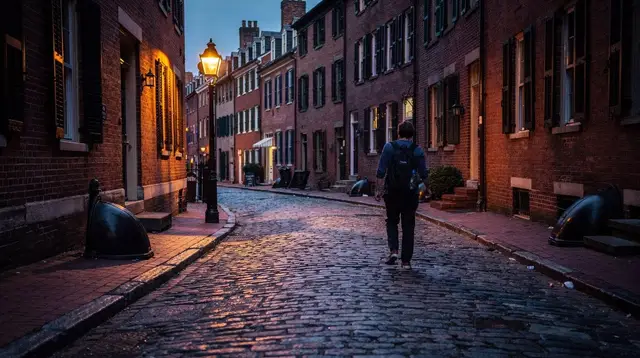
Acorn Street and Beacon Hill: a photographer's guide
Why is Acorn Street in Beacon Hill so popular for photos?
Acorn Street is a narrow cobblestone lane lined with early-19th-century brick rowhouses and gas lamps, often cited as one of the most photographed streets in Boston. It sits in a quiet residential pocket of Beacon Hill, a short walk from Boston Common, and it costs nothing to visit; the only real constraint is that people live there, so quiet, unobtrusive visits work best.
A cobblestone lane that outworks its size
Acorn Street runs for about 200 feet between Willow Street and West Cedar Street, on the flat side of Beacon Hill, one block up from Charles Street. It’s paved in cobblestones rather than asphalt, narrow enough that a single car fills the width, and lined on both sides by brick rowhouses built in the early 1800s, most of them with black shutters, wrought-iron railings, and gas lamps that are still lit rather than decorative relics. It’s routinely described as one of the most photographed streets in Boston, and on a weekday morning it’s easy to see why: the light runs down the brick in a straight line, the cobblestones catch reflections after rain, and there’s very little in the frame that dates the scene to a particular decade.
None of that makes it a landmark with an entrance or a ticket. It’s a residential street in a residential neighborhood, and the houses on either side are private homes, not museum facades. That distinction matters for how to plan a visit, more than any specific rule does.
Where it sits inside Beacon Hill
Beacon Hill is the compact, hilly neighborhood immediately north of Boston Common, built up through the 19th century on land that once rose more sharply before its peak was cut down and used as landfill elsewhere in the city. It’s almost entirely residential today, a grid of narrow streets, brick sidewalks, and gas lamps that the city has kept in working order rather than replacing with modern fixtures. Acorn Street sits in the flatter western section, sometimes called the “flat of the hill,” which was originally built for merchants and tradespeople, as distinct from the grander townhouses higher up the slope near the State House.
The neighborhood has no single entrance or exit; it’s simply the streets between Boston Common, the Charles River Esplanade, and Cambridge Street. Acorn Street is roughly in the middle of it, a short detour from Charles Street’s shops and cafés rather than a destination that requires a special trip on its own.
Getting there on foot or by the T
The most direct approach is on foot from Boston Common, which borders Beacon Hill on its southern edge. From the Common, it’s a walk of roughly 10 to 15 minutes uphill and across, depending on where you start and how many turns you take through the grid of side streets — there’s no single marked route, and part of the appeal of Beacon Hill is wandering its blocks rather than following a straight line.
By the T, the closest stations are Park Street, served by the Red and Green Lines, and Charles/MGH, on the Red Line, both a short walk from the neighborhood’s edge. Neither station sits inside Beacon Hill itself; both require five to ten minutes on foot through streets that are part of the same walk worth taking slowly. There’s no parking on Acorn Street, and Beacon Hill’s narrow, largely one-way streets make arriving by car impractical for what amounts to a short stop.
What makes the street photograph well
A few features repeat in most photos taken here, and they’re worth knowing before arriving, since they shape how to frame a shot rather than leaving it to chance:
- The cobblestones themselves, uneven and rounded, catch low-angle light differently than flat pavement, especially after rain, when they hold a reflective sheen.
- The brick facades run in a continuous line on both sides, with almost no gaps for driveways or modern infill, which keeps the frame visually consistent from one end of the street to the other.
- The gas lamps, mounted on brackets close to several front doors, are functioning fixtures maintained by the city, not props; they’re lit in the evening and off during the day, which matters if a shot depends on them glowing.
- The narrowness of the street compresses a shot quickly: a wide-angle lens captures more of the brick on both sides, while a longer lens flattens the cobblestones and railings into a tighter, more graphic composition.
None of this requires special access. A phone camera captures the same lines and textures as a dedicated camera; the difference is mostly in patience for the right light and the right gap in foot traffic, not equipment.
It’s a residential street — what that means in practice
Acorn Street is lived on, not staged. The houses are private homes with residents who use the sidewalk and the street daily, park cars where the width allows, and open their front doors onto the same cobblestones that show up in photos. That’s a practical fact to plan around, not a moral lecture: a few habits keep a visit workable for everyone.
- Keep gear light. A camera, a phone, or a compact tripod for a few minutes is easy to work around; lighting stands, reflectors, or multi-person crews are not, given the street is barely wide enough for a car to pass.
- Move when a resident or a vehicle needs the space. The street has no separate walkway; stepping to one side for a few seconds costs little and avoids blocking a doorway or a parking maneuver.
- Stay off private steps, stoops, and gardens. The cobblestones and the public sidewalk are the shared space; the stairs leading to front doors are not, even for a better angle.
- Skip amplified sound and large group shoots. A quiet visit of a few minutes draws no attention; a speaker, a styled group, or a long setup does, on a street where sound carries between close-set brick walls.
- Expect it to be brief. There isn’t much length to the street, and a five- to ten-minute visit is typically enough to work through a few angles before moving on to the rest of the neighborhood.
None of this is enforced by a posted sign or a fee; it’s simply what makes a visit to somebody’s street sustainable for the people who live on it, visit after visit, year after year.
For a longer, guided pass through these habits along with the neighborhood’s history, a small-group or private walking tour of Beacon Hill covers Acorn Street alongside the streets around it, with a guide who times the stop for quieter moments.
Beyond Acorn Street: Louisburg Square and Chestnut Street
Acorn Street is well known, but it isn’t the only photogenic corner of Beacon Hill, and treating it as the single required stop overstates its case. Louisburg Square, a few streets over, is a private, gated park ringed by some of the neighborhood’s grandest townhouses — the square itself is fenced and reserved for residents, but the street around it, with its matched brick facades and iron fences, photographs just as well as Acorn Street, often with fewer people stopping to shoot it. Chestnut Street, running roughly parallel to Acorn Street a few blocks north, is longer and wider, lined with well-preserved Federal-style rowhouses and window boxes that change with the season, and it’s a street that rewards a slower walk rather than a single stop.
Treating these three streets as a short loop, rather than a single destination, spreads the same visit across more of the neighborhood and reduces how long any one street needs to hold a crowd of photographers at once. A guided photography walk with edited images afterward is one way to plan that route in Cambridge; inside Beacon Hill itself, a guided photography walk that includes edited images afterward covers Acorn Street, Louisburg Square, and Chestnut Street in a single outing timed for good light.
Fitting it into a longer day in Beacon Hill
Acorn Street sits close enough to Boston Common and the start of the Freedom Trail that a photo stop here fits easily into a longer walk rather than requiring a dedicated trip. The trail itself doesn’t run through Acorn Street, but Beacon Hill borders its northern stretch, and a short detour off the marked route covers both in the same outing; for a sense of how much ground that adds, see the comparison of walking the Freedom Trail against riding a trolley, since a walking pace is what makes a detour like this practical.
Beacon Hill also holds the Black Heritage Trail, a separate marked route through the neighborhood’s 19th-century Black community and abolitionist history, with several stops within a few minutes of Acorn Street. Pairing the two — a short photo stop and a walk through that history — makes better use of a single visit than treating Acorn Street as an isolated errand. For a guide who covers both threads together, a guided walk built around Beacon Hill’s most photographed corners works the neighborhood’s history into the same route as its cobblestones and brick.
For a broader sense of where else in the city rewards a similar stop, the citywide guide to photogenic spots covers Acorn Street alongside other neighborhoods, and the Beacon Hill neighborhood guide fills in the shops, cafés, and other stops worth combining with a short photo walk. The Public Garden and Emerald Necklace guide is a reasonable next stop for green space and water views a short walk south, and the Beacon Hill walking tour built around Acorn Street lays out a self-guided route for anyone who’d rather skip a booked tour and walk it independently. The Beacon Hill activities page and the site’s photoshoots category both list further options for combining a photo stop with the rest of a Beacon Hill visit.
Beacon Hill and Acorn Street: a photographer’s FAQ
Is it free to photograph Acorn Street?
Yes. It is a public street with no entry fee and no permit required for casual, handheld photography. Commercial shoots with crews, lighting rigs, or vehicles may need a City of Boston film permit; check with the Mayor’s Office of Film and Entertainment before bringing equipment beyond a camera and a tripod.
What time of day is best for photos on Acorn Street?
Early morning tends to have fewer people on the cobblestones and softer light along the brick facades, since the street runs roughly east-west between taller rowhouses that shade it for parts of the day. There’s no posted opening or closing time; it’s a public street at all hours, though early and respectful visits are the most practical.
Can I bring a tripod or reflector to Acorn Street?
A tripod for a few minutes is generally tolerated on a quiet morning, but the street is barely wide enough for a car, let alone a stand, reflector, or lighting kit, and residents’ front steps are a few feet from the cobblestones. Keep gear to what you can carry and clear quickly if a resident needs to pass or a car needs the lane.
Do I need permission to photograph the houses on Acorn Street?
Photographing building exteriors from the public street is legal and doesn’t require permission. What isn’t appropriate is stepping onto private stoops, gardens, or windowsills for a better angle, or photographing directly into windows; the sidewalk and the cobblestones are the only shared space.
Is Acorn Street the only good photo spot in Beacon Hill?
No. Louisburg Square and Chestnut Street cover similar ground with less foot traffic, and much of Beacon Hill’s grid of brick rowhouses, black iron railings, and gas lamps photographs well without singling out one street; Acorn Street is simply the best known of several comparable blocks.
How do I get to Acorn Street without a car?
Walk from Boston Common, about 10 to 15 minutes depending on your starting point, or take the T to Park Street (Red or Green Line) or Charles/MGH (Red Line) and walk in from there. Acorn Street doesn’t have parking, and Beacon Hill’s narrow one-way streets make driving in for a quick photo impractical.
Professional photoshoots in Boston on GetYourGuide
Verified deep-linked GetYourGuide tours. Book through these links and we earn a small commission at no cost to you.
GetYourGuide does not provide a product photo for this activity — the image shows the meeting point, photographed by us.