Harvard Yard photoshoot guide: brick, ivy and the John Harvard statue
Is Harvard Yard a good spot for portrait or graduation photos?
Yes. The Yard's brick colonial and Georgian buildings, mature trees and the John Harvard statue give a reliable academic backdrop, and it's a five-minute walk from the Red Line's Harvard station. It's still a working campus, though, so plan around the academic calendar rather than expecting an empty courtyard.
Why photographers head to Harvard Yard
Harvard Yard is the oldest part of Harvard University’s campus in Cambridge, a separate city across the Charles River from Boston. The Yard is a roughly rectangular green space enclosed by brick buildings dating from the 18th and 19th centuries — Massachusetts Hall, from 1720, is the oldest surviving building on campus — with gravel paths, mature elms and a general sense of enclosure that keeps the surrounding city out of frame. That combination of old brick, ivy and open lawn is why it shows up so often in graduation portraits, engagement sessions and family photos, whether or not anyone in the photo actually has a connection to Harvard.
The centerpiece for most visitors is the John Harvard statue, seated in front of University Hall. It’s worth knowing before you shoot there that the statue isn’t really a portrait of John Harvard: no image of him survived from his lifetime, so when the statue was made in 1884, the sculptor used a contemporary Harvard student as the model instead. Tour guides sometimes call it the “Statue of Three Lies” for this and two other inaccuracies in its inscription. None of that changes how it photographs — it’s still the single most reliably crowded and most reliably photographed spot in the Yard, so budget a few extra minutes if you want a clean shot without strangers in the background.
Beyond the statue, the Yard itself gives useful variety: the wide lawn in “Old Yard” near the John Harvard statue, the tighter, more formal “New Yard” around Widener Library and Memorial Church, and the brick walkways connecting them. None of it requires a permit for casual, non-commercial photography, and none of it requires you to be a student or affiliated with the university to walk through.
Getting there without a car
Cambridge is not a neighborhood of Boston — it’s its own city, on the opposite bank of the Charles River — but it’s one of the easiest side trips on this site precisely because of how directly the MBTA connects the two. The Red Line runs straight from central Boston stops like Park Street, Downtown Crossing and South Station to Harvard station, with no transfer required. From Harvard station’s main exit, it’s a five-minute walk through Harvard Square to the Yard’s gates. For getting oriented on the T more broadly, see the MBTA guide and the wider notes on getting around Boston without a car.
If you’re bringing photo gear — reflectors, a second body, a tripod — the walk from the station is flat and short enough that a car adds more hassle than it saves, between Cambridge’s metered street parking and the fact that most of what you’d photograph is pedestrian-only anyway. Some photographers extend the trip by bike instead, riding over from Boston along the river; the Cambridge electric bike tour guide covers that route if you’d rather arrive that way than by train.
It’s a campus first, a backdrop second
The most important thing to plan around isn’t lighting or gear — it’s the fact that Harvard Yard is a working academic campus, not a museum or a park maintained for visitors. Students live in the Yard’s freshman dormitories, walk through it between classes, and use its buildings for lectures and exams. That has two practical effects for anyone planning a shoot.
First, foot traffic varies sharply with the academic calendar. During term time on a weekday, expect a steady flow of students crossing the paths, particularly around the hour marks when classes change. Early mornings, evenings and weekends thin that out considerably. Second, two periods bring genuinely heavy crowds and, at times, restricted access: move-in week in late August or early September, when new students and their families fill the Yard with belongings and emotion, and Commencement in late May, when the Yard is set up for ceremony seating and sections can be closed off entirely. If your date is flexible, avoid both.
Interior access is the other thing to be realistic about. The Yard’s buildings — libraries, halls, dormitories — are not open to visiting photographers as a matter of course, and you shouldn’t plan a shoot around getting inside Widener Library or a lecture hall without something specific arranged in advance. Treat the Yard as an outdoor location and build your shot list around its courtyards, gates and the statue rather than any interior.
For a larger production — a full engagement shoot with lighting stands, an assistant and a set schedule — it’s worth checking current university guidance on photography before you go, since rules for organized or commercial shoots can be stricter than for someone walking through with a camera. A casual portrait session with a couple of people and a handheld camera has never needed a permit in practice, but policies are set by Harvard and can shift, so confirm rather than assume if your setup looks more like a production than a visit.
Harvard Square as the second half of the shoot
Harvard Square sits directly outside the Yard’s main gates, and most photographers treat the two as a single outing rather than separate trips. Where the Yard gives brick, ivy and quiet green space, the Square gives street life: newsstands, bookstores, cafés with outdoor seating, brick sidewalks and the general texture of a college town center. It’s a natural second location if you want a set of images that isn’t uniformly academic — a couple sitting on the Square’s steps, a family walking past a bookshop window, that kind of thing.
The Harvard Square neighborhood guide has more on what’s around the Square itself, and the wider things to do in Cambridge page rounds up museums, food and other stops if you’re building a full day around the visit rather than just a photo session. If you want to fold in the university’s museums for indoor backdrops without needing special access, the Harvard museums guide and, on the MIT side of Cambridge, the MIT Museum guide cover what’s open to the public and roughly what to expect.
Making sense of Harvard and MIT while you’re there
Photographers sometimes come to Harvard Yard as part of a longer look at Cambridge’s two universities, and it’s worth being clear that Harvard and MIT are separate institutions with distinct campuses about a mile apart, connected by the Red Line (Harvard and Kendall/MIT stations) or a walk along the river. If you want context on the campus itself — history, layout, what the buildings actually are — a guided option beats wandering with a guidebook.
A guided walk covering both Harvard and MIT is a straightforward way to get oriented before or after your own photo session, especially if this is a first visit and you’d rather not guess which gate leads where. For a more personal, campus-life angle, a Harvard campus tour led by a current student tends to surface details — which dorms house first-years, where the crowded lecture halls are — that a general guide wouldn’t know. The Harvard Yard student-guided tour has more detail on how that format works, including for smaller groups who want a more private pace than a large walking tour allows.
If your day includes both universities and you’d rather not manage logistics between them, a private city tour covering Boston and Cambridge together lets you set the schedule and route, which can be useful if photography is the actual priority and a tour is just the framework around it. For a lower-key, self-paced way to see more of Cambridge between photo stops, a guided bike tour through Cambridge from Boston covers more ground than walking without the overhead of a car.
Planning the shoot itself
A few practical notes that don’t fit neatly elsewhere:
- Best light: early morning or late afternoon, when the sun angles through the Yard’s trees rather than sitting directly overhead. Midday shooting works but tends to look flatter and coincides with the busiest foot traffic.
- Best days: weekends and academic breaks (winter break, spring break, summer outside of orientation programs) are calmer than weekday term time. Avoid move-in week and Commencement entirely unless the ceremony itself is the point of the shoot.
- Weather: New England’s shoulder seasons — a clear day in fall before the leaves are gone, or a mild stretch in spring — tend to photograph best, with the Yard’s trees adding color without the summer’s heavier tourist and conference traffic on campus more broadly.
- What to bring: nothing beyond ordinary photo gear for a small, casual session. For anything larger — a full crew, lighting stands, a planned block of time — check current Harvard guidance on photography access before committing to a schedule.
- Realistic expectations: you’re shooting an active campus, not a set. Some paths will have students in the background, some buildings will be closed to you, and the John Harvard statue will very likely have other people around it. Plan your shot list with that in mind rather than expecting an empty Yard.
Building it into a longer day
Harvard Yard rarely takes more than an hour or two on its own, so most visitors fold it into a longer look at Cambridge. The Cambridge campuses in one day itinerary sketches out a route covering both Harvard and MIT if you want a fuller day rather than a quick in-and-out for photos. And if you’re curious how Harvard Square has changed as a place — independent bookstores closing, the square’s character shifting — the blog piece on Harvard Square after the bookstores closed is a useful bit of context before or after your visit.
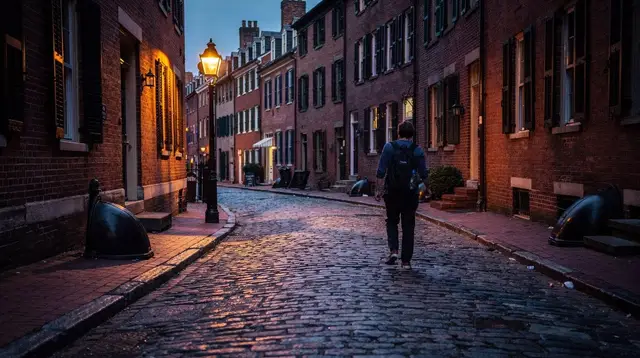
For photo locations elsewhere in Boston proper, the Boston photoshoot locations guide rounds up spots like Acorn Street on Beacon Hill — see the Acorn Street photoshoot guide for that one specifically — if you’re comparing Cambridge’s academic look against Boston’s brick-and-gaslamp streets. The things to do: photoshoots category page collects the rest of the site’s photo-focused guides in one place, and Harvard Yard’s own destination page links back to broader Boston planning if photography is only part of your trip.
Harvard Yard photoshoot logistics at a glance
| Question | Short answer |
|---|---|
| How do you get there | MBTA Red Line to Harvard station, then a five-minute walk |
| Do you need a car | No |
| Is a permit required | Not for casual, non-commercial photography in the open Yard; check current university guidance for larger productions |
| Can you go inside buildings | Not guaranteed — treat the Yard as outdoor-only |
| Quietest times | Early morning, evenings, weekends, academic breaks |
| Busiest times | Weekday term-time midday; move-in week; Commencement in late May |
| Nearby extension | Harvard Square, immediately outside the Yard’s gates |
Harvard Yard and Cambridge photoshoot FAQ
Do I need a permit to take photos in Harvard Yard?
Casual photography with a phone or personal camera is generally tolerated in the open parts of the Yard. Larger productions with tripods, lighting rigs, reflectors or a crew should check current Harvard University guidance before showing up, since rules for commercial or organized shoots can differ from casual visits and can change.
Can I go inside Harvard’s buildings for photos?
Don’t count on it. Harvard Yard’s buildings are active academic and residential spaces, and interior access is not guaranteed to visitors at any time of year. Treat the Yard as an outdoor backdrop and plan indoor shots elsewhere, unless you’ve arranged something specific in advance.
What’s the best time of day for light in Harvard Yard?
Early morning and late afternoon give softer, angled light through the trees and fewer people crossing between the gates. Midday sun tends to be flat and the paths busier with students moving between classes, especially on weekdays during term.
When is Harvard Yard most crowded?
Move-in week in late August or early September, and Commencement in late May, bring the heaviest foot traffic and the tightest access, since ceremonies and family gatherings can close off sections of the Yard entirely. Regular term-time weekdays are calmer, and weekends and academic breaks are calmer still.
How do I get to Harvard Yard from downtown Boston?
Take the MBTA Red Line to Harvard station. It’s a direct ride with no transfer from central stops like Park Street or Downtown Crossing, and the Yard’s main gates are a short walk from the station exit. No car is needed.
Is the John Harvard statue actually a portrait of John Harvard?
No — it’s a well-known case of mistaken identity. The 1884 statue was sculpted long after John Harvard’s death with no surviving likeness to work from, so the sculptor used a Harvard student as a model instead. It’s still the single most photographed spot in the Yard.
Should I combine Harvard Yard with Harvard Square for a photoshoot?
It’s a natural pairing. The Yard gives an academic, brick-and-ivy backdrop, while Harvard Square immediately outside the gates adds street life, bookstores and cafés for a more urban set of images, all within a few minutes’ walk.
Professional photoshoots in Boston on GetYourGuide
Verified deep-linked GetYourGuide tours. Book through these links and we earn a small commission at no cost to you.
GetYourGuide does not provide a product photo for this activity — the image shows the meeting point, photographed by us.