Boston ghost tours: downtown legends after dark
What is a Boston ghost tour actually like?
It's an evening walking tour through downtown Boston and Beacon Hill, mixing real colonial history (fires, epidemics, public executions) with local ghost legends passed down by guides. It has nothing to do with Salem's witch trials, which are a separate topic and a separate destination.
What a downtown Boston ghost tour actually covers
Boston runs its own ghost tour circuit, separate from anything in Salem. Where Salem’s tours are built around a single, well-documented historical event, the 1692 witch trials, Boston’s downtown tours draw on a broader mix: old cemeteries, narrow colonial-era streets, and centuries of fires, epidemics, and public executions that really happened in this part of the city. Guides weave that documented history together with ghost stories that have circulated locally for generations, sometimes for over a century.
The distinction matters because the two get lumped together constantly by visitors planning a trip. If you’re picturing courtroom drama and accused witches, that’s Salem, reachable from Boston by Commuter Rail in about half an hour. If you’re picturing dark, cobblestone lanes in Beacon Hill and guides pointing out gravestones by lantern light, that’s downtown Boston, and it’s what this page covers.
Most operators route their tours through the same general area: the edge of Boston Common, the Granary Burying Ground, and the tight, gas-lit streets of Beacon Hill. All three sit within a few blocks of each other, which is part of why the format works as an evening walk rather than a bus tour.
History first, legend second
The colonial and early republic history behind these tours is real, and it’s worth separating from the ghost stories built on top of it. Boston in the 17th and 18th centuries dealt with recurring fires that leveled entire blocks, disease outbreaks including smallpox epidemics that killed a meaningful share of the population in bad years, and public executions carried out downtown as a matter of routine colonial justice. None of that is folklore. It shows up in city records, church registries, and the gravestones themselves.
What guides add on top, ghostly figures tied to specific addresses, sounds attributed to specific deaths, sightings reported by specific residents, is local tradition passed down over decades, not verified history. A good operator will usually flag which is which as they go, but as a visitor it’s worth doing that filtering yourself too: real event first, legend layered on after. None of it should be taken as established fact, and no reputable tour will claim otherwise.
This is also why these tours don’t duplicate what you’d get walking the Freedom Trail during the day. The Freedom Trail is a self-guided, daytime route connecting 16 historic sites with a documented Revolutionary War narrative. A ghost tour covers some of the same physical ground after dark, but the framing is completely different: it’s about atmosphere and local legend, not the sequence of events that led to American independence.
The Granary Burying Ground, seen differently at night
The Granary Burying Ground comes up on the Freedom Trail for a straightforward reason: it’s the resting place of Paul Revere, Samuel Adams, and several other Revolutionary-era figures, and it’s one of the oldest cemeteries in the city, dating to 1660. During the day, that’s the whole story: a historic cemetery with well-known residents.
On an evening ghost tour, the same cemetery gets a different treatment. Guides typically stop at the gates, since the burying ground closes at dusk and tours generally don’t enter after hours, and use it as a jumping-off point for stories about the site’s age, its density of burials, and the local traditions that have grown up around a cemetery this old sitting in the middle of a modern downtown. It’s the same physical location covered on this site’s Freedom Trail content, but the angle here is tradition and hauntings, not the biographies of who’s buried there. If you want the historical detail on the cemetery itself, that’s covered separately in the Granary Burying Ground guide; this page focuses on what a ghost tour does with the same setting after dark.
Beacon Hill: narrow lanes built for this format
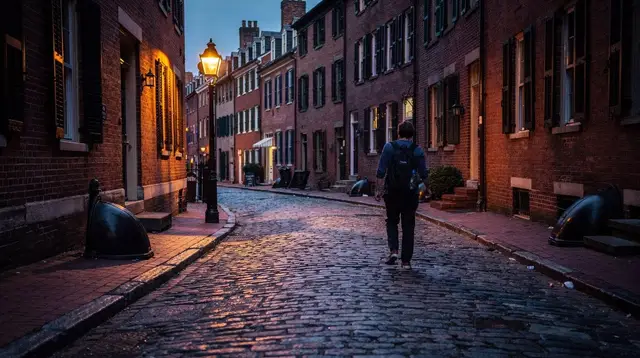
If one neighborhood defines the visual identity of Boston’s ghost tour circuit, it’s Beacon Hill. The brick rowhouses, gas lamps, and narrow lanes like Acorn Street weren’t built with tourism in mind, but they happen to be close to ideal for an evening walking tour: quiet, dimly lit, and genuinely old, with construction dating largely to the early 19th century.
Guides use Beacon Hill for stories tied to specific townhouses, alleys, and the neighborhood’s history as a residential enclave for Boston’s elite going back two centuries. As with the cemetery stops, the built environment is real and documented; the specific hauntings attached to specific addresses are oral tradition, not verified record. Beacon Hill’s role on these tours is covered in more depth in a dedicated Beacon Hill haunted walk guide, which focuses specifically on that neighborhood rather than the full downtown route.
Beacon Hill also shows up on this site in a non-ghost context, as a historic neighborhood in its own right and via the Acorn Street walking tour for daytime photography. Worth knowing if you’re deciding whether to see the neighborhood once, at night, or twice, at different hours.
What the format actually looks like
Boston’s downtown ghost tours are walking tours, almost without exception. You meet a guide at a set point downtown, generally near Boston Common or the edge of Beacon Hill, and walk a fixed route for the length of the tour, stopping periodically for stories tied to specific buildings, corners, or cemetery gates.
Duration varies by operator, but plan on somewhere between roughly 75 minutes and two hours. Always confirm the exact length, meeting point, and any weather policy directly with the operator before booking, since these details change and this site doesn’t track live schedules.
One operator runs a route built specifically around old burying grounds and colonial-era sites, useful if the historical framing matters more to you than pure scare factor:
an underground-themed evening walk through downtown cemeteries and colonial sitesAnother sticks closer to a traditional storytelling format, following guides through the same general downtown corridor with a focus on local legend:
a guided evening walk through downtown Boston’s ghost loreA third runs later in the evening, marketed as a nightwalk through gravestones and downtown streets for visitors who want a later start time:
a late-evening walking tour past downtown gravestones and historic streetsNone of these are ranked against each other here, and none is presented as objectively better. Formats, routes, and intensity differ enough that the right pick depends on what you want out of the evening, family-friendly storytelling versus a more intense adults-only format, a shorter walk versus a longer one.
Family formats versus adult formats
Operators generally split their offerings into two tiers, though the exact naming varies. Family or all-ages versions tend to lean on atmosphere and lighter storytelling, appropriate for children who can handle a dark walk and some spooky buildup without graphic content. Adults-only versions go further into the darker material, the executions, the disease deaths, the more unsettling legends, and are pitched at visitors who want a more intense evening.
This page doesn’t compare specific operators against each other, since offerings and quality shift over time. What’s worth doing before you book any tour is checking the age guidance and content description the operator publishes, rather than assuming a “ghost tour” automatically means one format or the other.
If you’d rather do this during the day
Not everyone wants an evening commitment, especially with kids or an early flight the next morning. Boston’s daytime walking tour options cover a lot of the same downtown ground, minus the ghost framing, and can be a reasonable substitute if the schedule doesn’t work for an evening tour:
a daytime walking tour through downtown Boston’s historic coreThat’s a straightforward historical walk, not a ghost tour, but it covers overlapping streets in Beacon Hill and downtown if you want the neighborhoods without the after-dark framing.
Boston versus Salem: picking between the two
This is the comparison most visitors are actually trying to make when they search for “Boston ghost tours,” so it’s worth being direct about it. Boston’s downtown tours are built around local legend layered onto real but general colonial history: fires, epidemics, executions, old cemeteries. There’s no single defining event, no museum built around one incident, and no courtroom record to point to. It’s atmosphere and oral tradition.
Salem’s witch trials tours are the opposite: a single, extensively documented historical event from 1692, with museums, historical societies, and primary-source records built around it. If historical depth and a specific, verifiable narrative matter more to you than atmosphere, Salem is the stronger choice, and it works well as a full or half-day trip from Boston via Commuter Rail. If what you want is an evening walk through Boston’s own old streets with some local legend mixed in, stay downtown.
Plenty of visitors do both, on different days, which avoids having to choose. A downtown Boston evening tour pairs naturally with daytime sightseeing in the same neighborhoods, Beacon Hill, the Freedom Trail, and the North End, while a Salem day trip works better as its own dedicated outing given the train time each way.
Practical notes before you book
A few things worth knowing regardless of which operator or format you choose. Downtown Boston’s sidewalks are old and uneven in places, particularly around Beacon Hill’s cobblestone lanes, so comfortable walking shoes matter more than they might for a typical city stroll. Evenings in Boston get cool for a good part of the year, especially once the sun is down, so check the forecast and dress for it rather than assuming daytime temperatures will hold.
Most tours run regardless of light rain, but heavier weather can lead to cancellations or rescheduling, handled directly by the operator. Meeting points are usually outdoor, public locations near Boston Common or the edge of Beacon Hill; confirm the exact spot with your booking confirmation rather than guessing from a general neighborhood name.
Finally, don’t expect graves to be opened, or any physical “proof” offered at any point. These are storytelling tours built on local tradition and documented history, not paranormal investigations. If that’s the expectation going in, the format works well as an atmospheric evening in one of Boston’s oldest neighborhoods.
Ghost tours in Boston, common questions
Are Boston ghost tours the same as the Salem witch trials tours?
No. Boston’s ghost tours focus on colonial-era urban legend around downtown cemeteries and Beacon Hill lanes. Salem’s tours center on the 1692 witch trials, a documented historical event with its own museums and sites. The two topics get confused often, but they’re geographically and thematically separate.
Is any of this historically proven?
The underlying events guides reference, fires, disease outbreaks, public hangings, are often real and documented. The ghost stories layered on top are local tradition, passed down through generations of guides and residents, not verified historical fact. Treat them as folklore, not history.
How long does a downtown ghost tour last?
Duration varies by operator and format, typically somewhere between 75 minutes and two hours for a walking tour. Always confirm the exact length and meeting point with the operator before booking, since itineraries change.
Are these tours suitable for kids?
Some operators run lighter, family-oriented versions with less graphic content, while others run adults-only formats with more intense storytelling. Check the specific tour’s age guidance before booking rather than assuming either way.
Which neighborhoods do these tours cover?
Most downtown ghost tours stay within walking distance of the Freedom Trail corridor and Beacon Hill, often passing the Granary Burying Ground, narrow Beacon Hill lanes, and other colonial-era buildings. Routes vary by operator.
Should I do a Boston ghost tour or a Salem day trip instead?
If you want ghost stories layered onto Boston’s own colonial history, a downtown evening tour fits. If you want a day trip built around a specific, well-documented historical event with dedicated museums, Salem’s witch trials sites are the stronger choice. Many visitors do both on separate days.
Do these tours go inside any buildings or cemeteries?
Format depends on the operator. Some tours stop at the gates of historic burying grounds without entering, since several downtown cemeteries close at dusk; others may include indoor stops. Confirm the route with the operator rather than assuming access.
Ghost and haunted history tours of Boston on GetYourGuide
Verified deep-linked GetYourGuide tours. Book through these links and we earn a small commission at no cost to you.
GetYourGuide does not provide a product photo for this activity — the image shows the meeting point, photographed by us.