Two days in Boston: a car-free highlights itinerary
Two days is not enough to see Boston. It is enough to walk its historic core, eat well in its oldest immigrant neighborhood, and get a sense of the brownstone city on the other side of the Common — without ever needing a car. This plan sticks to downtown Boston: the Freedom Trail’s first half, the North End, and Back Bay. It skips Cambridge, the islands, and the day trips entirely; those need their own time and are covered in three days in Boston and beyond.
Before you start: what this plan includes and skips
The Freedom Trail is a roughly 4 km (2.5-mile) walking route connecting 16 sites from Boston Common to Bunker Hill in Charlestown — not a single place, but a route you follow. Following the painted red line is free the whole way; some of the 16 sites along it charge their own admission. This itinerary covers only the first half, from the Common to Faneuil Hall. Bunker Hill and the Charlestown Navy Yard, including the USS Constitution, sit across the water and don’t fit into two days without cutting something else. Treat them as a reason to come back, or add a half-day if a third day opens up.
Opening hours and ticket prices for museums and historic sites change with the season and aren’t listed here — check with the site itself or Boston’s visitor information before you go.
Day 1: The Freedom Trail’s first half and the North End
Morning (8am–12pm): Boston Common to Faneuil Hall
Start at Boston Common, the country’s oldest public park and free to enter any day of the year. Pick up the Freedom Trail’s red line at the Common’s Tremont Street corner and follow it north. The route climbs past the Massachusetts State House on Beacon Hill, then continues through downtown toward Faneuil Hall. Walked without stopping, this stretch takes 25 to 30 minutes; budget closer to two hours with a look inside the sites that interest you.
A few of these sites charge admission — the Old South Meeting House and the Old State House among them — while others are free or run on a suggested donation. Check which applies to each stop as you go; see the self-guided walk guide for a site-by-site breakdown, or book a guided walk if you’d rather have the history explained as you move. Faneuil Hall and the Granary Burying Ground mark a natural stopping point before lunch.
Midday (12pm–2pm): Quincy Market
Quincy Market, next to Faneuil Hall, is Boston’s tourist-food hall — dozens of counters under one glass-roofed building, plus outdoor seating when the weather allows. It’s crowded and not cheap, but it’s fast and central, which is what this itinerary needs at the midpoint of a walking day. If you’d rather sit down properly, the North End is twenty minutes away and worth saving your appetite for.
Afternoon (2pm–5pm): the North End
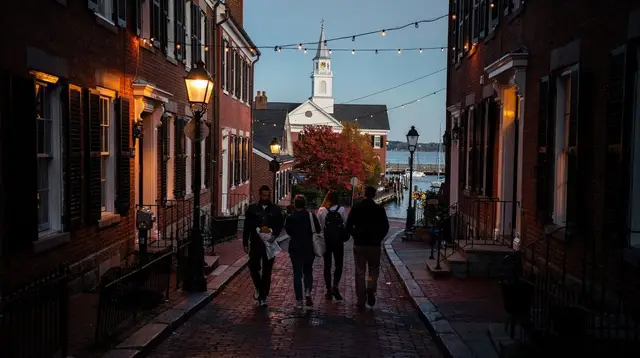
From Quincy Market, walk up Hanover Street — about ten minutes — into the North End, Boston’s Italian neighborhood since the early 20th century and still its best concentration of Italian food in New England. This is a walking neighborhood: narrow streets, small bakeries, and no obligation to follow a fixed route.
Two stops worth building the afternoon around: the Paul Revere House, Revere’s home before his 1775 ride, and the Old North Church nearby, where the signal lanterns that triggered his ride were hung. Both charge admission; check current hours before you go. Beyond those two stops, the point of the North End is simply walking it — Hanover Street and Salem Street both reward a slow pass, ideally with a stop for a cannoli.
Evening: dinner in the North End
Stay for dinner. The neighborhood’s best-known restaurants routinely have a wait on weekend evenings — walk-ins should expect 30 minutes or more at the popular spots, less if you’re flexible about which restaurant. A short detour off Hanover Street usually turns up something good without the line. If you want the neighborhood’s food history rather than a single meal, an Italian food tour covers several stops in one outing.
Day 2: Back Bay and the Skywalk Observatory
Morning: Newbury Street, Commonwealth Avenue Mall, and the Boston Public Library
Day 2 moves to Back Bay, a 19th-century neighborhood built on filled land, known for its brownstone row houses. Start on Newbury Street, Back Bay’s shopping and café strip, then walk one block over to the Commonwealth Avenue Mall — a tree-lined, park-like median running the length of the neighborhood and a quieter way to see the same brownstone architecture. A walking tour of Back Bay’s brownstones is worth booking if the architecture is what draws you here, and travelers interested in the neighborhood’s history beyond its façades can also look at the Votes for Women history tour, which covers Back Bay’s role in the suffrage movement:
a guided walk through Back Bay’s role in the women’s suffrage movementThe walk ends at the Boston Public Library on Copley Square. The building’s interior — including its courtyard, modeled on an Italian palazzo — is free to enter and worth ten minutes even if libraries aren’t usually your thing.
Midday: Copley Square
Copley Square itself is a good lunch stop: benches, a fountain, and cafés and restaurants on every side. It’s also the geographic hinge of the day, sitting between the morning’s brownstone walk and the afternoon’s Prudential Center stop a few blocks away.
Afternoon (2pm–5pm): the Prudential Center Skywalk Observatory
From Copley Square, it’s a short walk to the Prudential Center, whose Skywalk Observatory gives a rooftop view over the city — useful for making sense of the ground you’ve covered on foot over two days, from the Common to the North End to Back Bay. Admission is charged and hours vary by season; check before you go.
From the Prudential Center, the T’s Green Line runs from Copley station back to Park Street, at the edge of Boston Common, in about ten minutes — a fitting way to close the loop on a trip that started there the morning before.
Evening: free
No fixed plan for the second evening. Two full days of walking is enough; use the time to revisit a North End bakery, sit in the Public Garden, or simply rest. Travelers extending the trip by a day often use it for the harbor and islands or an evening on the water — a sunset cruise is a low-effort way to see the skyline from a different angle:
an evening sunset cruise on Boston HarborWhat this itinerary leaves out
Two days covers downtown Boston and nothing more. It does not include Cambridge (Harvard and MIT sit across the Charles River, in a separate city), the Boston Harbor Islands, or any of the North Shore or Cape Cod day trips. It also leaves out the second half of the Freedom Trail — Bunker Hill and the USS Constitution in Charlestown — for the same reason: there isn’t time to do it well alongside everything above. Travelers who want the harbor itself rather than just a view of it from land might also consider a tall ship sail:
a sail on a traditional tall ship in Boston HarborIf a third day is possible, three days in Boston adds Cambridge and the harbor without changing the pace of the first two.
Boston highlights, two-day itinerary at a glance
| When | What | Time needed |
|---|---|---|
| Day 1, morning | Boston Common to Faneuil Hall via the Freedom Trail | 2 hours with stops |
| Day 1, midday | Quincy Market | 1–2 hours |
| Day 1, afternoon | North End: Paul Revere House, Old North Church, walking | 2–3 hours |
| Day 1, evening | Dinner in the North End | 1.5–2 hours, expect a wait |
| Day 2, morning | Newbury Street, Commonwealth Ave Mall, Boston Public Library | 2 hours |
| Day 2, midday | Copley Square | 1 hour |
| Day 2, afternoon | Prudential Center Skywalk Observatory, T back to the Common | 2 hours |
Two days in Boston: frequently asked questions
Do I need a car for this itinerary?
No. Everything on Day 1 is within walking distance, and Day 2 uses about ten minutes on the T’s Green Line. A car adds parking costs and hassle without saving time downtown.
Is the full Freedom Trail included in two days?
No. This plan covers the trail from Boston Common to Faneuil Hall, roughly the first half. Bunker Hill and the USS Constitution, across the harbor in Charlestown, are left out for lack of time and are better added as a half-day extension.
How much walking is involved?
Day 1 morning is a continuous 25 to 30 minute walk along the Freedom Trail, plus more ground covered in the North End in the afternoon. Day 2 is a shorter, flatter walk through Back Bay. Comfortable shoes matter more than any single sight.
Do I need to book museum or historic-site tickets in advance?
For a two-day visit at this pace, same-day tickets are usually fine outside peak weekends. Opening hours and admission policies vary by season, so check directly with each site or the visitor center before you go.
What if it rains?
The Freedom Trail and North End walk both work in light rain with an umbrella. The Boston Public Library and Prudential Center’s Skywalk Observatory are indoor fallbacks that fit naturally into Day 2 regardless of weather.
Where should I eat dinner on Day 1?
In the North End, without question. Expect a wait at the better-known spots on weekend evenings; a short walk down side streets off Hanover Street usually turns up something good without the line.
Is this itinerary the same in winter as in summer?
The route stays the same, but pace changes. Winter days are short and cold, so the morning Freedom Trail walk and evening dinner window compress; summer allows more time to linger in the Public Garden or on Newbury Street.
tours.2 days
Verified deep-linked GetYourGuide tours. Book through these links and we earn a small commission at no cost to you.
GetYourGuide does not provide a product photo for this activity — the image shows the meeting point, photographed by us.