The North End is Boston’s oldest residential neighborhood, and it has been the city’s Italian-American quarter since waves of immigration in the late 1800s and early 1900s. It is small: a tight grid of narrow streets between the Rose Kennedy Greenway and the harbor, walkable end to end in about fifteen minutes. What draws most visitors is the combination in one compact area: a dense concentration of Italian bakeries and restaurants, and two stops on the Freedom Trail, the Old North Church and the Paul Revere House.
Getting to the North End
The North End sits a five- to ten-minute walk from downtown Boston and from Faneuil Hall, across the Greenway. There is no need to drive or take the T if you are already downtown; it is faster and simpler on foot.
If you are coming from further away, the closest T stations are Haymarket (Orange Line and Green Line) and North Station (Orange Line, Green Line, and the Commuter Rail, a separate network with its own ticket). Both put you a short walk from the neighborhood’s edge. North Station is the better choice if you are arriving by Commuter Rail from the suburbs, since the Commuter Rail is a separate network from the T with its own ticketing, not covered by a CharlieCard.
Parking in the North End itself is scarce and metered on-street parking fills up quickly; garages nearby charge downtown Boston rates. Walking or the T is the practical option for almost everyone.
If you do ride the T in, the system runs on a CharlieCard, with a single-ride fare in the neighborhood of $2.40 as of 2026 and free transfers within a two-hour window — worth checking on mbta.com since fares move. Keep in mind the T doesn’t run around the clock: the Orange, Green, and Blue Lines all stop for the night and resume in the morning, so a late dinner in the North End followed by a T ride home only works before the last trains. After that, it’s a walk back downtown or a rideshare.
Old North Church and Paul Revere House
Two of the sixteen stops on the Freedom Trail sit inside the North End. The Old North Church is where, on the night of April 18, 1775, two lanterns were hung in the steeple to signal that British troops were crossing the Charles River by boat rather than marching out by land — the “one if by land, two if by sea” signal tied to Paul Revere’s ride. The church itself charges an entry fee to go inside; following the Freedom Trail’s red line past it on the sidewalk outside costs nothing. Check thefreedomtrail.org for the current admission price and hours before you go.
A short walk away is the Paul Revere House, the home Revere owned at the time of his ride and one of the oldest buildings in downtown Boston. It also charges its own separate admission; it is not covered by any Freedom Trail pass. For the full context of both stops and the walk connecting them, see our Old North Church and Paul Revere House guide.
Remember that the Freedom Trail itself is not a single site or a museum — it is a 2.5-mile (4 km) walking route linking sixteen sites from Boston Common to Bunker Hill in Charlestown. The North End is one stretch of that longer route, not a stand-alone stop.
The food, and why it’s crowded
Food is the other reason people come to the North End, and it is a legitimate reason: this small neighborhood holds one of the highest concentrations of Italian bakeries and restaurants in New England. Cannoli are the signature item, sold at multiple bakeries along the main streets, and the neighborhood is generally regarded as home to the region’s best Italian cooking.
We won’t name specific restaurants or bakeries here, because recommendations date fast and turn into unpaid advertising for whichever place happened to be good the week we wrote this. What’s more useful and stays true: this is a small area with a lot of demand. On weekend evenings, and most evenings in summer, expect lines outside the better-known addresses, sometimes 20-40 minutes long. Weekday lunches and early dinners are calmer. If you want a sit-down meal without a wait, arrive before 6pm or well after 8:30pm, or accept the wait as part of the experience. For a structured way to sample multiple spots without guessing, a guided food walk can be worth the cost — see our North End Italian food tour guide.
A neighborhood, not a district
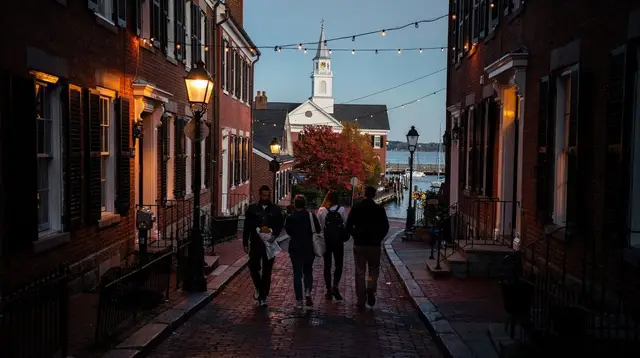
It’s worth being precise about what the North End is and isn’t. It is a residential neighborhood, still home to longtime residents alongside the restaurants, not a themed dining district or an open-air museum. Its narrow streets predate the automobile, which is part of why it feels different from the wider avenues of Back Bay or the Financial District nearby. Don’t confuse it with the South End, a separate neighborhood on the other side of downtown with its own character.
The Haymarket market
At the edge of the North End, where it meets downtown near Haymarket station, an open-air produce market runs on certain days of the week — traditionally Friday and Saturday, though vendors and exact hours can shift, so check locally before planning around it. It’s a working market for fruit, vegetables and some seafood, cash-friendly and unpolished, a useful contrast to the restaurant rows a block away.
Budgeting a North End meal
Restaurant bills in Massachusetts carry a meals tax of around 7% — the state’s 6.25% sales tax plus a 0.75% local option that Boston applies — which is a separate line from the general 6.25% sales tax you’ll see on retail purchases like bakery pastries to go. It’s a small enough amount that it rarely changes a decision, but it explains why the number on the check runs a bit higher than the menu price, and it’s worth budgeting into an evening that’s already likely to include a wait for a table. Cannoli and other bakery items bought to eat on the sidewalk fall under the general sales tax rather than the meals tax, for what it’s worth, though the difference is marginal either way.
The Harborwalk and onward to the harbor
The North End’s eastern edge runs along the water, where the Harborwalk — a continuous public path along Boston’s waterfront — passes by. Following it north and east from the North End leads toward the Boston Harbor waterfront and on to the Charlestown Navy Yard, home of the USS Constitution, one of the Freedom Trail’s final stops. You can walk there directly along the water, or in season take the ferry that connects the North End waterfront area to Charlestown — a pleasant shortcut if you’d rather not walk the whole distance. Either way, the Harborwalk ties the North End’s food-and-history half-day naturally into a fuller harbor visit; see our Boston Harbor guide for what’s on that side.
Practical notes
The North End is flat and compact, which makes it manageable on foot even after a long day of Freedom Trail walking, but its sidewalks are narrow and can feel congested at peak dinner hours. Public restrooms are limited; plan around cafe or restaurant stops. Most businesses are cash- and card-friendly, though some smaller bakeries prefer cash for small purchases.
Because the neighborhood is so densely packed with day-trip and evening visitors, it also works well as a stop on a broader guided walk rather than a self-navigated one, particularly if you want the Revolutionary War history explained on the spot rather than pieced together from plaques. A guided combination of the Freedom Trail sites here with the neighborhood’s food culture covers both halves of what draws people to the area in a single outing.
Combine the Freedom Trail’s North End stops with a guided walk through the neighborhood’s Italian streets, which pairs the history with context on the food scene without you having to research either separately.
If you’re focusing purely on the Revolutionary War history end to end, from Boston Common through the North End to Charlestown, a full guided walk of the Freedom Trail covers the whole route including both North End stops in one session.
For an evening angle on the same streets, some operators run walks that mix the neighborhood’s history with its ghost-story reputation; a walking tour built around the North End and downtown’s darker stories is one way to see the same blocks after dark.
The North End and Boston’s other historic quarters
The North End works well paired with the rest of downtown Boston in a single day: Beacon Hill on the opposite side of downtown offers the quieter, residential counterpoint with its brick townhouses and gas lamps, while Boston Common and the Public Garden sit between the two. None of these are within the North End itself, but all are within a comfortable walk, and most visitors combine two or three in one day. For the broader downtown picture — the Freedom Trail’s full route, the harbor cruises that depart nearby, and how the pieces connect — see the Boston hub.
If you’re planning a first Boston visit and trying to decide how much time to give each neighborhood, our first-time Boston guide and how many days in Boston guide both cover where the North End fits into a multi-day itinerary.
Fitting the North End into a longer stay
For visitors building out a multi-day trip, the North End slots naturally into the downtown portion of it. Our two days in Boston highlights itinerary and three days first visit itinerary both route through the neighborhood alongside the rest of the Freedom Trail, and the one-day Freedom Trail walking itinerary treats the North End’s two stops as the closing stretch of the full route rather than a separate outing. If you’re weighing whether to walk the trail on your own or join a guided version, our Freedom Trail guided versus self-guided comparison and self-guided walk guide lay out the tradeoffs.
Travelers timing a visit around the calendar should also know the North End is at its busiest — and least available for a same-day walk-in dinner — during the weeks around Patriots’ Day in mid-April, when the Boston Marathon draws crowds to the whole downtown core, and during New England’s fall foliage stretch from late September through late October, when weekend evenings fill up faster than usual. Outside those windows, and away from Friday and Saturday nights, tables and sidewalks are noticeably calmer.
It’s also worth being clear about what the North End is not. It isn’t Cambridge — Harvard and MIT sit across the Charles River in a separate city entirely, not a Boston neighborhood, and confusing the two is a common first-timer mistake; see our Cambridge and Harvard Square guide if that’s actually what you’re after. And it isn’t an island: the ferries that leave from the nearby waterfront serve the Boston Harbor Islands and Charlestown, not Cape Cod, Martha’s Vineyard, or Nantucket, which depart from Hyannis or Woods Hole well south of the city.
The North End: frequently asked questions
Is the North End safe to walk at night?
Yes, it is a heavily trafficked, well-lit neighborhood in the evening, busiest exactly when restaurants fill up. Normal city awareness applies, as anywhere in central Boston.
Do I need to book restaurants in advance?
Many of the well-known spots don’t take reservations and operate on a walk-in, wait-in-line basis, especially on weekend evenings. If a specific address does take reservations, booking a few days ahead for weekend dinners is worth it. Otherwise, arriving early or late reduces the wait.
How long does it take to walk through the North End?
The neighborhood itself can be crossed in about fifteen minutes. Budget two to three hours if you want to see the Old North Church, the Paul Revere House, and stop for food along the way, more if you’re waiting in line at a popular spot.
Is the Old North Church free to enter?
No. Standing outside it on the Freedom Trail’s route is free, but going inside the church requires a paid ticket. Check thefreedomtrail.org for the current price, since it changes.
Is the North End part of the Freedom Trail?
It holds two of the trail’s sixteen stops, the Old North Church and the Paul Revere House, but the neighborhood as a whole is not “the Freedom Trail” — the trail is a 2.5-mile walking route that passes through several neighborhoods, of which the North End is one stretch.
What’s the best way to get to the North End from the airport?
From Logan International Airport, take the Silver Line SL1 (free from the airport to South Station) or the Massport shuttle to the Blue Line’s Airport station, then transfer toward Government Center or Haymarket. Either route lands you a short walk from the North End. See our Logan Airport to Boston transfer guide for the full breakdown.
Is the Haymarket market open every day?
No, it runs on select days of the week, traditionally toward the end of the week, and hours can shift by season. Check locally before planning a visit around it specifically.
Can I walk from the North End to the harbor and Charlestown?
Yes, the Harborwalk runs along the North End’s waterfront edge and continues toward the Charlestown Navy Yard and the USS Constitution; it’s a flat, walkable route, and a seasonal ferry also connects the two areas if you’d rather not walk the whole way.
Is there a meals tax on North End restaurant checks?
Yes. Massachusetts restaurant bills carry a meals tax of roughly 7%, combining the state’s 6.25% rate with a 0.75% local option Boston applies, separate from the general sales tax on retail goods.
Is the North End the same as Cambridge or Harvard Square?
No. Cambridge, home to Harvard and MIT, is a separate city across the Charles River, not a Boston neighborhood. The North End is entirely within Boston itself.