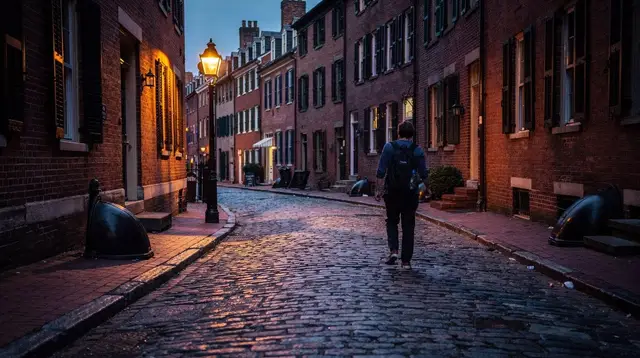
Paul Revere House and Old North Church: the North End's Freedom Trail duo
How are the Paul Revere House and the Old North Church connected?
Paul Revere lived in the Paul Revere House before his April 1775 ride, and the Old North Church is where two lanterns were hung to signal that British troops were crossing the Charles River by boat. The two sites are about a 10-minute walk apart in the North End and are both stops on the Freedom Trail.
Two sites, one signal
The Paul Revere House and the Old North Church are the North End’s two anchor stops on the Freedom Trail, and they only make full sense together. One is where the story starts — the home Paul Revere left on the night of April 18, 1775. The other is where the signal was sent that set the rest of the night in motion. Visited on their own, each is a modest historic building with an admission fee. Visited as a pair, they tell a single, specific episode of the Freedom Trail rather than two unrelated stops.
This guide treats them as a linked unit: what each site actually is, how the “one if by land, two if by sea” signal worked, how to walk between them, and where they fit into a longer day in the North End.
The Paul Revere House: where the ride started
The Paul Revere House, on North Square, is the oldest building in downtown Boston. It was built around 1680, well before Revere owned it, and he lived there with his family from 1770 until 1800 — meaning he was still a resident on the night of his ride. The house has been restored and operates as a small museum, with period furnishings and rooms that reflect the working silversmith’s household Revere actually kept, rather than a grander version of his life.
Inside, the focus is on Revere as a craftsman and a Boston tradesman embedded in the Revolutionary movement, not only on the single night he’s best known for. Silverwork, family history, and the physical structure of a 17th-century Boston house are as much the point as the ride itself. The site can be visited independently (small entry fee, its own hours — check paulreverehouse.org for the current figures, since both can change) or as part of a guided Freedom Trail walk that stops here along the route.
The Old North Church: where the signal was sent
A short walk away, on Salem Street, stands Christ Church in the City of Boston — universally known as the Old North Church. Built in 1723, it’s the oldest surviving church building in Boston, and it is still an active Episcopal parish today, which means visiting hours can shift around services and church events.
Its place in the story is specific: on the night of April 18, 1775, church sexton Robert Newman climbed into the steeple and hung two lanterns, briefly, as a prearranged signal to Charlestown that British troops were crossing the Charles River by boat rather than marching out over the Boston Neck by land. That’s the origin of “one if by land, two if by sea” — a phrase that describes a signal system, not something anyone actually shouted. Paul Revere didn’t need the lanterns to know which route the troops were taking; he arranged for them so that colonial forces watching from Charlestown would know too, in case he himself was stopped before he could cross the water and ride on.
The church interior — box pews, a historic organ, a crypt used for burials — can be visited with a small suggested or fixed entry, and the site also runs steeple and crypt tours on a separate schedule. As with the Revere House, treat any specific price or hour you read as provisional and check the church’s own site (oldnorth.com) before you go.
Ten minutes that connect two buildings
North Square and Salem Street sit close enough that the walk between the Paul Revere House and the Old North Church takes about 10 minutes on foot, through the North End’s tight grid of streets. That short distance is worth noticing: this wasn’t a citywide relay so much as a compact, local sequence of events, all happening within a few blocks of the same neighborhood on the same night.
Walking it yourself, in either direction, gives a better sense of scale than reading about it does. The Freedom Trail’s painted line connects both sites directly, so following the trail on foot through this stretch does the routing for you — see the self-guided walk for the full sequence if you want to place these two stops in context with what comes before and after.
Patriots’ Day: the one day this story replays itself
Most of the year, the Paul Revere House and the Old North Church are quiet stops on a self-paced walk. Patriots’ Day — the third Monday in April — is the exception. It’s the state holiday built around this exact story, and it’s also marathon day: the Boston Marathon runs on the same Monday, which reshapes traffic and T service well beyond the North End. Re-enactors, church events tied to the lantern signal, and a general Revolutionary-history mood take over the neighborhood, and both sites tend to be busier and to run modified hours around the holiday rather than a normal weekday schedule. If a visit is flexible, see the Patriots’ Day and spring guide before locking in a date — it’s a meaningful day to be here for the story, but not the easiest day to move around the city.
Visiting both: practical shape of the stop
Treat the Revere House and the Old North Church as two separate admissions, not one combined ticket, unless a specific tour package says otherwise. Each has its own opening hours, which can vary by season and, for the church, by service schedule — neither site publishes a single figure that holds all year, so check each one’s own site close to your visit date rather than relying on an old number.
| Site | What it is | Typical visit length | Entry |
|---|---|---|---|
| Paul Revere House | Oldest building in downtown Boston, restored home and museum | 30–45 minutes | Small admission fee |
| Old North Church | Oldest surviving church building in Boston, active parish | 30–45 minutes | Small admission fee, separate steeple/crypt tours available |
| Walk between them | North Square to Salem Street through the North End | About 10 minutes | Free |
Budget roughly two hours for both sites plus the walk, more if you add a guided component at either stop or linger over the church’s crypt and steeple tours. Both sites are commonly visited on foot as part of a longer Freedom Trail day rather than as a standalone outing, which is also the more efficient way to see them given how central they sit on the route.
a guided Freedom Trail walk that works this stretch of the North End into a full-route tour is one way to see both sites with context supplied along the way, rather than reading plaques on your own.
Where these two stops sit on the Freedom Trail
The Freedom Trail is a roughly 2.5-mile (4 km) route connecting 16 sites from Boston Common to Bunker Hill in Charlestown — not a single attraction, and not a museum you walk into. The Paul Revere House and the Old North Church fall in the trail’s middle stretch, after the downtown sites like the Old State House and Faneuil Hall and before the trail crosses the water toward Charlestown.
Following the painted red line on the ground costs nothing; it’s the individual site admissions — including these two — that carry a fee. If you’re walking the full trail in one go, these two North End stops land at a natural point to slow down, since they’re close together and don’t require a detour off the main line.
The night these two sites describe didn’t end in the North End. After the lanterns were hung and Revere set off on his ride, the sequence continues across the water at the Charlestown Navy Yard and Bunker Hill, where the same Revolutionary period is told from the other side of the harbor — worth treating as the next chapter rather than a separate day trip, if you want the fuller arc of events.
The North End around the two sites
Both the Paul Revere House and the Old North Church sit inside the North End, Boston’s historic Italian neighborhood — tight streets, older brick and clapboard buildings, and a level of everyday activity that most Freedom Trail stops elsewhere in the city don’t have. It’s also the most food-forward stretch of the entire trail, known citywide for its Italian bakeries and restaurants, which makes it a practical place to plan a meal break around the two historic sites rather than route lunch somewhere else entirely.
This guide isn’t the place to work through where to eat — that’s covered separately — but it’s worth knowing going in that the neighborhood itself, not just the two historic buildings, is part of why this stop tends to run long for visitors who came expecting a quick 20-minute detour.
Getting there and combining with the rest of your day
The North End is walkable from most of downtown Boston, and it’s also where the Freedom Trail naturally routes you if you’re following it from Boston Common. If you’re arriving independently rather than mid-trail, the closest T stops are on the Orange and Green Lines at Haymarket, a short walk from North Square.
The T is run by the MBTA, and a CharlieCard is the standard way to pay — a single ride runs on the order of $2.40, with transfers between lines included inside a two-hour window (check mbta.com before you go, since fares move). The North End itself has no subway station inside the neighborhood, which is part of why Haymarket, on the edge of it, is the stop most visitors use. Keep in mind the T doesn’t run all night; service starts in the morning and stops overnight, so a late-evening lantern tour or dinner in the North End may mean a rideshare or a walk back rather than a train. For the fuller picture of how the T, the separate Commuter Rail network, and Bluebikes fit together, see the guide to the T and getting around Boston without a car.
For a broader sense of how this stop fits into a first Boston visit, see how many days to plan for Boston and the one-day Freedom Trail walking itinerary, which sequences this North End stretch alongside the rest of the trail’s 16 sites. If you’d rather have the history narrated as you walk, an official North End–focused Freedom Trail tour covers this exact pairing of sites with a guide, and an evening lantern-themed Freedom Trail tour leans specifically into the signal story at the center of this guide.
For the debate between doing this on your own versus joining a guide for the whole route, see self-guided versus guided Freedom Trail walks. If you’re building out a longer North End stop, the neighborhood guide and the Freedom Trail history category both go beyond these two sites into the rest of what the area covers, including the Black Heritage Trail in nearby Beacon Hill as a related but separate Revolutionary-era walking route.
Fitting food into the stop
Given how central these two sites sit in the North End, it’s worth planning the meal, not just the museum stops. The neighborhood’s Italian bakeries and restaurants cluster along Hanover and Salem Streets, close enough to both sites that a coffee-and-pastry break or a full lunch fits naturally between the Revere House and the church rather than requiring a detour. A guided North End Italian food tour is one way to combine the history with the food in a single outing, and if the day also includes the downtown end of the Freedom Trail, the Quincy Market and Faneuil Hall food scene covers the other cluster of eating options along the route.
If crowds or accessibility shape your plans
Both sites are small, and both can feel crowded at once — narrow rooms in the Revere House, box pews and a working aisle in the church — which matters more for visitors managing mobility needs or simply trying to avoid a packed room. Neither site is large enough to “spread out” the way an outdoor site like Boston Common can. If accessibility is a planning factor, the Freedom Trail accessibility guide covers the route in more detail than this page does. For timing generally, see the best time to visit Boston guide: fall foliage season (roughly late September through late October) and summer weekends bring the heaviest Freedom Trail traffic, while a weekday outside those windows tends to mean shorter waits at both doors. If a guided option matters more than picking your own hours, a Freedom Trail walking tour sets a fixed schedule and handles the pacing between stops for you.
The Paul Revere House and Old North Church, in short
Two buildings, a 10-minute walk apart, telling one connected story: a Boston tradesman’s home and the church steeple where a signal was sent on the night that opened the Revolutionary War. Both sit on the Freedom Trail rather than off it, both have their own separate admission and hours worth checking before you go, and both work best treated as one linked stop rather than two disconnected errands in the North End.
Freedom Trail and Revolutionary history tours on GetYourGuide
Verified deep-linked GetYourGuide tours. Book through these links and we earn a small commission at no cost to you.
GetYourGuide does not provide a product photo for this activity — the image shows the meeting point, photographed by us.