What guidebooks still get wrong about Boston
The accent I keep waiting to hear
I moved to Boston expecting to hear it everywhere: the dropped Rs, the flattened vowels, the cadence every impression of a Kennedy speech leans on. I’ve been walking around Beacon Hill and the North End for long enough now to say plainly that I mostly don’t. Every so often, in a hardware store in Charlestown or at a counter in a neighborhood I won’t name because it would feel like I’m making fun of someone, there it is, unmistakable. But it’s the exception, not the rule, and treating it as the rule does something odd to a visitor’s expectations: it primes them to hear a city that isn’t quite the one in front of them.
Guidebooks keep reaching for the accent because it’s an easy signal. One line of dialogue and the reader knows where they are. The trouble is that the line gets reused edition after edition, decade after decade, long after the demographic reality it describes has moved on. Boston has always been a city shaped by waves of arrival — Irish, Italian, more recently a huge influx of students and young professionals from everywhere — and each wave changes what the city sounds like on an ordinary Tuesday. The Kennedy voice is one thread in that, not the whole fabric, and I think most guidebook writers know it. They keep it anyway because a shortcut that already works is hard to give up, especially when the alternative is a paragraph that admits the truth is messier.
A compact city, until it isn’t
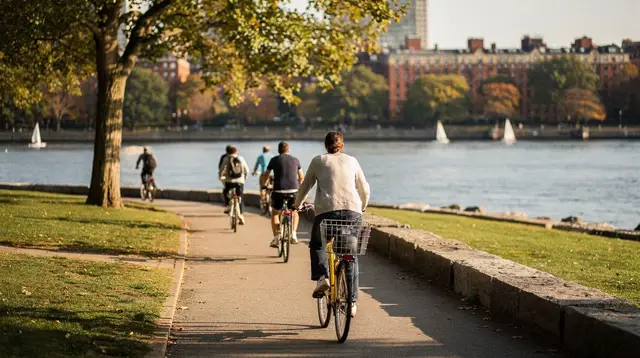
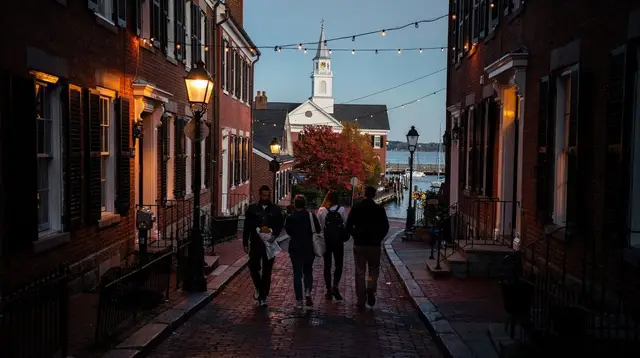
The second cliché is more forgivable, because part of it is simply true. Walk from the Public Garden through Boston Common to the start of the Freedom Trail, and you really can cover the historic core on foot in an afternoon, threading between Back Bay and Beacon Hill without ever needing the T. That compactness is real and it’s one of the city’s better qualities — you can build a genuinely good long weekend without renting a car, something I’d never say about most American cities this size.
What guidebooks tend to skip is what happens once you step outside that core. The city everyone pictures when they picture “Boston” is a few square kilometers around the Common. The metro area that actually functions as Boston — where people commute in from, where the hospitals and universities and tech offices pull workers from — sprawls out toward the western suburbs and down through the South Shore, a scale that has almost nothing to do with the postcard version. I noticed this most clearly trying to explain to a visiting friend why “just Uber over” from a hotel near Fenway to a friend’s place past Newton wasn’t the ten-minute hop she’d assumed from a map that made the whole region look pocket-sized. The confusion wasn’t her fault. It’s baked into how the city gets described before anyone arrives.
I don’t think the fix is to drop the “compact and walkable” framing — it’s genuinely useful for someone with three days and a hotel near the Freedom Trail. The fix is a single honest sentence distinguishing the walkable historic core from the much larger region around it, something most guides still can’t be bothered to include.
The cold-city reputation, tested against Cambridge on a Tuesday night
The third myth is the one that annoyed me most before I lived here, because it’s the one most guidebooks state as settled fact: Boston as reserved, insular, slow to warm up to outsiders. It’s not baseless — there’s a real New England reticence that shows up in small interactions, a certain unwillingness to perform friendliness for strangers the way some other regions do. But treat that as the whole story and you miss something obvious the moment you cross the Charles River into Cambridge.
Harvard Square on a weeknight, MIT’s campus after a seminar lets out, the stretch of Allston that turns over almost entirely every September as leases flip — this is one of the most open, transient, conversation-prone environments I’ve been in. A huge share of the population is new to the city every single year, which means the social defaults skew toward introducing yourself, not toward the guarded reserve the guidebooks describe. It’s a different Boston than the one around the Freedom Trail, shaped by a completely different economy — universities instead of history — and it barely gets a paragraph in most guides, which spend far more real estate on Salem day trips than on the city where a fifth of the metro area actually spends its twenties.
Why the shortcuts survive anyway
None of this means the guidebooks are simply lying. A visitor with four days and one shot at Boston needs some kind of compressed mental model, and “Kennedy accent, walkable old city, reserved Yankee manners” is a model that’s easy to hold onto and doesn’t require nuance to use. Replace it with nothing and you leave that visitor more lost, not less — wandering Back Bay without any frame for what they’re seeing.
What I’d rather see is a smaller, more honest fix: keep the shorthand, but date-stamp it. Say plainly that the accent is a minority sound now, that the walkable core is a fraction of the real metro area, that the reserve softens fast once you’re near a campus. Guidebooks get revised on a schedule; the revisions rarely touch the character sketches, because nobody goes back to check whether the city still sounds and feels the way it did when the description was first written. I don’t think that’s malice. I think it’s just easier to keep copying forward than to walk the neighborhoods again and see what’s actually changed. A slow sunset out on the harbor is one of the better ways to see how the skyline and the water actually sit together — I took the evening sunset cruise out of the harbor my first week here and it did more to correct my mental map than any chapter I’d read beforehand.
A more honest starting point
If I were rewriting the opening chapter, I’d keep the useful parts of the old shorthand and cut the parts that have quietly gone stale. I’d say the historic core really is walkable, and send readers toward the Charlestown Navy Yard and the Harbor Islands — reachable by the islands ferry — as an easy half-day that also gets you off the peninsula. I’d say the accent is worth listening for, not expecting. And I’d point people toward Cambridge and a weeknight in Allston as proof that the closed-off Boston of the old paperback is, at most, half the picture. For a day away from the myth-making altogether, the Salem witch-trial walking tour or a sunset cocktail cruise on the Charles both do more to show you the real texture of the region than another paragraph of received wisdom ever could.
Guidebooks aren’t going anywhere, and they shouldn’t — someone new to the city genuinely benefits from a compressed, confident version of the place. But confidence and accuracy aren’t the same thing, and a city that keeps changing deserves a description that’s occasionally checked against what’s actually on the ground, not just handed down from one edition to the next.
Questions readers ask about Boston’s guidebook myths
Is the “Kennedy accent” really how people in Boston talk?
You’ll hear it, but rarely, and mostly from older residents in a handful of neighborhoods. Walk through Cambridge, the South End, or the Seaport and you’ll hear far more variety than any guidebook caricature suggests.
Is Boston actually a small, walkable city?
The historic core around Beacon Hill and Boston Common is genuinely compact and walkable. The wider metro area, reaching well into the suburbs to the west and south, is not, and most guidebooks blur that distinction.
Why do guidebooks call Boston cold and unfriendly?
It’s an old shorthand that gets copied forward. It doesn’t hold up well against the open, student-heavy energy of Cambridge or Allston, where a huge share of the population is new to the city every September.
Are these guidebook shortcuts entirely wrong?
Not entirely. They simplify a genuinely complicated city for a visitor with three days and no local context, and simplification isn’t automatically dishonest — it just needs updating more often than it gets.
Where do these myths come from in the first place?
Mostly from older editions that get lightly revised rather than rewritten, and from a handful of enduring cultural touchstones that keep getting recycled as shorthand for the whole city.
Is Cambridge part of Boston?
No. Cambridge is a separate city across the Charles River, home to Harvard and MIT, and it’s central to the student-life counterexample this piece is making.
tours.Media & Myth
Verified deep-linked GetYourGuide tours. Book through these links and we earn a small commission at no cost to you.
GetYourGuide does not provide a product photo for this activity — the image shows the meeting point, photographed by us.