The North End and the question of authenticity
Streets built for fewer people than walk them now
There’s a line outside a pastry shop on Hanover Street most afternoons, rain or not. It moves slowly, wraps around the corner sometimes, and it’s made up almost entirely of people who don’t live within a mile of it. A few doors down, someone is unlocking a side gate to what looks like a private stairwell, pushing past the line without a glance at it, headed home. Both things are happening in the same twenty feet of sidewalk, and neither one is fake.
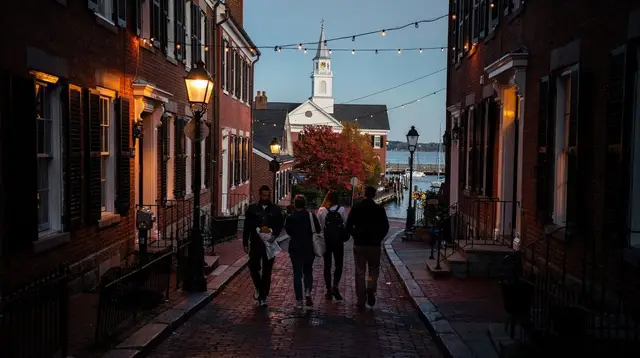
That’s the version of the North End I keep coming back to. It’s a neighborhood where Italian-American families have lived for three, four, sometimes five generations — where a woman on a folding chair outside her building will greet a neighbor by name while a tour group of twenty photographs the building behind her — and where, at the same time, an entire visible layer of the neighborhood exists because that tour group is going to walk through. I’ve stopped expecting one of those observations to cancel the other out.
What “authentic” is actually asking
The word gets used constantly here, usually by writers like me. Is the North End still authentic? Has it become a theme park version of itself? I’ve started to think the question tells you more about the person asking it than about the neighborhood. It assumes there’s a pure, unstaged version of North End life sitting somewhere underneath the pastry shops and flag-draped balconies, and that a careful enough visitor could find it if they just avoided Hanover Street at the wrong hour.
I don’t think that version exists as something separate. The pastry shops are real businesses owned by real families who also, reasonably, benefit from the volume that the Freedom Trail sends their way. The flags and the window displays are both genuine expressions of identity and, in some cases, deliberate signaling to a passing audience that has money to spend on cannoli. Both motives can sit in the same shopkeeper without contradiction. Somewhere along the way I decided that looking for the “real” North End underneath the visible one was the wrong project.
The view from inside, which isn’t mine to claim
Here’s where I have to be careful, because I’m one more outsider writing about a neighborhood I don’t live in. The residents I’ve talked to over a few visits didn’t frame their own lives around this question at all. One man, waiting for the bus on Salem Street, put it more or less like this: he wasn’t performing anything for anybody, he was just getting groceries and going home, the same as he had for forty years, and whether the street looked “authentic” to a visitor with a camera wasn’t a thought that occurred to him before I raised it.
That’s a serious point, not a dismissal. The whole framework of “is this place authentic” is built by people who arrive, look, and leave — it’s a visitor’s category, applied from outside. For someone who was born two streets over and has never lived anywhere else, the neighborhood isn’t a performance of Italian-American identity that needs certifying. It’s just where they’re from. Treating that unbothered, ordinary version of North End life as somehow less real than a “tourist-corrupted” version gets the whole thing backwards. If anything, the residents who’ve stopped noticing the crowds might have the more honest relationship with the place than I do, arriving with a notebook and a thesis.
The processions nobody’s performing for you
The clearest counter-evidence to the theme-park read is something most visitors never see on purpose: the summer feast processions, still organized by North End religious societies that in some cases predate most of the buildings around them. A statue of a saint gets carried through the streets by parishioners, followed by a band, past storefronts hung with dollar bills pinned on as offerings. Visitors are welcome to watch and plenty do, but the event isn’t calibrated for them. It happens on the society’s calendar, in the society’s language of ritual, and it would keep happening at roughly the same scale if every tourist in Boston stayed home that weekend. I’ve watched one of these from the edge of a crowd that was maybe half residents, half strangers, and the two groups weren’t really having the same experience of it — which felt like the most honest split I’d seen all trip.
What other Little Italys didn’t get to keep
I try not to name comparisons directly, but anyone who has spent time in more than one American city’s historic Italian quarter knows how this story sometimes ends elsewhere: the families move out to the suburbs a generation or two after arriving, the businesses turn over to operators with no personal connection to the neighborhood’s history, and what’s left is a branded district that performs Italian-ness for visitors without much of the substance underneath.
The North End hasn’t gone that far, and the density of small, still-family-run businesses squeezed between old apartment buildings is part of why. But the pressure is the same pressure. Real estate in a neighborhood this walkable, this close to downtown, with a river-view park and direct highway access, doesn’t stay cheap because a place is charming. It’s an open question, not a settled one, whether the North End keeps its residents or slowly becomes the version of itself that only exists for people passing through.
Sitting with both things at once
I don’t think this essay is supposed to resolve into a verdict, and I’d be suspicious of one that did. The North End is a place where people live full, unremarkable lives, and it’s a place actively shaped by the expectations of everyone who arrives expecting cannoli, checkered tablecloths, and a whiff of the old country. Both of those are the neighborhood. If you want a walking route through the food history and a sense of where the lines form and why, a North End food-focused walking tour will get you that context better than wandering alone.
If you’d rather see the neighborhood from the water, where it looks less like a stage set and more like a dense old waterfront district, a walking tour through the North End paired with a private harbor cruise covers both angles in one afternoon. For a slower, more residential read on the same streets, a guided walk that connects the Freedom Trail’s official North End stops at least gives you the history that predates the pastry shops by two centuries.
I still don’t know how to answer the “authentic or not” question cleanly, and after several visits I’ve come around to thinking that’s the right place to end up. The self-guided walk along the Freedom Trail will take you through the North End whether you’re thinking about any of this or not, past Old North Church and out toward Beacon Hill on the other side of downtown. If you want a quieter evening on the water once you’re done walking, a sunset cocktail cruise along the Charles River is a reasonable way to let the day settle before you decide what you actually think about the neighborhood you just walked through.
For a broader look at how this same tension plays out across the whole city, I’d point you to what guidebooks still get wrong about Boston and whether the Freedom Trail itself is worth following — both circle the same problem from different streets. For the practical version of a North End visit, start with the neighborhood guide, the Quincy Market and Faneuil Hall food tour nearby, or a hands-on North End Italian cooking class if you’d rather learn the food than just eat it. And if you’re plotting the rest of your day, the one-day Freedom Trail walking itinerary and the general Boston and North End pages cover the logistics I’ve deliberately left out here.
Common questions about visiting the North End
Is the North End still a real Italian neighborhood, or is it mostly for tourists now?
Both are true at once. Italian-American families have lived here for generations, some going back three or four generations on the same streets. At the same time, the neighborhood’s visible Italian character is also shaped by the steady flow of visitors coming off the Freedom Trail, which runs directly through it.
Why is the North End so crowded with tourists?
The Freedom Trail’s red line runs straight through the neighborhood on its way to Old North Church and Bunker Hill, so people following the route arrive whether or not they set out to visit an Italian neighborhood specifically. The streets, laid out for a smaller resident population, were never built to absorb that volume.
Do North End residents mind the tourism?
Reactions vary. Some residents describe the daily foot traffic as background noise to an ordinary life; others say the framing itself — visitors arriving to judge whether the neighborhood is “authentic enough” — is a visitor’s concern, not something they spend time thinking about.
Are the North End’s religious processions staged for visitors?
No. The summer feast processions are organized by neighborhood societies with histories going back over a century, for parishioners and residents first. Visitors are welcome to watch, but the events exist independently of tourism.
What is the best way to see the North End without adding to the crowding?
Visit outside peak midday hours, walk rather than move through the narrowest streets in a large group, and treat it as a residential neighborhood you’re passing through rather than a themed attraction.
Is the North End part of the Freedom Trail?
The North End contains several Freedom Trail stops, including Old North Church, but the trail itself is a 2.5-mile (4 km) route linking 16 sites across several neighborhoods, from Boston Common to Charlestown. The North End is one neighborhood the trail passes through, not the trail itself.
tours.Food & Identity
Verified deep-linked GetYourGuide tours. Book through these links and we earn a small commission at no cost to you.
GetYourGuide does not provide a product photo for this activity — the image shows the meeting point, photographed by us.