The island ferries and life without a car
There’s a moment on every crossing when the mainland stops being a place I can walk back to.
The first time I took a ferry to Martha’s Vineyard, I stood at the rail near the Woods Hole terminal and watched the parking lot — full of cars whose owners had just handed over the one thing that runs New England — shrink into a gray smear. Everywhere else on this trip I’d been driving: from Boston down to Cape Cod, along Route 6, through towns built for cars long before they were built for anything else. Then, for about 45 minutes, none of that mattered. I wasn’t driving. I wasn’t even a passenger in the usual sense. I was cargo on someone else’s timetable, and there was nothing to do about it but wait.
What the terminal teaches you before the boat does
The wait itself is the first lesson. At the Boston Harbor departure points and at Woods Hole and Hyannis, the terminal is where day-trippers with rolling suitcases stand next to islanders hauling groceries, lumber, and, more than once, a mattress. Nobody in that second group is checking a phone for updates. They already know the boat runs when it runs, and that the schedule bends for weather, not for anyone’s plans. I found that unsettling at first — I’m used to a car, where leaving five minutes later just means arriving five minutes later. A ferry doesn’t work that way. Miss it, and the next one might be ninety minutes out, or gone for the day.
That’s the part a guide to whale watching or a harbor cruise won’t tell you: the boat is not a shuttle bus. It’s infrastructure with its own logic, and visiting an island means submitting to it.
No car, and the island doesn’t want one anyway
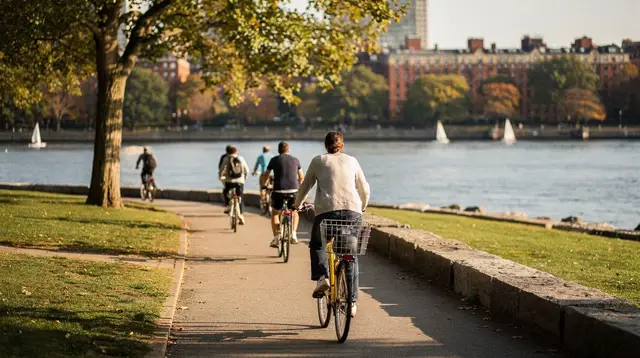
Once you’re off the boat, the absence of a car becomes the organizing fact of the day. On Martha’s Vineyard and Nantucket, everything gets planned around your own two feet, a rented bike, or a shuttle that runs on its own reduced version of the same logic as the ferry. I rented a bike in Vineyard Haven and pedaled out toward Aquinnah with no real sense of how far it was, because for once distance wasn’t something I could out-drive. It took longer than I expected. It also meant I actually saw the scrub oak, the stone walls, the way the light changes as the island narrows toward the cliffs — things I would have blurred past at 40 miles an hour on the mainland.
This is the real contrast with the rest of the region. Everywhere else on a Boston-based trip — Salem, Lexington and Concord, Newport — the car is king, or close enough to it, and the T and Commuter Rail only get you partway before you’re back to driving or waiting for a bus that may or may not show. On the islands, the car isn’t just inconvenient — it’s largely beside the point. A New England culture built around asphalt runs up against water it can’t pave over, and what’s left is something closer to how these places actually worked before automobiles: walk, bike, or wait.
The honest complaint about all of this
I don’t want to oversell it. A ferry-dependent visit is, by definition, a visit where you don’t control the ending. On my second trip, this time to Nantucket in early October, a stiff wind out of the northeast delayed the afternoon sailing I’d planned to leave on. I sat in a nearly empty terminal for two extra hours, watching gulls fight over a dropped sandwich, recalculating a dinner reservation back in Boston that I was now going to miss. That’s not romantic. That’s just a missed connection with better scenery. Anyone who tells you the wait is always meditative hasn’t been stuck in it during a nor’easter with a flight to catch the next morning.
Off-season makes this worse, not better. Crossings thin out considerably once the summer schedule ends, and a canceled boat in October can mean losing the rest of your day, not just an hour. If your itinerary has almost no slack in it — a single night, a tight connection back to Logan International Airport — the dependency on a boat and the weather it answers to is a real risk, not just a character-building inconvenience. I’d rather be honest about that than pretend every delay teaches you something.
What changes when you can’t just drive off
What I keep coming back to, though, is how different the islands feel once you’re actually there, precisely because getting there cost you something. On the mainland, a place is rarely more than a parking spot away. On Cape Cod itself, and even more on the islands beyond it, distance reasserts itself. You notice the quiet of a side street on Nantucket not because it’s objectively quieter than a side street in Beacon Hill, but because you worked to get there and can’t simply drive to the next thing the moment you’re bored.
There’s also a strange intimacy to sharing a boat with the people who actually live where you’re visiting. On the mainland day trips out of Boston, you’re mostly moving among other visitors — at Faneuil Hall, along the Freedom Trail, on a trolley circling downtown. On the ferry, half the boat is headed home. That reframes the island, at least for me, from a destination into somewhere other people’s ordinary lives happen to take place, which I’m passing through on a schedule I don’t set.
So is it worth it
I think so, with a caveat. If you can build slack into your plans — an extra half-day, a willingness to eat dinner later than planned — the ferry crossing does something a car never could: it forces you to stop treating travel as something you control down to the minute. If your trip is rigid, the same dependency turns into stress, and I wouldn’t pretend otherwise. Before you book, it’s worth reading up on the Martha’s Vineyard and Nantucket ferry routes and the general shape of a Cape Cod and Provincetown getaway, and thinking honestly about how much unpredictability you can actually absorb. For a longer stretch of days, an island-focused itinerary gives you more room to let a delayed crossing be a shrug instead of a crisis.
Back in Boston, walking down to the harbor to watch the ferry to the Harbor Islands pull away, I noticed I’d started reading the water differently — checking the whitecaps, guessing at the wind, the way islanders clearly do without thinking about it. It’s a small thing. But it’s not a habit a car ever taught me. If you want an easier version of that same shift in pace, a slow sunset cruise around the harbor or an evening out on a sunset cocktail cruise on the Charles River gets you a taste of it without the risk of a canceled return trip.
Ferry travel to Boston’s islands: questions
Do I need a car to visit Martha’s Vineyard or Nantucket?
No. Both islands are compact enough to get around by bike, shuttle, or on foot in the main towns. Bringing a car onto the ferry is possible but expensive and often unnecessary for a short visit.
What happens if the ferry is cancelled?
Coastal weather, especially fog and wind, can delay or cancel crossings with little notice. Operators rebook passengers on the next available sailing, but on a tight schedule that can mean losing hours or a full day.
Which port do the ferries leave from?
Passenger and vehicle ferries to the islands leave from Woods Hole and Hyannis on Cape Cod, not from downtown Boston. Getting there from Boston Harbor itself is a separate trip, usually by car or Commuter Rail plus a connection.
Is it cheaper to skip the islands and stick to the mainland?
Usually, yes. Ferry tickets, bike rentals, and island lodging add up quickly, and a single missed crossing can turn a day trip into an overnight stay you didn’t plan or budget for.
How much time should I budget for a one-day island trip?
More than you think. Between the drive to the ferry terminal, the crossing itself, and the return sailing, a lot of a single day disappears before you’ve properly seen anything.
Are the islands quiet outside summer?
Considerably. Ferry frequency drops after Labor Day, many businesses close for the season, and the towns that felt crowded in July can feel close to empty by October.
Can I bring a car on the ferry?
Yes, on the vehicle ferries from Woods Hole and Hyannis, but space is limited and reservations fill up well in advance, especially in summer. Passenger-only, faster ferries don’t take vehicles at all.
tours.Transport & Perspective
Verified deep-linked GetYourGuide tours. Book through these links and we earn a small commission at no cost to you.
GetYourGuide does not provide a product photo for this activity — the image shows the meeting point, photographed by us.