Whale watching from Boston: what the trip actually involves
Can you see whales from Boston, and how does it work?
Yes. Boats leave the Boston waterfront, near the New England Aquarium and Long Wharf, for Stellwagen Bank National Marine Sanctuary, a known feeding ground for humpback and other whales. Trips run roughly April to October, peak in summer, and last several hours round trip. Sightings are likely in season but never guaranteed.
How whale watching from Boston works
Whale watching in Boston means a boat trip, not a shore activity. Vessels leave the downtown waterfront, in the area around the New England Aquarium and Long Wharf, and head out past the Boston Harbor Islands toward open water. The destination is Stellwagen Bank National Marine Sanctuary, a stretch of underwater plateau off the Massachusetts coast that concentrates the small fish and plankton whales feed on. It is a federally protected marine sanctuary, not a harbor attraction, and it sits well beyond sight of the city skyline.
The basic shape of the trip is the same across operators: board at the pier, cruise out to the sanctuary, spend time searching for and following whales when they are found, then cruise back. A naturalist is typically on board to narrate the trip and identify what shows up. Boston is one of the more established whale watching ports on the US East Coast largely because Stellwagen Bank is close enough to reach and return from in a single outing, which is not true of every whale feeding ground.
Trips are seasonal, run several hours round trip, and never come with a guarantee. Those three facts shape almost every practical decision below: when to go, what to book, and what to wear.
Season: spring through fall, not a winter activity
Whale watching cruises from Boston run roughly from April to October, with the heaviest schedule and the highest number of daily departures in the summer months of June through August. Outside that window, in winter, whale watching does not operate at all: the whales that feed at Stellwagen Bank in the warmer months move on, and no operator runs sightseeing cruises to the sanctuary in the cold season.
Exact start and end dates are not fixed. They depend on the individual operator’s schedule and on when whales are being reported on the bank, and they can shift from one year to the next. Rather than planning around a specific calendar date, check the current season dates and trip calendar directly with the operator you plan to book, particularly if you are traveling in early spring or late fall at the edges of the season.
Within the season, summer is the most reliable stretch for both weather and whale activity, but it is also when boats are fullest and prices tend to sit at the higher end of the range. Shoulder months (May, September, into October) can mean smaller crowds, though trip frequency drops as the season winds down.
Duration: plan for several hours
A round-trip whale watching cruise from Boston takes several hours. That figure covers the outbound run to Stellwagen Bank, time spent on the whale grounds actively searching and observing, and the return trip to the dock. The exact length is not standard across operators — some run shorter, more frequent trips, others run longer outings that spend more time on the bank — so treat any duration printed on a ticket as the number to plan around, and confirm it when booking rather than assuming all trips run the same length.
Because the outbound leg alone covers real distance in open water, this is not a quick harbor loop. Budget the better part of a morning or afternoon for it, and avoid scheduling anything tight immediately afterward in case the boat runs later than planned, which happens when a captain chooses to stay longer with an active pod.
What you’re likely to see, and what’s never promised
Humpback whales are the animal most associated with Stellwagen Bank, drawn by the sanctuary’s dense summer feeding grounds, and they are the species most commonly reported on Boston whale watching trips. Depending on the day, boats may also encounter other cetaceans and marine life in the area, along with seabirds that follow the same feeding activity.
What a guide can say honestly is this: whales are wild animals following food, not a scheduled attraction, and no cruise, however well run, can guarantee a sighting on any specific day. Operators describe their in-season trips as reliable, and repeat visits over the years back that reputation up, but reliability in aggregate is not the same as a guarantee on your one outing. This guide does not quote a success rate, because outfitters vary in how they track and report one, and a single number would flatten a lot of day-to-day variation in weather, whale movement, and time of season. If a guaranteed sighting matters to you, ask the operator directly what happens if no whales are seen — some have a policy for that, others do not, and it is worth knowing before you book rather than after.
Getting to the dock without a car
The Boston waterfront departure points are within the compact downtown core, close to the Freedom Trail and the North End, so most visitors reach them on foot from a downtown hotel or by riding the MBTA into the city center rather than driving and parking near the harbor. If you’re arriving from Logan Airport, see the Logan Airport transfer guide for how to get into town first. Once you’re downtown, the MBTA “T” guide and the broader guide to getting around Boston without a car cover how to reach the waterfront on transit rather than by taxi or rideshare, which can get congested near the piers when several harbor cruises are loading at once.
Because the whale watching dock sits in the same general area used for other Boston Harbor cruises, it’s worth building extra time into your morning if you’re also trying to see the Freedom Trail or the North End beforehand — walking distances downtown are short, but boarding usually starts well before departure, and boats do not wait for late arrivals the way a walking tour might.
What to bring: dress warmer than the city weather suggests
The single most common mistake on a Boston whale watching trip is dressing for the temperature on land. Out at Stellwagen Bank, well offshore, the air is consistently cooler and windier than it is downtown, and the boat’s own speed adds a wind chill on top of that. This holds even in the middle of summer: a warm, humid July day in Boston does not mean a warm ride on open water.
Bring a windbreaker or warm layer regardless of the season, along with:
- A hat that won’t blow off, or one with a chin strap
- Sunglasses and sunscreen — sun exposure on open water is stronger than it feels
- Closed-toe shoes with grip, since decks can be wet
- Motion sickness precautions if you’re prone to it, taken before boarding rather than after
Binoculars are useful but not essential; most boats maneuver reasonably close when whales are found, and naturalists often point out what to look for.
Where trips leave from
Most Boston whale watching operators depart from the downtown waterfront, in the vicinity of Long Wharf and the New England Aquarium, with some departures also running from the Seaport side of the harbor. This is the same general stretch of waterfront used for other Boston Harbor cruises, so it’s worth double-checking the specific pier printed on your ticket rather than assuming all operators use the same dock.
a whale watching cruise to Stellwagen Bank departing the Boston waterfront is the most direct way to book this trip; confirm the season, departure pier, and stated trip length on the listing before you go, since all three vary by date and operator.
Booking ahead, and what to check before you buy
Whale watching trips run on a fixed schedule of departures rather than continuous boarding, and in peak summer months the most popular sailing times can sell out. Booking ahead, rather than showing up at the pier and hoping for space, is generally the safer approach in season — the general guide on booking in advance versus on the spot in Boston covers the tradeoffs for harbor activities more broadly, and they apply here.
When comparing listings, check three things before booking: the departure pier (since operators use more than one dock along the waterfront), the stated round-trip duration, and whether the season dates on the listing still cover your travel date, especially if you’re visiting in April, May, or October at the edges of the season. If you or someone in your group needs step-free boarding or other accommodations, the guide to accessible tours and cruises in Boston and the broader wheelchair-accessible Boston guide are worth checking, since accessibility varies by vessel and by operator rather than being standard across every whale watching boat.
Other cruises from the same Boston waterfront
Whale watching shares its general departure area with several other Boston Harbor cruises, so it’s easy to combine it with a different outing on the same trip or on a different day without changing neighborhoods. Operators running from Long Wharf and the Seaport also offer historical sightseeing cruises that cover the harbor and skyline rather than open-water wildlife, and evening sunset cruises that run a shorter loop with commentary on the city rather than a run out to Stellwagen Bank.
If a slower, narrated look at the harbor and downtown skyline fits your trip better than a full open-water outing, a historical sightseeing cruise of Boston Harbor covers that ground in a shorter sitting. For an evening on the water instead, a sunset cruise with skyline commentary runs later in the day and stays inside the harbor rather than heading out to the sanctuary. Neither is a substitute for whale watching — both stay closer to the city and are not aimed at wildlife — but they’re useful if you want a second, shorter outing on the water without repeating the several-hour Stellwagen Bank trip.
Comparing whale watching to other water activities
Whale watching is a long, open-water trip aimed specifically at wildlife. It is not the only way to get on the water in Boston, and it is worth knowing how it differs from the alternatives before booking.
| Activity | Location | Typical duration | What it’s for |
|---|---|---|---|
| Whale watching cruise | Stellwagen Bank, open ocean | Several hours round trip | Wildlife, specifically whales |
| Boston Harbor Islands ferry | Boston Harbor, inner islands | Half day or less per island | Hiking, beaches, history on the islands |
| Charles River kayaking | Charles River, in the city | 1 to 2 hours typical | Short, self-paced paddling with skyline views |
| Sunset or dinner cruise | Boston Harbor | 1.5 to 2.5 hours | Views and dining, not wildlife-focused |
If the several-hour open-water commitment of whale watching doesn’t fit your schedule, the Boston Harbor Islands are reached from the same general waterfront area and make for a shorter outing that still gets you on the water. For something shorter still and entirely within the city, kayaking on the Charles River is a self-paced alternative that takes an hour or two rather than half a day, with none of the open-ocean travel — a different kind of trip aimed at the river and skyline rather than marine wildlife.
A few other harbor options worth knowing about, even though none of them substitute for a trip to Stellwagen Bank: Boston Duck Tours combine a short amphibious ride on the Charles River with a city tour, sailing on a schooner is a slower, wind-powered way to see the harbor, and a dinner cruise pairs a meal with a shorter loop of the harbor rather than open water. If you’d rather compare whale watching directly against a general harbor cruise before deciding, the harbor cruise versus whale watching guide lays out the difference in more detail than the table above.
Whale watching, season by season
| Period | Availability | Notes |
|---|---|---|
| Winter (Dec–Mar) | Not offered | Whales move on from the feeding grounds; no operators run trips |
| Spring (Apr–May) | Season begins | Schedules ramp up; confirm start dates with the operator |
| Summer (Jun–Aug) | Peak season | Most frequent departures, warmest air temperatures, still cool on the water |
| Fall (Sep–Oct) | Season winds down | Fewer departures as the season closes; confirm end dates directly |
Whale watching from Boston: FAQ
Where do whale watching boats leave from in Boston?
Most operators depart from the downtown waterfront, around Long Wharf near the New England Aquarium, and from the Seaport area. Check the exact dock on your ticket, since operators use different piers along Boston Harbor.
How long is a whale watching trip from Boston?
Figure on several hours round trip, covering the run out to Stellwagen Bank, time on the whale grounds, and the return. Exact duration varies by operator and by how far the whales are that day, so confirm the stated length when booking.
When is whale watching season in Boston?
Operators generally run trips from spring into fall, with the strongest activity in summer. There is no whale watching in winter. Exact start and end dates shift year to year and operator to operator, so check current listings rather than assuming a fixed calendar.
Are whale sightings guaranteed?
No. Whales are wild animals on a working feeding ground, not on a schedule. In-season trips are described as reliable by the operators who run them, but no cruise can promise a sighting on any given day.
What should I wear on a whale watching cruise?
Bring a warm layer and a windbreaker even in summer. The boat picks up speed on open water and it is noticeably cooler and windier out at Stellwagen Bank than on the harbor or downtown.
Is Stellwagen Bank part of Boston Harbor?
No. Stellwagen Bank National Marine Sanctuary sits in open water off the Massachusetts coast, well beyond the harbor islands. Boats cross open ocean to reach it, which is part of why the round trip takes several hours.
What might I see besides whales?
Naturalists on board typically point out other marine life encountered along the way, such as dolphins, seabirds, or fin whales, depending on the day. What turns up is not predictable and varies by trip.
Whale watching and outdoor tours around Boston on GetYourGuide
Verified deep-linked GetYourGuide tours. Book through these links and we earn a small commission at no cost to you.
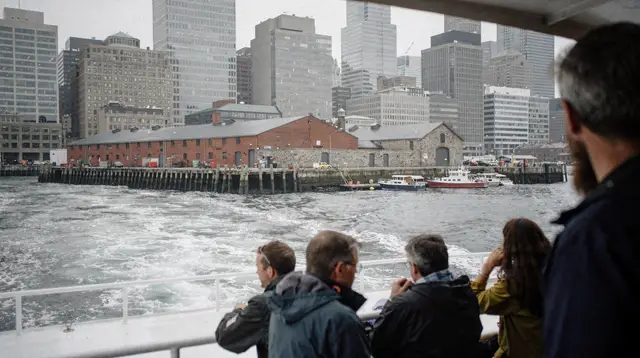
GetYourGuide does not provide a product photo for this activity — the image shows the meeting point, photographed by us.