Quincy Market and Faneuil Hall food tours
What is a Quincy Market and Faneuil Hall food tour?
It's a guided walk through the food stalls of Quincy Market's historic covered hall and the surrounding Faneuil Hall Marketplace, sampling seafood, New England specialties and desserts from several vendors. Some operators extend the route into the neighboring North End for Italian food.
What’s actually at Quincy Market
Quincy Market is the long, colonnaded market hall that sits directly behind Faneuil Hall, in the middle of downtown Boston, a few minutes’ walk from stops on the Freedom Trail. The building opened in 1826 as a produce and meat market and now runs a central corridor of food stalls flanked by two side buildings (North Market and South Market) filled with shops and restaurants. It sits close enough to the trail’s red line that most people encounter it while walking between the Old State House and Faneuil Hall itself, whether or not a market visit was on the plan.
The stalls sell a wide spread: seafood (chowder, oysters, fried clams, lobster rolls), regional specialties, ethnic food from several countries, and a long run of dessert counters. A food tour here is built around tasting a sample from several of these stalls in one guided walk, rather than choosing one stall and sitting down. This guide covers how those tours work, what they typically include and skip, and how the market connects to the rest of downtown Boston. It does not rank individual stalls or restaurants — the lineup changes, and a guide isn’t the place to crown a winner.
Faneuil Hall: the building the market sits behind
Faneuil Hall predates Quincy Market by nearly a century — it opened in 1742 as a market and public meeting hall, and it’s the building most food tours name-check even when the tastings themselves happen in Quincy Market itself. The ground floor still functions as a market space with a handful of stalls; the meeting hall upstairs is where Revolutionary-era town meetings were held, and it’s free to walk into during opening hours. Because Faneuil Hall sits directly in front of Quincy Market, most guided routes treat the two as a single stop rather than two separate destinations, even though they’re distinct buildings with roughly 80 years between their openings.
For the surrounding burying ground and a closer look at the hall’s Revolutionary history, see the Faneuil Hall and Granary Burying Ground guide. If your interest runs more toward the Freedom Trail’s Revolutionary sites than the market’s food, a self-guided walk of the Freedom Trail or a guided Freedom Trail tour covers Faneuil Hall as one of the trail’s sixteen official stops, alongside sites like the Old North Church and Bunker Hill.
How a guided food tour through the market works
A typical Quincy Market food tour groups a handful of tastings — often four to six stops — into a walk of roughly two to three hours, mixing market stalls with a short amount of history about the building and the surrounding Faneuil Hall Marketplace. Some itineraries stay entirely inside the market halls; others step outside to cover Faneuil Hall itself and a stretch of the nearby Freedom Trail before or after the tastings.
The market halls are open daily, but a guided tour is not a walk-in, any-time activity: the operator sets fixed departure times, usually a small number of slots per day, and group size is often capped. Always check the exact time slot when booking — operators adjust these, and what’s listed weeks in advance can shift. If you’d rather set your own pace, you can walk the market unguided at no cost and choose your own stalls; a guide mainly adds route curation and background you’d otherwise have to piece together yourself.
What’s usually included and what isn’t
| Element | Typically included | Typically not included |
|---|---|---|
| Food and drink samples | Yes, several small tastings | A full meal at any single stall |
| Historical commentary | Often, on the market and Faneuil Hall | Deep-dive Freedom Trail history (separate tours cover that) |
| Walking route | Fixed, guide-led | Free time to backtrack or linger |
| North End extension | On some tours only | Assume nothing — check the listing |
| Dietary accommodations | Sometimes, ask ahead | Guaranteed vegetarian, vegan or allergy-safe options |
Because tastings come from working market stalls, portions are sample-sized rather than full servings, and the exact dishes depend on what a given stall is running that day. If you have dietary restrictions, contact the operator before booking rather than assuming the route can flex around you.
Getting there on the T
The market sits between two MBTA stations, and either works:
- State — served by the Orange Line and the Blue Line, about a five-minute walk to the market.
- Government Center — served by the Blue Line and the Green Line, roughly the same distance on the opposite side.
Both stations put you within sight of Faneuil Hall. Fares run on the standard T system — a CharlieCard trip is on the order of $2.40 in 2026 with transfers included in a two-hour window, though this changes; check mbta.com before you travel. The T doesn’t run 24 hours a day, so if your tour ends late in the evening, confirm the last train on your line rather than assuming service is still running.
If you’re walking from elsewhere on the Freedom Trail, the market is a short, flat walk from both the Old State House and Faneuil Hall — no transit needed if you’re already downtown.
Crowds and timing
Quincy Market is one of the most heavily visited spots in the city, largely because of its location on the Freedom Trail route and its mix of food, shops and street performers. Traffic builds through the day and peaks in summer, when both cruise-ship crowds and general tourist season overlap. There’s no reliable published visitor count to cite here, and any specific number you see elsewhere should be treated as a marketing estimate rather than a fact.
Practically: mornings and weekdays are calmer than weekend afternoons and evenings. If a guided tour gives you a choice of time slots, an earlier one will usually mean shorter lines at individual stalls, even though the tour itself moves at a fixed pace regardless of foot traffic.
Seasonality shapes crowd levels more than day of week does. New England’s fall foliage season, roughly late September through late October, brings a wave of visitors to Boston generally, and Quincy Market’s central downtown location means it absorbs a share of that traffic even though the market itself has nothing to do with foliage. Winter is the opposite: crowds thin out, some tour operators run fewer daily departures, and a warm indoor market becomes more appealing on a cold day. If your visit lands on Patriots’ Day — the third Monday in April, when the Boston Marathon runs through the city — expect road closures and shifted transit patterns downtown; check tour and market hours specifically for that date rather than assuming a normal schedule.
When a tour adds the North End
Because the North End — Boston’s Italian neighborhood — is only about a ten-minute walk from Quincy Market, several operators build a longer combined route that starts (or ends) at the market and continues into the North End for a second round of tastings, usually Italian bakeries, cafés and restaurants. This is a different, longer itinerary than a market-only tour, so read the stop list carefully before booking: some tours use “food tour” loosely to mean either the market alone or the combined route.
For a tour focused specifically on the North End’s Italian food scene rather than the market, see the North End Italian food tour guide. If seafood specifically — chowder and lobster rolls — is what you’re after, the lobster and lobster roll guide covers where that fits into a Boston trip beyond the market stalls.
Combining a food tour with the rest of a downtown day
Because Quincy Market sits at the midpoint of most Freedom Trail routes, a food tour here pairs naturally with the rest of a downtown Boston day rather than standing alone. Travelers comparing a guided Freedom Trail walk against a self-guided one often build the market tasting into whichever version they choose, since the trail passes within a block of Faneuil Hall regardless of who’s leading the walk.
If you’d rather extend the day toward the waterfront, Boston Harbor cruises depart from docks a short walk from the market, and a combined market-and-harbor afternoon avoids backtracking across downtown. Travelers staying multiple days sometimes fold a Quincy Market stop into a broader itinerary — the three days in Boston and two days in Boston itineraries both route through this part of downtown early in the trip, when energy for a longer walking day is highest.
For travelers based a bit further out, Beacon Hill is a level, roughly ten-minute walk from the market and makes a quieter contrast to the market’s crowds — see the Beacon Hill neighborhood guide for what’s there beyond the market’s food stalls.
Booking one: what to check before you commit
A handful of Boston tour operators run food-and-history walks that pass through or start at Quincy Market. Several combine tastings with a Freedom Trail history component, since the two overlap geographically.
a guided walk pairing Freedom Trail history stops with food tastings near the market is one option if you want the market covered alongside Revolutionary-era sites rather than as a stand-alone stop. For a route weighted more toward seafood specifically, a seafood-focused tasting walk through the historic downtown area covers chowder- and shellfish-style stops in the same part of the city. Travelers who’d rather not share a group can look at a private walking food tour through downtown Boston, which sets its own pace and timing with the operator. And if your Boston day is combining downtown with a trip across the river, a small-group day tour linking Harvard, MIT and Quincy Market pairs a Cambridge university visit with a market stop on the same outing.
Whichever you pick, confirm three things before booking: the exact departure time slot, whether the North End is included or separate, and how dietary restrictions are handled — none of this is standardized across operators, and current details live on the booking page, not in this guide.
What a market food tour actually costs
Beyond the price of the tour itself, food and drink bought at Quincy Market’s stalls is subject to Massachusetts’ meals tax, which runs around 7% in Boston — combining the state’s 6.25% meals tax rate with a 0.75% local option the city has added, so it’s a separate rate from the state’s general 6.25% sales tax on goods. A tour’s advertised price sometimes includes gratuities for the included tastings and sometimes doesn’t; check the listing rather than assuming, since a guide’s tip and any tip you’d leave a vendor for extra food you buy on your own are two different things.
For travelers weighing a paid tour against a self-guided walk through the market, see the Boston on a budget guide for a broader look at where a guided food experience fits against free alternatives nearby, like Boston Common and the Public Garden, both within easy walking distance and free to visit.
If you’re arriving from Logan or staying elsewhere in the city
Travelers coming straight from the airport can reach downtown Boston, and Quincy Market by extension, without a car — see the Logan Airport to Boston transfer guide for how the Silver Line and Blue Line connect the airport to the same T network the market sits on. For choosing a base for a longer trip, the best neighborhood to stay in Boston guide covers how downtown, the North End and other neighborhoods compare for a visit built around food and walking rather than a car.
Beyond the market: what’s nearby
Quincy Market’s location makes it a natural stop rather than a destination requiring a special trip. It sits a few minutes from Faneuil Hall and the Granary Burying Ground, a similar distance from the start of the North End, and within easy walking range of the Boston Harbor waterfront if you want to extend a downtown day with a harbor view or a cruise. For a broader look at where Boston’s markets fit into a food-focused visit, see the Boston museums guide for indoor options on a rainy day, or the Quincy Market and Faneuil Hall food tour page itself if you’ve arrived here from a linked itinerary.
If you’re building a longer downtown day around food, pair a market visit with a walk of the Freedom Trail itself — the red line passes within a block of Faneuil Hall, so the two fit into the same outing without backtracking across the city.
Quincy Market and Faneuil Hall food tours: FAQ
North End food tours and tastings on GetYourGuide
Verified deep-linked GetYourGuide tours. Book through these links and we earn a small commission at no cost to you.
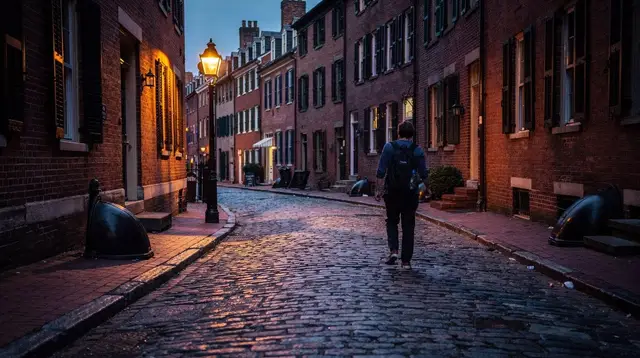
GetYourGuide does not provide a product photo for this activity — the image shows the meeting point, photographed by us.