Fenway Park for people who don't follow baseball
What I noticed instead of the score
I did not grow up with baseball. I can tell you what an inning roughly is, and that is close to the limit of my competence. So when a friend who lives in Back Bay handed me a ticket and said, “you’ll get it once you’re inside,” I assumed she meant I would finally understand the rules. I did not. What I got instead was something I have not quite shaken off since: the sense that a baseball game at Fenway Park is not really the point of a baseball game at Fenway Park.
I want to be honest about the limits of that claim before I make it, because I know it will annoy the people for whom it is not true. For a real fan, reducing this stadium to “ambiance” is close to an insult. The game itself — the pitching duel, the history written into every at-bat, the decades of memory tied up in this particular franchise — is the actual substance, and a neophyte tourist blinking at a wall of green paint is, from that angle, missing the entire point while congratulating himself on catching something deeper. I take that objection seriously. I did not understand what I was watching, in the way a fan understands it, and no amount of atmosphere replaces that understanding. But I also think something real happened to me that evening that had very little to do with balls and strikes, and I don’t think I’m the only visitor it happens to.
The neighborhood starts the ritual hours early
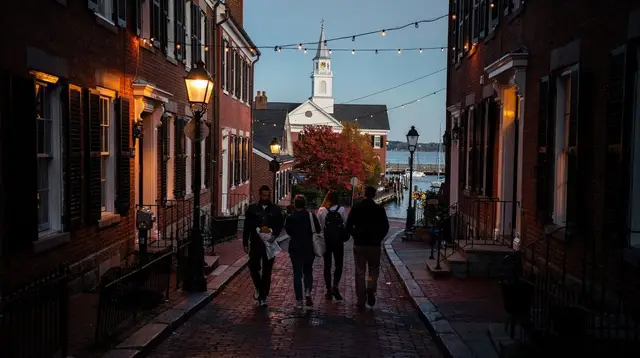
It begins before you’re anywhere near a turnstile. I walked over from Cambridge in the late afternoon, and by the time I crossed into the neighborhood around the ballpark, the red had already taken over — not everyone, not uniformly, but enough that the shift was unmistakable. Bars with their doors propped open. People in jerseys eating on the sidewalk outside places that clearly exist for exactly this purpose three or four nights a week. Nobody was rushing. There’s a particular kind of crowd that gathers not because something is about to start, but because gathering itself is the activity, and the game later is almost an excuse. I don’t know what the pregame ritual looks like to someone who’s done it fifty times. To me it looked like a neighborhood quietly rearranging itself around a building.
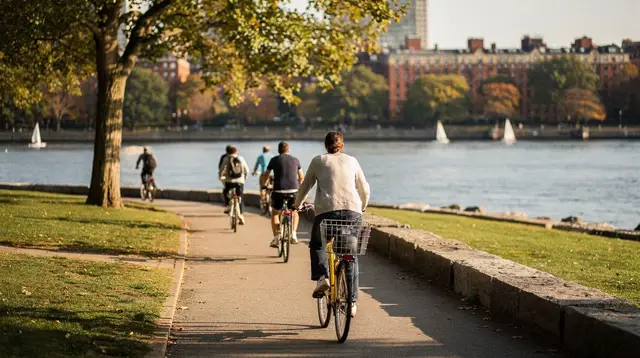
Getting there is part of what makes the evening feel unhurried rather than logistical. The Green Line stops right at Kenmore and Fenway, and if you’re staying anywhere in Back Bay or across the river in Cambridge, the ride in is short enough that a car never enters the conversation. I’d read a general guide to getting around Boston without a car before the trip, and everything it said about the T held up for a Fenway night specifically — you get dropped close enough that the walk to the gates becomes part of the ritual rather than an errand before it.
Inside, the stadium argues with itself
Fenway Park opened in 1912, and you feel that age the moment you’re inside, in a way that has nothing to do with nostalgia marketing. The rows are narrow. My knees found the seatback in front of me before I’d even sat down properly. This is a stadium built before anyone was designing for cupholders and sightlines and concourses wide enough for a family of four to walk abreast — it was built for a city, for people who could walk or take the trolley, and it has been patched and preserved and squeezed into its original footprint ever since. Sitting in it doesn’t feel like attending an event so much as visiting a building that has hosted the same event, more or less unchanged in shape, for well over a century.
And then there’s the wall. The Green Monster rises over the left field line at a height that looks almost like a design error until you remember the whole park was shoehorned onto a city block and something had to give. It is enormous, flatly green, and it dominates the sightline from nearly every seat whether the ball is anywhere near it or not. I kept looking at it instead of the pitcher. I don’t think that’s a neophyte’s mistake, exactly — I think the wall is built to be looked at.
None of what I’m describing replaces an actual explanation of the building itself — the sightlines from different sections, the seats where the Green Monster does and doesn’t block your view, the history layered into specific corners of the park. A proper tour of Fenway Park covers that ground in a way one confused evening from the cheap seats can’t.
A song, and what it does to a crowd
Midway through the game, something happened that I was not prepared for. A song started — the kind of communal, slightly sappy singalong that every ballpark in the country probably has its own version of — and the entire stadium joined in, badly, happily, in a register that had nothing to do with how the game was going. I didn’t know the words. I mouthed along anyway, watching thousands of strangers do the same thing in near-unison, and I understood, for about ninety seconds, exactly why people keep buying tickets to a sport they’ve already watched a thousand times. It wasn’t about anticipation for the next pitch. It was about being one voice in a room full of voices doing the same slightly ridiculous thing at the same time. I’ve felt something like it at a wedding, or a funeral, or standing in a crowd for a fireworks show. It’s not a baseball feeling. It’s a room feeling.
What the rivalry and the drought are really about
Boston fans will tell you, unprompted, about the team from New York, and they will tell you about the decades this city spent waiting for a championship before that finally ended. I didn’t grow up with either grievance, so I can’t feel them the way a lifelong fan does. But sitting there, I started to understand both as something bigger than sports arguments.
A city that spent so much of its founding myth insisting on its own difference from everywhere else — its own revolution, its own universities, its own version of being right — holds onto a sports rivalry the same way it holds onto the Freedom Trail: as one more story about who is authentically Boston and who is an outsider claiming the same ground. And a long wait for a title, whatever its length, becomes less about statistics and more about identity — proof that loyalty here doesn’t depend on winning. I’m speculating. I’m an outsider describing something I watched from the cheap seats for one night. But the intensity of it, even secondhand, was not something I expected to take home with me.
It reminded me of something I’d noticed elsewhere in the city, thinking about how Boston handles its own revolution as a piece of ongoing civic performance rather than a settled historical fact. A few blocks over in the North End, that same instinct shows up as an insistence on being the most authentically Italian corner of New England, whether it’s on a plate at dinner or on a guided food tour through its streets. Boston keeps re-litigating who belongs to it, and a ballpark turns out to be as good a stage for that argument as a battlefield or a burying ground.
The part I still can’t argue with
Here’s where I land, and where the fan’s objection still has a foothold. If you go to Fenway Park never having followed baseball, you will leave without understanding baseball. You won’t know why a particular pitch mattered, or what a given player’s history means to the people sitting around you cheering for him. That knowledge is real, and it’s not something atmosphere substitutes for — it’s a different, deeper relationship with the same building. What I got was not that. What I got was an evening where a hundred-year-old, uncomfortable, oddly-shaped stadium in a neighborhood that had spent all afternoon getting ready made me feel, briefly, like a Bostonian by proxy. I’d go back without learning a single rule.
If a Fenway night is one piece of a longer visit
A game here doesn’t have to be the whole trip, and for most visitors it isn’t. If you’re still deciding where to stay, a night at Fenway is a decent argument for something in or near Back Bay — walkable to the ballpark and to most of the rest of the city — and a guide to picking a neighborhood to stay in Boston lays out the tradeoffs better than I can here. On the days that aren’t game nights, the same instinct that pulled me into the streets around Fenway early applies to the rest of the city too — a general walking tour of Boston hits a lot of the same “the street is the attraction” quality, and there’s a long list of free things to do in Boston if the budget is already stretched by tickets.
Timing matters more than I expected going in. I happened to be there outside of peak baseball season crowds, and a guide to the best time to visit Boston is worth checking against the team’s schedule before you book anything. And if you’re pairing the game with food the way I did with the neighborhood bars, Quincy Market and Faneuil Hall is a reasonable stop earlier in the day, and the view from the Prudential skywalk is a good way to see where Fenway sits relative to the rest of the city before you’re down at street level and lose that perspective entirely.
Questions about visiting Fenway Park as a first-timer
Do I need to understand baseball to enjoy a game at Fenway Park?
No. The atmosphere, the building itself, and the neighborhood around it carry a lot of the experience independent of the score or the rules on the field. Fans will tell you, fairly, that you’re missing a real layer of meaning — but you won’t be bored.
What is the Green Monster?
It’s the nickname for the towering left-field wall at Fenway Park, unusually tall because the stadium was built on a constrained city block in 1912. It dominates the view from most seats and has become one of the park’s defining features.
Why does Fenway Park feel so cramped compared to newer stadiums?
It was built in 1912, before ballparks were designed around wide concourses and modern seat spacing. The narrow rows and tight footprint are original to the era, not a design flaw, and they’re part of what makes the building feel historic rather than generic.
Is the neighborhood around Fenway Park worth arriving early for?
Yes, in the sense that the pregame atmosphere in the streets around the park is its own experience, separate from anything happening inside. Bars, sidewalks, and foot traffic fill up with supporters well before first pitch.
What’s the communal song sung during the game about?
It’s a longstanding ballpark tradition — a singalong moment partway through the game that pulls the whole crowd into one shared, informal chorus, regardless of how the game itself is going. You don’t need to know the words in advance; most of the crowd is singing along imperfectly too.
Does the rivalry with New York still matter if I’m not from either city?
It’s worth paying attention to even as an outsider. It functions as more than a sports storyline — it taps into how Boston tells its own story about identity and loyalty, in ways that echo the city’s broader history.
Is a Fenway Park visit better paired with anything else nearby?
Many visitors combine an evening at the park with time in the surrounding streets, or with a different kind of Boston evening earlier in the day, such as a sunset cruise on Boston Harbor or a cocktail cruise on the Charles River before heading over.
Is there a way to combine food and the ballpark experience?
Yes — a guided food tour through the streets around the park before first pitch is one way to experience the pregame ritual I’m describing here with some structure, rather than wandering it alone.
tours.Local Culture
Verified deep-linked GetYourGuide tours. Book through these links and we earn a small commission at no cost to you.
GetYourGuide does not provide a product photo for this activity — the image shows the meeting point, photographed by us.