Free things to do in Boston
What can you actually do in Boston without paying for a ticket?
Walk the Freedom Trail's red line on your own, spend time in Boston Common and the Public Garden, wander Beacon Hill and the North End, and walk the harborfront to watch the port without boarding anything. Some museums occasionally offer reduced-cost windows, but those change and aren't something to plan a trip around.
What “free” actually means in Boston
Boston has more genuinely free ground to cover than most American cities its size, mostly because its best-known attraction is a sidewalk, not a building. This guide sticks to what’s structurally free: public parks, public streets, a public trail, and a public waterfront. It stays away from museum discount windows and similar exceptions, because those hours shift from year to year and aren’t something you can verify from a guide written months in advance. If you want the fuller budget picture, including where it makes sense to spend, see Boston on a budget. If you’re weighing a paid city pass against paying per site, are Boston passes worth it covers that trade-off directly.
Walk the Freedom Trail yourself
The Freedom Trail is a 2.5-mile (4 km) route marked by a painted or brick-inlaid red line on the sidewalk, connecting 16 Revolutionary-era sites from Boston Common to Bunker Hill in Charlestown. It is not a single site and not a museum — it’s a walking route through several neighborhoods, and following the line costs nothing at any point.
What you can see from the outside, or walk into, without a ticket:
- Boston Common and the Massachusetts State House exterior on Beacon Hill
- Park Street Church and the Granary Burying Ground
- King’s Chapel and its burying ground
- The Old South Meeting House and Old State House exteriors (interiors are ticketed)
- Faneuil Hall’s public meeting hall level
- The Paul Revere House exterior in the North End (interior is ticketed)
- The Old North Church exterior (interior visits are ticketed)
- Copp’s Hill Burying Ground
- The Bunker Hill Monument grounds and the Charlestown Navy Yard, where the USS Constitution is docked
A handful of the 16 stops, notably the Old South Meeting House, the Old State House, and the Paul Revere House, sell their own admission if you want to go inside. That’s a small fraction of the full trail. For a longer breakdown of which stops are worth the separate ticket and which aren’t, Old North Church and the Paul Revere House and Faneuil Hall and the Granary Burying Ground go stop by stop. If you’d rather have someone narrate the route instead of reading plaques as you go, that’s the guided version — see guided versus self-guided Freedom Trail for how the two compare, or book a guided walk along the full Freedom Trail if a couple of hours with a local guide is worth more to you than reading every plaque yourself. A French-language version also runs regularly — a Freedom Trail walking tour narrated in French — for travelers who’d rather not do the history in English.
Boston Common and the Public Garden
Boston Common, established in 1634, is the oldest public park in the country, and it’s free every day of the year — no gate, no ticket booth, no seasonal closure. It anchors the start of the Freedom Trail and is a normal place for Bostonians to cut through on a commute, not just a tourist stop.
Next door, the Public Garden is also free to walk through. Its manicured paths, statuary, and pond cost nothing to see. The one paid element inside it is the Swan Boats, the pedal-powered boats that circle the pond — those run on a seasonal schedule, generally from mid-spring into early fall, and charge a fare. Walking the perimeter and crossing the small suspension bridge over the pond doesn’t. For how the Common and Public Garden connect to Boston’s wider park system, the Public Garden and Emerald Necklace covers the full chain of connected green space.
Boston Common and the Public Garden are only the starting point of that chain. The Emerald Necklace, the string of connected parks originally designed in the 19th century, runs on from the Public Garden through the Back Bay Fens and beyond, and every link in it is public land with no gate and no admission fee. You don’t need a reason to be there beyond wanting to be outside; benches, footpaths, and open lawn are free to use at any hour the park is open, and locals treat the whole chain as a normal route on foot or by bike rather than an attraction to check off. If you’re staying in Back Bay or the South End, the Back Bay brownstones walking tour covers the residential streets that border this stretch of the Necklace.
Beacon Hill and the North End on foot
Two of Boston’s most photographed neighborhoods cost nothing to walk through, and neither charges for the privilege of looking.
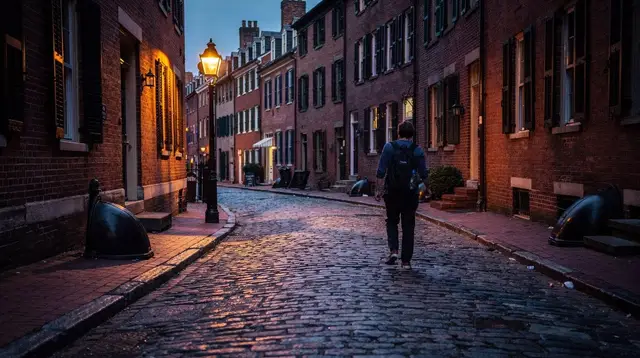
Beacon Hill is a residential district of brick rowhouses, narrow lanes, and gas-powered streetlamps just north of Boston Common. Acorn Street, often described as the most photographed street in Boston, is a public road — you can walk it any time, though it’s worth remembering that people actually live behind those doors. The neighborhood is also home to sites on the Black Heritage Trail, a separate walking route through Beacon Hill’s history as a center of Boston’s free Black community before the Civil War; like the Freedom Trail, it’s a route through public streets, not a ticketed site. For a fuller neighborhood walk, see the Beacon Hill neighborhood guide.
The North End is Boston’s Italian neighborhood — narrow streets, more bakeries per block than anywhere else in the city, and the section of the Freedom Trail that runs past Paul Revere’s house and the Old North Church. Walking its streets, browsing shop windows, and people-watching outside the bakeries costs nothing; buying a cannoli is optional but recommended. The North End neighborhood guide has more on the layout if you want to explore beyond the trail itself.
The harborfront, without boarding anything
You don’t need a harbor cruise ticket to spend time by the water. Boston’s harborfront, running from the Seaport past Long Wharf to the Charlestown Navy Yard, is lined with public walkways where you can watch working boats, ferries, and the occasional tall ship without paying for passage on any of them. Long Wharf and the area around the New England Aquarium are especially active with harbor traffic on a clear afternoon.
At the Charlestown Navy Yard, the USS Constitution — the U.S. Navy’s oldest commissioned warship still afloat — is free to board, with a photo ID required for adults and a routine security check at the gate. The USS Constitution Museum next to it runs on a suggested donation rather than a mandatory ticket, so you set your own price, including nothing, though a contribution helps keep an independent museum running. These are two separate things on the same dock: a free ship and a pay-what-you-wish museum, not one free site and one paid one.
Further south, the Seaport District and Fort Point have their own stretch of public waterfront, separate from the Freedom Trail side of the harbor. The boardwalks and public plazas along the water there cost nothing to walk, and on a clear day they give a straight-on view back toward the Financial District skyline across the harbor without paying for a boat or an observation deck. It’s a newer, glassier part of the city than the North End or Beacon Hill, and it rewards a slow walk rather than a checklist. The Seaport District neighborhood guide has more on what’s there beyond the waterfront itself, including where the paid harbor cruises depart if you decide the free walk isn’t enough and you want to get out on the water. Harbor cruise versus whale watching breaks down that paid option if you’re weighing it.
Free views, where they exist
Boston doesn’t have many free high vantage points, and the ones that exist aren’t guaranteed to stay open, free, or unticketed indefinitely — access to specific overlooks changes with building management and events, so treat any single free viewpoint as something to check on the day rather than something to build an itinerary around. Some park hills and bridge approaches around the Charles River give a workable skyline view at no cost. Most of the well-known observation experiences, including deck-style skyline views, are ticketed; if that’s what you’re after, the Boston skyline and observation deck guide covers what those cost and what they show.
Cambridge, on the other side of the river
Cambridge is a separate city from Boston, across the Charles River, reachable by the Red Line or on foot over one of several bridges. Harvard Yard and the streets around the MIT campus are open public space — walking through both costs nothing, and neither university charges an entry fee to see its grounds. Specific museums on either campus, and guided student-led tours of the two schools, are ticketed separately.
a guided walk through Harvard, MIT, and the historical sites around themis one way to get context on both campuses at once if you’d rather not piece the history together from plaques and building names.
Harvard Square itself, just outside the Yard’s gates, is free to wander regardless of what you spend once you’re there — a dense grid of streets built around a T stop, with plenty to look at even on a walk with no purchases planned. The Harvard Square neighborhood guide covers the area block by block, and the Harvard Yard photoshoot guide is useful if you’re there mainly for photos rather than a museum stop. Specific collections inside Harvard’s and MIT’s own museums remain ticketed — the Harvard museums in Cambridge and the MIT Museum both cover what those cost and what’s inside — but none of that changes what’s free outside their doors.
Getting to the free stuff without spending much on transit
Nothing about reaching these sights should cost more than getting around Boston normally does. If you’re flying into Logan International Airport, the Silver Line SL1 runs free from the terminals into South Station on the way in (the return trip toward the airport is paid); from there, downtown, the Freedom Trail, and the harborfront are all within walking distance or a short ride on the MBTA’s T. The T itself isn’t free — a CharlieCard is the standard way to pay, and transfers are included within a set window — but it’s a small cost layered on top of destinations that charge nothing to enter. If you’d rather skip transit fares altogether and cover the city on foot, getting around Boston without a car lays out how far that gets you, and Boston on foot versus the trolley makes the same comparison specifically for the Freedom Trail.
Institutions with occasional reduced-cost access
Several Boston museums and cultural institutions periodically offer discounted or free access at certain times — this is common practice at major U.S. museums generally. This guide won’t name a specific day or hour for any of them, because those windows change from season to season and sometimes from year to year, and printing a stale one would send you to a locked door. If a reduced-cost slot matters to your plan, check the museum’s own website shortly before your trip rather than relying on any guide, including this one, for the current schedule.
Making the free version work with a short visit
None of this requires a car or a transit pass beyond what you’d use anyway to get around the city — see getting around Boston without a car if you haven’t sorted that out yet. A day built entirely around free ground still covers a lot: the Common, the Public Garden, a stretch of the Freedom Trail through Beacon Hill and the North End, and a walk along the harborfront to the USS Constitution. That’s a full day on foot for most travelers, no tickets required.
If you’d rather have someone else set the pace and handle the history for you, a guided option exists for most of this ground — the Freedom Trail walking tours listed above cover the same route with narration included, and a private guide is available if you’d rather customize the day:
arrange a private, custom-paced tour with a local guideFor the larger question of where a Boston trip’s money should actually go, and where free stops fit alongside paid ones, Boston on a budget lays out the fuller picture, and are Boston passes worth it walks through when a paid multi-attraction pass earns back its cost against paying per site.
FAQ: free things to do in Boston
Is the Freedom Trail really free?
Following the painted red line on the sidewalk from Boston Common to Bunker Hill costs nothing. Several of the 16 sites it connects, including the Old South Meeting House and the Paul Revere House, sell their own separate ticket if you want to go inside.
Is Boston Common free to enter?
Yes, every day, year-round. It’s the oldest public park in the United States and has no admission fee. The adjoining Public Garden is also free to walk through; only the seasonal Swan Boats on its pond charge a fare.
Can you board the USS Constitution for free?
Yes. The ship itself, docked at the Charlestown Navy Yard, is free to board with a photo ID for adults. The USS Constitution Museum next door operates on a suggested donation rather than a required ticket.
Do any Boston museums have free admission?
Major museums like the Museum of Fine Arts, the Isabella Stewart Gardner Museum, and the Museum of Science charge admission for all visitors. Some institutions occasionally run reduced-cost or by-donation windows, but the days and hours change often enough that this guide won’t name a specific one.
Is Cambridge, with Harvard and MIT, free to visit?
Walking through Harvard Yard and around the MIT campus costs nothing; both are open public spaces on a separate city across the Charles River from Boston. Specific museums and guided student tours on those campuses are ticketed separately.
Where can I get a free view over Boston?
A handful of public spots, such as certain park overlooks, offer a no-cost vantage point over the city, but most of the well-known skyline views, including observation decks, require a ticket. Check current access before building a plan around any single free viewpoint.
Do I need to pay for transit to reach these free sights?
Most of what’s covered here is walkable within downtown Boston, Beacon Hill, and the North End. If you’re coming from Logan Airport, the Silver Line SL1 runs free into the city (the return trip is paid); if you’re coming from Cambridge, the Red Line connects Harvard Square and MIT to downtown for a standard fare. None of that changes whether the destination itself is free once you arrive.
Is Boston’s Emerald Necklace park system free to walk?
Yes. The connected chain of parks that starts at Boston Common and the Public Garden and runs through the Back Bay Fens is public land with no admission fee at any point along it.
Budget-friendly tours in Boston on GetYourGuide
Verified deep-linked GetYourGuide tours. Book through these links and we earn a small commission at no cost to you.
GetYourGuide does not provide a product photo for this activity — the image shows the meeting point, photographed by us.