Accessible tours and cruises in Boston: what to check before you book
Are Boston Harbor cruises and boat tours wheelchair accessible?
Many Boston Harbor sightseeing cruises use larger, more stable vessels with level or ramped boarding, which generally suits wheelchair users better than whale watching trips, where boats are often smaller and conditions in open water are rougher. Accessibility still depends on the specific vessel, the boarding pier, and the day's tide, so it always needs a direct check before booking rather than an assumption either way.
What “accessible” means differently on the water
Boston markets a long list of harbor tours, and a fair number of them mention wheelchair access somewhere in the fine print. That single word covers a wide range of real conditions on the water, and it is worth separating before you book anything. A boat that is accessible once it is underway is not necessarily accessible to board. A tour that works for a manual wheelchair on a calm afternoon may not work the same way for a power wheelchair when the tide has dropped the gangway’s slope. None of this means harbor tours are off-limits for reduced-mobility travelers — plenty of people manage them every season — it means the checking has to happen before you buy the ticket, not after you arrive at the dock.
This guide focuses on two categories that get lumped together too often: sightseeing cruises inside Boston Harbor, and whale watching trips that head out into open water. They are not interchangeable from an accessibility standpoint, and the difference is largely about the boat and the water, not the operator’s goodwill.
Harbor cruises versus whale watching: why the distinction matters
A standard Boston Harbor sightseeing cruise generally stays inside the harbor, moving at a moderate pace past the Charlestown Navy Yard, the airport, and the outer islands. These cruises tend to run on larger vessels with more deck space, more stable footing, and, often, a level or gently ramped boarding process from a fixed pier. That combination — bigger boat, sheltered water, established route — is generally the friendlier starting point for a wheelchair user comparing options.
A whale watching trip toward the Stellwagen Bank National Marine Sanctuary is a different proposition. These trips run seasonally, roughly April through October, and head into open water well outside the harbor, where swell and chop are far more common than on an inner-harbor route. Boats used for whale watching are sometimes smaller or built for speed rather than stability, and the trip length — often three to four hours round trip — means more time exposed to those conditions. None of this makes whale watching impossible for a wheelchair user, but it does mean the margin for a boarding or mobility issue to become a real problem is narrower. For a side-by-side look at what each type of trip actually involves, see our comparison of harbor cruises and whale watching.
The honest summary: sightseeing cruises are, as a category, more likely to suit a wheelchair user without complications. Whale watching is not automatically off the table, but it deserves a more careful call to the operator before booking, not a decision made from the website copy alone. Our Boston Harbor cruises guide covers the sightseeing side in more detail, including route and boat variety, while the whale watching guide walks through what a Stellwagen Bank trip actually involves before you weigh it against a calmer harbor route.
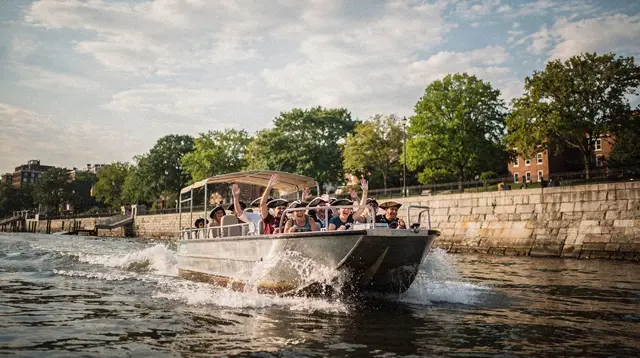
a historical sightseeing cruise around Boston Harbor is a reasonable starting point for travelers who want to see the harbor without committing to open water, and it is worth asking directly about the boarding setup for the specific departure you choose.
The pier matters as much as the boat
One detail that gets skipped in most general advice: accessibility on a Boston Harbor cruise depends on where in the harbor you are boarding, not only on which boat you are boarding. Boston Harbor has several passenger piers in active use, and they were not all built or renovated at the same time. Some of the newer or more recently rebuilt docks have wider, more gradual gangways and clearer step-free approaches from the street. Older piers can have narrower ramps, steeper approaches at low tide, or uneven surfaces on the walk from parking or the T station to the boat itself.
This means two cruises that look identical on a booking site — same company, similar boat class — can have meaningfully different boarding conditions if they leave from different points along the waterfront, including the Seaport, Long Wharf, and Central Wharf. When you are comparing options, ask specifically which pier a given departure uses, not just which boat. If you have a choice between two similar cruises from different embarkation points, the newer pier is often, though not always, the safer bet.
Tide is the other variable tied to the pier. Boston Harbor has a real tidal range, and a floating dock connected to a fixed pier by a gangplank will change slope over the course of the day — flatter near high tide, steeper near low tide. A boarding ramp that is manageable at 10am on a rising tide may be considerably steeper by early afternoon. This is a genuinely useful, narrow question to ask an operator: not just “is it wheelchair accessible” but “what does boarding look like at the time of my specific departure.”
What to actually ask before booking
Rather than relying on a general accessibility label, it helps to ask a short, specific set of questions when booking a harbor cruise or whale watching trip. None of these require special knowledge, and any legitimate operator should be able to answer them without hesitation:
| What to ask | Why it matters |
|---|---|
| Which pier does this specific departure use? | Piers vary in ramp grade and surface, as covered above |
| Is boarding level, ramped, or does it involve steps? | Determines whether a wheelchair can board without assistance |
| Does the boarding ramp’s slope change with the tide? | A ramp fine at high tide may be steep at low tide |
| Is there an accessible restroom on board? | Not universal, especially on smaller or older vessels |
| What is the weight or size limit for mobility devices? | Power wheelchairs can exceed limits that manual chairs do not |
| Is staff assistance available at boarding, and is it guaranteed or first-come? | Affects reliability, not just theoretical possibility |
| What happens if conditions change on the day (weather, tide, mechanical swap to a different boat)? | A backup boat may not have the same accessibility features |
This is not an exhaustive checklist and it will not eliminate every unknown, but it moves the conversation from a marketing claim to a specific, verifiable answer. This guide does not name a particular cruise operator’s equipment or guarantee that any given trip will work for a specific wheelchair or mobility device — that verification has to happen directly with the company running the boat you are considering, close to your travel date, since equipment and piers can change between seasons.
a sunset skyline cruise with harbor commentary is a shorter option some travelers use as a lower-commitment first cruise, which can make it easier to ask pointed boarding questions without the pressure of a longer, harder-to-reschedule trip.
Trolley tours as a land-based alternative
Not every visitor wants to be on the water at all, and Boston’s downtown core presents its own mobility challenge: much of the historic center, including sections of the Freedom Trail, runs over brick sidewalks that are uneven, narrow in places, and interrupted by curbs that are not consistently ramped. Walking the full 2.5-mile (4 km) route is demanding even for travelers without mobility limitations, given the mix of surfaces and Beacon Hill’s cobblestones and hills.
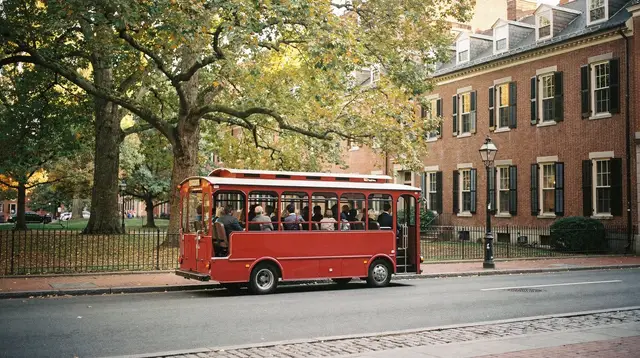
A multi-stop trolley tour is worth considering as an alternative way to see the same neighborhoods — downtown Boston, the North End, Beacon Hill, and the waterfront — without covering that distance on foot. These tours generally use buses or trolleys with a small number of stops where passengers get on and off, which limits walking to short stretches near each stop rather than the full trail. It is not a substitute for every experience a walking tour offers, and getting on and off a trolley still involves steps on most vehicles, so it is not automatically wheelchair accessible either — that, too, needs a direct check with the operator, including whether a specific trolley is lift-equipped. For the practical trade-offs between the two approaches, see our comparison of trolley touring and walking Boston.
Boston also runs hop-on hop-off bus routes and duck tours covering similar ground; the hop-on hop-off guide and duck tours guide cover route and vehicle details for travelers weighing those against a trolley option.
Most multi-stop trolley and bus routes cover the same historic ground described in our North End neighborhood guide and Beacon Hill neighborhood guide, which is useful context for deciding which stops matter enough to plan around, versus which ones can be skipped if walking time at a given stop is limited.
What accessibility looks like away from the harbor
Reduced mobility in Boston is not only a harbor-tour question. The city’s public transit system, the T, has accessible stations on most of its lines, but not uniformly across every line and every stop, particularly on some of the system’s older Green Line sections. Sidewalks in older neighborhoods — Beacon Hill’s brick and cobblestone streets, parts of the North End — are narrower and less even than in newer areas like the Seaport. None of this is unusual for a city with a 17th- and 18th-century historic core, but it is worth planning around rather than discovering on the day.
Our general guide to accessibility in Boston covers the city-wide picture: transit, sidewalks, museum access, and lodging considerations, beyond the specific question of boat tours addressed here. If you are also weighing whether to walk or ride the Freedom Trail itself, the Freedom Trail accessibility guide goes into the route’s specific surfaces and step-free alternatives at each of its 16 sites.
The T, Boston’s subway and bus system run by the MBTA, has accessible stations on most of its lines, though coverage is not uniform across the network; the guide to the T and the broader guide to getting around Boston without a car both cover which routes and stations are the more reliable step-free options, useful background if a harbor tour or trolley stop is only reachable by transit.
Boston’s harbor also includes the Boston Harbor Islands, reached by their own ferries rather than by the sightseeing or whale watching cruises covered above; accessibility on the islands depends on the specific ferry and dock and is worth checking separately if a trip out to the islands is part of the plan.
Booking through a third party versus the operator directly
Many harbor cruises are sold both directly by the cruise company and through third-party booking platforms. Buying through either channel does not change the boat or the pier, but it does change how quickly you can get a direct answer to an accessibility question. When mobility access is a firm requirement rather than a preference, it is generally worth following up with the operator directly — by phone or email — even after booking through a platform, to confirm the specific boat, pier, and boarding conditions for your date rather than relying on a general accessibility icon shown at checkout.
a buffet lunch or dinner cruise around the harbor and similar longer sightseeing cruises are worth the same direct check, since a longer trip means more time on board if boarding or seating turns out not to match what was expected.
Seasonality and timing
Both harbor cruises and whale watching trips are seasonal in Boston, generally running from spring through fall, with whale watching in particular tied to the roughly April-to-October window when whales are present at Stellwagen Bank. Outside that window, whale watching options largely disappear, while some harbor sightseeing and dinner cruises continue on a reduced schedule closer to the shoulder seasons. If accessibility planning already adds a layer of advance coordination, it is worth booking earlier in the season rather than trying to arrange a specific accessible boarding at the last minute during a peak summer week, when boats and staff are booked at capacity.
The bottom line
There is no single accessible label that covers every Boston Harbor tour, and this guide will not pretend otherwise. As a general pattern, inner-harbor sightseeing cruises on larger boats tend to be the more manageable starting point for wheelchair users, and open-water whale watching trips carry more variables worth checking closely. The pier a cruise departs from matters as much as the boat itself, and tide can change a ramp’s slope over the course of a single day. Trolley tours offer a land-based way to see the historic core without the sidewalks of a full walking tour, though boarding a trolley has its own accessibility questions. In every case, a specific question to the operator about your date, your boat, and your device beats a general assurance printed on a booking page.
Frequently asked questions about accessible tours and cruises in Boston
Is a Boston Harbor sightseeing cruise easier for a wheelchair user than a whale watching trip?
Generally yes, though not universally. Sightseeing cruises tend to run on larger, more stable boats with more deck space and a calmer route inside the harbor. Whale watching trips head into open water toward Stellwagen Bank, often on a smaller or faster vessel, with more motion and less predictable boarding conditions. Confirm the specific boat and route with the operator before assuming either way.
Does every Boston Harbor cruise dock have a ramp?
No. Boston Harbor has several passenger docks of different ages, and boarding setups vary: some have a fixed ramp or a level gangway, others use a movable gangplank whose slope changes with the tide. Ask the operator which pier your specific cruise departs from and what the boarding surface looks like that day.
Can I bring my own wheelchair on board a harbor cruise?
Most operators allow manual and power wheelchairs, but weight limits, aisle width, and the number of accessible spaces on a given boat vary by vessel and by company. This is exactly the kind of detail to confirm directly with the operator when booking, rather than assuming it matches another boat you have used elsewhere.
Are trolley tours a good alternative to walking the Freedom Trail?
For travelers who want to see Boston’s historic core without prolonged walking on uneven brick sidewalks, a multi-stop trolley tour is worth considering. It covers similar ground to a walking tour of downtown Boston while keeping time on foot to the stops themselves. See our comparison for the practical differences.
Does accessibility depend on which part of the harbor a cruise leaves from?
Yes. Boston Harbor has multiple embarkation points, and some piers have been rebuilt more recently than others, with wider gangways and step-free approaches, while older docks may have narrower ramps or more exposure to tide-driven slope changes. The pier matters as much as the boat.
Should I call ahead even if a tour is advertised as wheelchair accessible?
Yes. An advertised accessibility feature can still leave out details that matter for a specific wheelchair or mobility device, such as exact ramp gradient, doorway width, or whether staff are available to assist at boarding. A short call or email to the operator, ideally a few days before the trip, is the only reliable way to confirm conditions match what you need.
Is Boston generally a manageable city for wheelchair users outside of boat tours?
Boston has a mix of modern, step-free areas and older neighborhoods with narrow, uneven, or cobblestone sidewalks, particularly around Beacon Hill and parts of the North End. The T has accessible stations on most lines, but not universally on older sections. See our general accessibility guide to the city for the broader picture beyond harbor tours.
Accessible tours in Boston on GetYourGuide
Verified deep-linked GetYourGuide tours. Book through these links and we earn a small commission at no cost to you.
GetYourGuide does not provide a product photo for this activity — the image shows the meeting point, photographed by us.