Boston on a budget: 3 days on foot and on the T
Three days, mostly on foot
Boston rewards budget travel better than most American cities, mainly because its center is compact and its best-known sight — the Freedom Trail — costs nothing to follow. This itinerary covers three days across downtown Boston, the North End, Cambridge, and Back Bay, using only walking and the T. It skips every paid museum interior and every guided tour, not because they lack value, but because the point here is to prove how much of the city is genuinely free.
A word on transport before you start: the T, run by the MBTA, covers the whole route if your feet get tired, and a multi-day visitor pass exists for unlimited rides — check current pricing on mbta.com before you go, since it changes. See the MBTA guide and getting around Boston without a car for the practical details. Nothing in this itinerary assumes a car, and nothing assumes a museum ticket.
Day 1: the Freedom Trail, Boston Common, and the North End
Morning: the full Freedom Trail
The Freedom Trail is not a museum and not a single site — it’s a 2.5-mile (4 km) painted or bricked line that connects 16 sites from Boston Common to Bunker Hill in Charlestown. Following the line itself costs nothing, start to finish. Start early at Boston Common, the oldest public park in the country, then walk the route through the Massachusetts State House, the Granary Burying Ground, Faneuil Hall, and into the North End toward the Old North Church.
Some of the 16 stops sell their own interior tickets — the Old State House and the Paul Revere House among them — and this itinerary skips those interiors on purpose. Standing outside them, reading the plaques, and walking on costs nothing. If you want a structured walk instead of winging it, the self-guided Freedom Trail walk lays out the stops in order. The trail eventually crosses into Charlestown for the Bunker Hill Monument and the USS Constitution, both of which are free to see and, in the ship’s case, free to board — but that leg alone is close to an hour each way, so this itinerary treats Charlestown as optional if you’re short on time.
Midday: Quincy Market without sitting down
Quincy Market, next to Faneuil Hall, is where most visitors end up around lunch, and it’s also where most visitors overspend. The market’s food hall has dozens of counters selling by the item — a slice, a cup of chowder, a single roll — which is considerably cheaper than a sit-down restaurant with a tip on top. Buy a few items, take them outside, and eat on a bench or on the Common. If the weather’s decent, this is a genuine picnic, not a compromise. The Quincy Market food tour guide is useful for figuring out which counters are worth the money if you do want to spend a little here.
Afternoon: the North End on foot
From Quincy Market, it’s a short walk into the North End, Boston’s Italian neighborhood and the densest concentration of bakeries and small restaurants in the city. There’s no admission to walk its narrow streets, and the North End rewards aimless wandering more than almost anywhere else in Boston. If you allow yourself one splurge on Day 1, make it a cannoli from one of the neighborhood bakeries — a few dollars, not a meal-sized expense, and arguably the most useful thing to spend money on all day. The North End food tour guide covers the bakery options in more detail if you want to plan the stop.
End the day back at Boston Common or the Public Garden next door, both free, both open daily. The Public Garden’s Swan Boats are a paid, seasonal add-on — skip them if you’re keeping this strictly budget, or treat them as the one paid activity of the trip if you want a single splurge.
Day 2: Beacon Hill, the Charles River, and Cambridge
Morning: Beacon Hill and the Esplanade
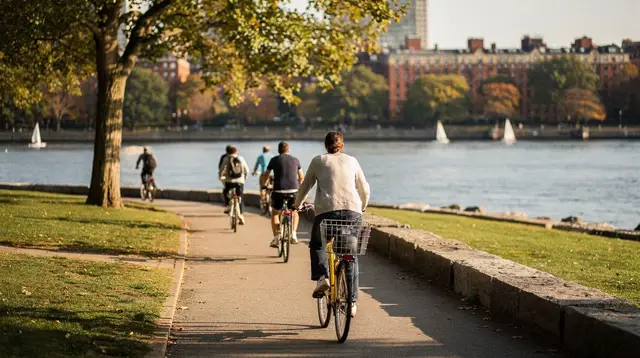
Start at Beacon Hill, the brick-and-gaslamp neighborhood just north of the Common. There’s no ticket for walking its streets — Acorn Street, the steepest and most photographed of them, is a public street like any other. Give it an hour of unhurried walking, then head down toward the river to the Charles River Esplanade, a free public park that runs along the water for miles. It’s a good place to sit, and in warm weather it’s genuinely pleasant rather than just a route to somewhere else.
Afternoon: Cambridge, Harvard, and MIT
Take the Red Line across the Charles River to Cambridge — a separate city from Boston, not a neighborhood of it, though the T makes the distinction feel smaller than it is. Harvard Yard is open to the public and free to walk through; so is most of the MIT campus a few stops further down the Red Line. Neither requires a ticket to see the buildings, the quads, or the general atmosphere of two of the country’s best-known universities.
The museums on both campuses — the Harvard Museum of Natural History, the MIT Museum — are paid, and this itinerary skips their interiors, same as it skipped the Freedom Trail’s paid stops on Day 1. What’s free is the campus itself: Harvard Square for browsing (not necessarily buying) in its bookstores, and the general walk between the two schools along the river. If you’d rather have a guide explain the history and student life on-site rather than reading plaques, a small-group walking tour of Harvard Yard led by a current or recent student is the one paid option worth naming here — it’s inexpensive relative to most Boston tours and adds context a self-guided walk doesn’t.
Head back into Boston on the Red Line before dinner, or stay in Cambridge for a cheaper meal near the university — food prices around Harvard Square tend to run lower than downtown Boston.
Day 3: Back Bay, the Public Library, and Copley Square
Morning: the Boston Public Library
Back Bay is Boston’s brownstone district, and its centerpiece for a budget day is the Boston Public Library on Copley Square. The library’s entrance and its main reading rooms are free and open to the public, and the building itself — murals, courtyard, architecture dating to the 1890s — is worth the visit on its own, independent of whether you’re there to read anything. It’s one of the more overlooked free sights in the city, mostly because visitors assume a library isn’t a sight.
From there, Copley Square itself is worth a slow lap: Trinity Church’s exterior, the library across the square, and the general architecture of the block. None of it requires a ticket.
Afternoon: Newbury Street and the Prudential Center
Walk Newbury Street, Back Bay’s main shopping corridor, with no obligation to buy anything — the street itself, lined with brownstones converted into storefronts, is the point, and window shopping costs nothing. At the end of Newbury, the Prudential Center’s exterior and its public plaza are free to see; the paid observation deck at the top isn’t part of this itinerary, but standing at the base and looking up costs nothing.
If you want one more piece of structured history for the afternoon, the South End sits just south of here and has its own paid and unpaid options — a guided walk through Back Bay’s suffrage history covers ground most Freedom Trail-focused visitors miss entirely, and it’s a reasonable way to close out three days that have otherwise been entirely self-guided.
For a last look at the water before heading to dinner, the harbor itself is free to walk along; if you have the budget and the time for one paid activity across the whole trip, a ferry out to the Boston Harbor Islands or an evening sunset cruise on Boston Harbor is a reasonable single splurge to end the trip on the water rather than on foot.
What this itinerary actually costs
The honest budget breakdown for these three days comes down to three categories: T fares, food, and the one or two optional paid activities you choose to add. None of the core sights — the Freedom Trail’s outdoor route, Boston Common, the Public Garden, Beacon Hill, the Charles River Esplanade, Harvard Yard, MIT’s campus, the Boston Public Library, and Newbury Street — carry an admission fee.
| Category | What it covers | Cost |
|---|---|---|
| T fares | Getting to Cambridge and back, optional rides elsewhere | Per-ride fare or a multi-day pass — check mbta.com |
| Food | Counter-service lunches, one bakery stop, dinners | Varies widely; counter service is cheaper than sit-down |
| Optional paid stop | Interior museum ticket, guided tour, or harbor cruise | Only if you choose to add one |
| Core sights | Freedom Trail route, Common, Public Garden, Beacon Hill, Harvard Yard, MIT campus, Public Library, Newbury Street | Free |
For more on what a realistic week in Boston costs beyond this stripped-down version, see the Boston budget guide and the free things to do guide, which cover a wider set of no-cost options across all three days’ neighborhoods and beyond. Boston’s public transport also has a budget calculator worth checking before you commit to a multi-day pass versus paying per ride — see the budget tool.
Budget Boston: common questions
Is the Freedom Trail really free?
Following the painted or bricked line from Boston Common to Bunker Hill costs nothing. Several of the 16 sites it connects — including the Old State House and the Paul Revere House — sell their own interior tickets, but you can walk the entire route and read every exterior plaque without paying for any of them.
Can you visit Harvard and MIT without paying?
Yes. Harvard Yard and most of the MIT campus are open, public, and free to walk through. Only the campus museums, such as the Harvard Museum of Natural History and the MIT Museum, charge admission, and this itinerary doesn’t include their interiors.
Is the Boston Public Library actually free to enter?
Yes. The main library on Copley Square is a public building with free entry to its lobby, reading rooms, and courtyard. It’s one of the more overlooked free sights in Back Bay.
Do you need a car for this itinerary?
No. All three days work entirely on foot and via the T’s Red Line, which is the only line this route requires, for the crossing into Cambridge. A car adds parking costs and isn’t needed for any of the neighborhoods covered here.
Is a T pass worth buying for three days?
It depends on how many rides you’ll actually take. If you’re mostly walking, as this itinerary assumes, and only crossing into Cambridge once or twice, per-ride fares may cost less than a multi-day pass. Check the current fare structure on mbta.com before deciding, since both options change.
What’s the one thing worth paying for on this trip?
If you allow yourself a single paid item across three days, a cannoli from a North End bakery on Day 1 is the cheapest and most representative option. For a single paid activity rather than food, a short harbor cruise on Day 3 is a reasonable way to see the city from the water without committing to a full-price guided tour package.
Does this itinerary work in winter?
The walking is the same, but New England winters run cold, typically near freezing during the day, and some of the outdoor stretches — the Esplanade, Beacon Hill’s side streets — are less pleasant in snow or wind. The indoor free option, the Boston Public Library, becomes more valuable as a warm-up stop in winter than it is in warmer months.
Are there paid options if I want to upgrade part of this trip?
Yes. A guided walk of Harvard Yard, a South End history tour focused on the suffrage movement, or a harbor cruise are all reasonable additions if your budget allows one or two paid activities without turning the whole trip into a paid itinerary.
Tours for your first trip to Boston on GetYourGuide
Verified deep-linked GetYourGuide tours. Book through these links and we earn a small commission at no cost to you.
GetYourGuide does not provide a product photo for this activity — the image shows the meeting point, photographed by us.