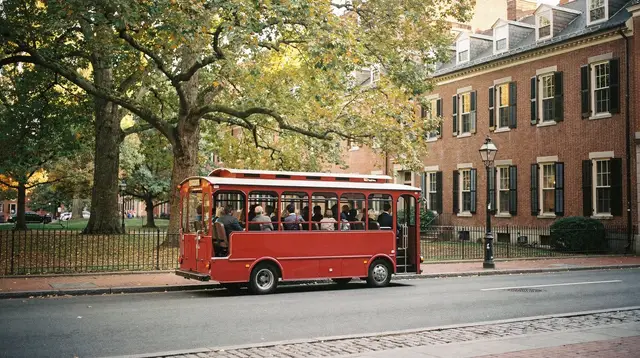
Boston hop-on hop-off bus and trolley: what it's actually for
Is a hop-on hop-off bus worth it in Boston?
It's most useful for covering ground between Back Bay, the Seaport, and Cambridge without juggling T transfers, less useful downtown where the Freedom Trail is walkable. Tickets typically run one or two days; confirm the exact window and stop frequency with the operator before buying.
How the loop actually works
A hop-on hop-off trolley in Boston is a fixed circular route, usually run with open-sided or converted-look “trolley” buses rather than double-deckers, that stops at a set list of points around the city. You buy one ticket, board at any stop, ride as far as you want, then get off and rejoin a later trolley on the same route whenever you’re ready, no separate ticket required for the rest of the loop. The appeal isn’t the ride itself so much as the flexibility: one pass covers unlimited re-boarding for its whole validity window, instead of a single one-way fare.
Most operators sell tickets valid for one or two consecutive days, with the clock starting the first time you scan or show the ticket, not at purchase. Whether a two-day pass has to be used on consecutive days, and exactly how many hours a “day” ticket buys past midnight, varies by company and sometimes by season. This is worth confirming directly with whichever operator you book through before you commit to a plan built around it.
Commentary comes either as a live guide talking through the neighborhoods from the driver’s seat or a co-pilot’s spot, or as recorded audio played through onboard speakers or headphones, depending on the operator and sometimes the specific vehicle assigned that day. Either way, the content covers similar ground: the Revolutionary War sites downtown, the Back Bay’s brownstone-era expansion, the waterfront’s shipping history, and whatever neighborhoods the route touches.
Frequency at each stop is the detail that makes or breaks the experience, and it’s also the detail that changes the most. In peak summer, a popular stop like Faneuil Hall Marketplace might see a trolley every 15 to 20 minutes; in shoulder season that can stretch to 30 or 40. Service is commonly reduced in the colder months, and some operators suspend hop-on hop-off routes entirely in the deepest part of winter, running only private charters or nothing at all. None of this is fixed year to year, so check the current schedule with the operator for your travel dates rather than planning around a number you saw in an older guide.
Where it actually earns its keep
Boston’s historic core is unusually compact. The Freedom Trail itself is a 2.5-mile (4 km) marked walking route connecting 16 sites from Boston Common to Charlestown, and most visitors cover downtown, the North End, and Beacon Hill faster on foot than waiting for a trolley to work its way through the same narrow streets. If your day is confined to that downtown wedge, a hop-on hop-off pass mostly buys convenience, not speed, and sometimes it’s slower than walking between two adjacent stops.
Where the format actually saves time is stitching together neighborhoods that are genuinely far apart on foot but awkward to connect by MBTA transfer: Back Bay and its Copley Square museums, the Seaport waterfront, and Cambridge across the Charles River. Getting from the North End to Harvard Square on the T means a walk to a Green or Orange Line station, a transfer to the Red Line, and another walk, which is entirely manageable but adds up if you’re doing it three or four times in a day with stops in between. A single hop-on hop-off ticket covering those stops removes the transfer planning, at the cost of a fixed route and someone else’s schedule.
It’s also a reasonable option for a first afternoon in the city when orientation matters more than efficiency; riding the full loop once, without getting off, works as a rough overview of how the neighborhoods relate to each other before you commit to walking any of them in depth.
Real stops to expect
Exact stop lists differ by operator and change over time, but the pattern is consistent across companies operating in Boston. Expect something close to this set, in some order:
| Typical stop | Why it’s on the route |
|---|---|
| Boston Common | Central, walkable to downtown and Beacon Hill |
| Faneuil Hall Marketplace | High foot traffic, food, shopping |
| North End | Old North Church, Italian restaurants |
| Charlestown / Navy Yard | USS Constitution, Bunker Hill |
| Copley Square | Back Bay, Boston Public Library, Trinity Church |
| Seaport District | Boston Tea Party Ships & Museum area |
| South Station | Rail connections, South Boston access |
| Cambridge (route-dependent) | Harvard Square or MIT, not on every route |
Not every operator crosses into Cambridge; some routes stay entirely within Boston proper and treat Harvard and MIT as a separate add-on or a different pass altogether. If reaching Cambridge without touching the T is the actual goal, check the specific route map before buying rather than assuming it’s included.
Language options and accessibility
Not every hop-on hop-off operator runs English-only commentary. Some Boston companies offer a dedicated tour with narration in another language rather than relying on translated headphone tracks bolted onto the standard English route, which tends to cover the same historic ground with fewer gaps in translation:
a Boston sightseeing tour narrated in Spanish rather than translated audioAccessibility varies by operator and by vehicle, since older trolley-style buses were not all built with the same boarding equipment as standard motorcoaches. If step-free boarding, wheelchair space, or a companion seat matters for your group, confirm it directly with the operator before booking rather than assuming every trolley in the fleet is equipped the same way. For a broader look at what’s accessible across the city beyond the hop-on hop-off format, see the wheelchair-accessible Boston guide and accessible tours and cruises in Boston.
Fitting it around an airport arrival
Because Logan International Airport sits close to downtown, some visitors are tempted to start a hop-on hop-off loop the same day they land. That can work if the flight arrives early enough and the bags are dropped at a hotel first, but it’s worth building in a buffer: getting from the airport into the city, whether by the Silver Line SL1 or the Blue Line’s free Massport shuttle to the Airport station, plus check-in, easily eats two or three hours before a trolley pass is worth boarding. Details on that first leg are in the Logan Airport to Boston transfer guide. Cruise passengers arriving by ship face a similar timing question at the other end of a Boston stay; see the Boston cruise port transfer guide for how that connects to downtown.
Trolley versus walking versus the T
None of these three options is categorically better; each solves a different problem.
Walking wins inside the historic core, where distances are short and the Freedom Trail’s red line does the navigating for you at no cost beyond your own time. It loses once you’re trying to reach Back Bay from the North End, or Cambridge from anywhere downtown, where 30 to 45 minutes on foot starts competing with faster alternatives.
The T, run by the MBTA, wins on raw speed and cost for a single point-to-point trip: a Red Line ride from downtown to Harvard Square is direct and inexpensive per trip, but it requires knowing the system, buying or loading a CharlieCard, and handling transfers if your route isn’t a straight shot on one line. It also doesn’t narrate anything.
The hop-on hop-off trolley wins when the day involves multiple stops across neighborhoods that don’t sit on the same T line, when you’d rather not think about transfers, or when the live or recorded commentary adds enough value to justify riding rather than walking or transiting. It loses on flexibility of timing, since you’re bound to the loop’s frequency, and it loses inside downtown, where it can’t beat a 20-minute walk along the Freedom Trail.
For a side-by-side built specifically around the Freedom Trail question, see trolley versus walking the Freedom Trail. For getting around Boston generally without renting a car, see getting around Boston without a car, and for how the T itself works, the MBTA and the T guide.
a narrated hop-on hop-off trolley loop through downtown Boston’s historic stopsHow it compares to duck tours and harbor cruises
Boston’s other well-known sightseeing format, the amphibious duck tour, is a different product entirely: a single fixed-length narrated ride that includes a stretch on the Charles River, with no re-boarding and no choice of stops. It’s built for a one-time overview in roughly 60 to 90 minutes, not for using across a full day the way a hop-on hop-off pass is. The full mechanics, including how the water portion works, are covered in the Boston Duck Tours guide.
Harbor cruises are a third category again, oriented toward the water and the skyline rather than street-level neighborhoods, and they don’t connect to Back Bay or Cambridge at all. Some operators sell combined passes bundling a hop-on hop-off trolley ticket with a harbor cruise, which can make sense if you want both the land loop and time on Boston Harbor without booking two separate outings; details on that combination are in the Boston harbor cruises guide.
a guided city tour that crosses into Cambridge to cover Harvard and MITWhat it doesn’t replace
A hop-on hop-off ticket is not a substitute for the MBTA if your plans include destinations outside the trolley’s fixed route, and it’s not a Commuter Rail alternative for day trips to Salem, Plymouth, or Concord, which run on an entirely separate rail network with its own ticketing. It also isn’t the fastest way to see the Freedom Trail itself; the trail’s value is in walking it at your own pace past the Old North Church, Faneuil Hall, and the Granary Burying Ground, something a moving trolley window doesn’t replicate.
If your trip includes a multi-attraction city pass, it’s worth checking whether hop-on hop-off access is bundled in or sold separately, since bundling logic differs by pass provider; see the Boston CityPASS and Go City guide for how those compare.
For visitors who’d rather have a guide adjust the pace and stops on the fly instead of following a fixed loop, a private guided option is worth weighing against the trolley format:
a custom-paced private tour with a local guide instead of a fixed trolley loopPlanning it into a first visit
For a first visit built around two or three days, a hop-on hop-off pass fits most naturally on a day earmarked for Back Bay, the Seaport, and possibly Cambridge, rather than a day dedicated to the Freedom Trail itself. See two days in Boston: the highlights or three days in Boston for a first visit for how that split tends to work in practice, and first-time Boston guide for the broader orientation question of how many days to plan for.
Bus hop-on hop-off in Boston: frequently asked questions
How long does a hop-on hop-off ticket last in Boston?
Most operators sell one-day or two-day passes, with the clock starting at first use rather than at purchase. Exact validity windows and rules about consecutive versus non-consecutive days vary by operator, so check the fine print before paying.
How often do the trolleys come by each stop?
Frequency depends on the season and the operator’s schedule for that day, generally more frequent in summer and around major stops like Faneuil Hall, less frequent in shoulder months. Boston’s hop-on hop-off routes typically run less often, or not at all, in the depths of winter.
Can I walk the Freedom Trail instead of taking the trolley?
Yes. The Freedom Trail is a 2.5-mile (4 km) walking route through downtown Boston, and most of it is more efficient on foot than by trolley, since the loop bus has to follow streets and traffic that the marked walking path skips.
Does the hop-on hop-off bus go to Cambridge?
Some routes cross the Charles River into Cambridge, stopping near Harvard Square or MIT; others stay within Boston proper. Confirm the specific route map before buying if reaching Cambridge without the T is the point.
Is the trolley better than the T for getting around Boston?
For a single point-to-point trip, the T is almost always faster and cheaper. The trolley earns its cost when you want to string together several stops across neighborhoods in one day without planning transfers.
Do hop-on hop-off tours run in winter?
Service is commonly reduced or suspended in the coldest months, with fewer daily departures or a shorter operating season overall. Check current winter schedules directly with the operator rather than assuming year-round service.
Is there live commentary or is it recorded audio?
It depends on the operator and sometimes the specific trolley. Some routes run with a guide narrating live on board, others use a recorded audio track through headphones or speakers. Both formats cover similar historical ground.
Hop-on hop-off bus tours of Boston on GetYourGuide
Verified deep-linked GetYourGuide tours. Book through these links and we earn a small commission at no cost to you.
GetYourGuide does not provide a product photo for this activity — the image shows the meeting point, photographed by us.