Renting a car in Boston: when it helps and when it doesn't
Should I rent a car for a trip to Boston?
Not for the city itself — narrow historic streets and paid parking make a car a liability downtown. A rental makes sense for specific excursions the Commuter Rail doesn't reach well, such as deep Cape Cod exploration beyond the ferry towns or combining several New Hampshire and Maine coastal stops in one day.
The short answer: skip it for the city, consider it for the edges
Most guides to Boston either tell you to rent a car without qualification or dismiss the idea entirely. Neither is accurate. Inside the city, a car is close to a liability: narrow one-way streets in Beacon Hill and the North End were laid out for foot traffic and horse carts, not sedans, and parking downtown is scarce, metered, or locked behind garage rates that add up fast over several days. For getting around Boston proper, see getting around Boston without a car — it covers the T, walking, and the Commuter Rail in detail, and it’s the default this whole site assumes.
Where a car earns its cost is outside that radius, on specific excursions where public transit either doesn’t go or goes only partway. This guide is about that exception, not a general endorsement.
Why downtown Boston is a bad place to drive
Boston’s core street grid predates the automobile by more than a century. The Freedom Trail area, Beacon Hill, and the North End were built as a walking city, and it shows: one-way streets double back on themselves, intersections meet at odd angles, and what looks like a two-minute drive on a map can take fifteen with traffic and detours.
Parking compounds the problem. Street parking in these neighborhoods is metered where it exists at all, and garages near downtown attractions charge by the hour with daily rates that often exceed what a T day pass or several individual rides would cost. A car parked for three days while you walk the Freedom Trail and ride the T between Back Bay and Cambridge is a car earning you nothing and costing you a parking fee every night.
The T, run by the MBTA, plus walking and the Commuter Rail, cover the overwhelming majority of what a first-time or repeat visitor to central Boston needs. See MBTA and the T guide for the practical details.
Where a car changes the trip: Cape Cod in depth
The Cape Cod day trip most visitors take goes by Commuter Rail-adjacent bus or a booked tour to Provincetown or Hyannis, sees a beach and a lighthouse, and returns. That covers the highlights, and it’s genuinely the easier way to do a single day on the Cape — see Cape Cod and Provincetown day trip guide.
But the Cape stretches roughly 65 kilometers (40 miles) from the canal to Provincetown at its tip, and public transit along it is thin outside the main tourist towns. If the plan is to explore several of the smaller Cape towns in one visit — working along Route 6A through the historic district villages, stopping at less-visited beaches within the Cape Cod National Seashore, or timing a specific sunset or low tide at a spot off the main bus routes — a rental car is the only realistic way to string that together in a day or two. The Cape Cod Rail Trail is itself often reached more easily by car with a bike rack than by transit connections.
This is a case where the alternative (patching together local buses or hiring a private driver for each stop) costs more in time and often in money than a rental car with the flexibility to detour.
Where a car changes the trip: stacking coastal stops in Maine and New Hampshire
The same logic applies going north. A single day trip to Portland, Maine or Kennebunkport is well covered by a guided tour or a straightforward highway drive — see Portland, Maine and Kennebunkport day trip guide. The New Hampshire coast around Portsmouth works the same way on its own — see Portsmouth, New Hampshire day trip guide.
But none of these towns are linked to each other or to Boston by a rail service built for that kind of hopping, and there’s no single tour that reliably combines, say, a stop in Portsmouth, a swing through the southern Maine coast, and an hour in Kennebunkport in one day without a car. If the goal is to see several coastal towns across two states in a single day rather than committing a full day to just one of them, a rental car is what makes that itinerary possible. It’s a genuinely different trip than the single-destination day trips this site otherwise recommends by tour or train, and it only makes sense if seeing multiple towns matters more than depth in any one of them.
What the Commuter Rail already covers — check this first
Before booking a rental, check whether the Commuter Rail already reaches the destination directly. It’s a separate network from the T, with its own ticketing, running out of North Station and South Station to the suburbs and several of this site’s day trips. Salem, Plymouth, and Concord are all direct or near-direct Commuter Rail trips, typically faster and cheaper than driving and parking once you factor in Boston traffic and destination parking. See Commuter Rail day trips guide for routes and approximate travel times.
A car is the answer only where the Commuter Rail, a bus connection, or a booked tour doesn’t reach, or reaches only one stop when the plan calls for several.
| Destination | Best way there | Why |
|---|---|---|
| Salem, Plymouth, Concord | Commuter Rail | Direct or near-direct rail service |
| Newport, Providence | Guided tour or intercity bus | Well-served single-destination trips |
| Cape Cod (single highlight) | Booked tour or bus | Covers the main towns without driving |
| Cape Cod (in-depth, multiple towns) | Rental car | Thin transit along the peninsula |
| One Maine or NH coastal town | Guided tour or drive | Direct route, no need for flexibility |
| Multiple ME/NH coastal towns in one day | Rental car | No transit or tour links them together |
Newport, Providence, and the places a car doesn’t help
Not every place outside Boston needs a car — some of the region’s most popular day trips are already well served without one. Newport and its Gilded Age mansions are usually visited by guided tour or intercity bus rather than a rental; see the Newport mansions day trip guide for how that works without driving. Providence is close enough that a bus or train connection covers it directly — see the Providence day trip guide. Neither destination gains much from a rental car unless the plan is to combine it with a longer, multi-stop coastal itinerary of the kind described above.
The same logic applies to the islands. Martha’s Vineyard and Nantucket are reached by ferry from Woods Hole or Hyannis, not by driving onto the island — see the Martha’s Vineyard and Nantucket ferry guide. Ferry service to both islands is seasonal and thins out sharply once the main season ends, so a car parked at the ferry terminal on the mainland is usually more useful than one taken onto a boat, since vehicle space on the ferries is limited and typically requires an advance reservation.
Returning the car without doubling back to Boston
If the plan is a loop — Boston out to the Cape and back, for example — a standard round-trip rental works fine, since pickup and return happen at the same location. But if the itinerary continues north and doesn’t circle back through the city before flying out, ask about one-way rental terms before booking. Many companies charge a drop-off fee for returning a car to a different location than where it was picked up, and that fee can be substantial enough to change whether renting still makes sense compared to a guided day trip covering the same towns. Confirm the one-way fee, if any, at the same time you confirm toll billing, so the full cost of the excursion is clear before the itinerary is locked in.
Tolls: expect them, plan a payment method, don’t expect a number here
Several of the highways you’d use for these excursions — sections of the Massachusetts Turnpike among them — charge tolls. Toll rates change and vary by route and vehicle class, so this guide won’t quote a figure; check with your rental company on pickup, since most rental cars in the region come equipped with an electronic toll transponder that bills tolls automatically to the rental agreement, sometimes with an added service fee. Ask specifically how tolls are billed before you drive off, so there’s no surprise on the final invoice.
The pickup timing that saves money: don’t grab the car on arrival
The single most common mistake among visitors who do rent a car is picking it up the moment they land at Logan International Airport or arrive downtown, then parking it for several days while they walk the Freedom Trail and ride the T. That’s paying for a hotel garage or a daily parking rate on a car that isn’t moving.
The better sequence: get from Logan or your hotel into the city using the T, the Silver Line SL1, or a rideshare, spend your downtown days on foot and on the T as this site otherwise recommends, and only pick up the rental car on the specific day you’re leaving the city for the Cape or the coastal drive north. Return it, or extend it by another day, depending on how long the excursion runs. This alone can save the cost of several days of urban parking, which in Boston is not cheap.
If your itinerary already includes an airport transfer, see Logan Airport to Boston transfer guide for getting into the city without a car in the first place.
A day of driving, without giving up a guided introduction
None of this rules out combining a rental car excursion with guided experiences earlier in the trip. Many visitors spend their downtown days with a guide who can explain what’s in front of them — history, neighborhoods, architecture — and save the rental for the one or two days that need it. A private, custom-tailored guided tour of Boston the day you arrive is one way to get oriented before deciding whether the rest of the trip needs a car at all. If Cambridge is on the list, a guided walk through Harvard and MIT covers both campuses without needing to park near either.
For the harbor side of the city, a architecture and history cruise along the harbor and the Charles River is a way to see the waterfront without driving or parking near it, and a guided walk through Back Bay’s chocolate shops and art galleries works the same way for that neighborhood.
Practical notes before you book
A few things worth confirming directly with your rental company rather than assuming:
- Pickup location: airport counters are convenient but often carry an airport surcharge; a downtown location may be cheaper if you’re picking the car up mid-trip rather than on arrival, as recommended above.
- Insurance: check what your personal auto policy or credit card already covers before adding the rental company’s coverage, which varies by provider.
- Vehicle size: if the plan includes narrow Cape Cod side roads or coastal New Hampshire lanes, a smaller vehicle is easier to place and park than a full-size SUV.
- Return timing: match the return to when you’re back in range of the T or your hotel, so you’re not paying for a parked car again at the end of the trip.
Renting a car in Boston: frequently asked questions
Do I need a car to visit Boston?
No. The T, the Commuter Rail, and walking cover downtown Boston, Cambridge, and most single-destination day trips like Salem or Plymouth without a car.
When does renting a car actually make sense in this region?
For excursions with limited or no rail service, especially detailed Cape Cod touring beyond Hyannis and Provincetown, or a single day that strings together multiple towns along the New Hampshire and Maine coast.
Are there tolls on the highways around Boston?
Yes, on several major routes in the region, including sections of the Massachusetts Turnpike and other limited-access highways. Rental cars are typically equipped with an electronic toll transponder or billed automatically; check with the rental company for how charges are handled.
When should I pick up my rental car?
On the day you leave the city for your excursion, not on arrival. Picking it up early means paying for urban parking during days you’ll spend on foot or on the T, when the car sits unused.
Can I use a rental car to get around downtown Boston?
You can, but it’s inefficient. Streets in the North End and Beacon Hill are narrow and were laid out long before cars existed, and parking is limited and metered or garage-based. The T and walking cover downtown more reliably.
Is Martha’s Vineyard or Nantucket reachable by car?
Only by ferry, and only certain ferries carry vehicles, with limited space and advance reservations often required. Most visitors leave the car on the mainland and travel as foot passengers.
What’s a rail alternative to renting a car?
The Commuter Rail, a separate network from the T, reaches several of this site’s day trips directly, including Salem, Plymouth, and Concord, without the cost or hassle of driving and parking.
Getting around Boston on GetYourGuide
Verified deep-linked GetYourGuide tours. Book through these links and we earn a small commission at no cost to you.
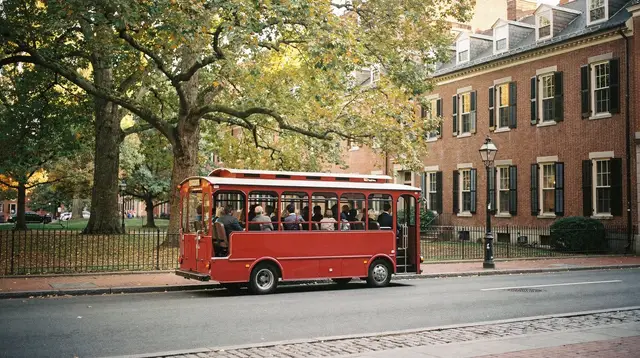
GetYourGuide does not provide a product photo for this activity — the image shows the meeting point, photographed by us.